Author Archives: DHamel

EpLink survey will help steer research in the direction people with epilepsy want

July 7, 2016

By Deron Hamel

EpLink, the epilepsy research program of the Ontario Brain Institute (OBI), is hoping to garner as much feedback as possible through a survey to help the organization prioritize research.
eplink300
The survey is aimed at people living with epilepsy, their families and those working at epilepsy support agencies.

EpLink’s No. 1 priority is to conduct research aimed at creating and improving therapies for people living with drug-resistant epilepsy. The organization wants to know which areas of epilepsy research are most important to those living with the condition. This is why the survey is important, says Tiffany Scarcelli, EpLink’s knowledge translation lead.

“As we move forward, we want to make sure that the research we’re doing on epilepsy treatments and therapies reflects the needs of people with epilepsy and their families … and to best prioritize this research being done at EpLink,” Scarcelli tells Voices of Epilepsy.

“This is really important because (people living with epilepsy) know firsthand what is important to them – they go through their journey (with epilepsy) on a daily basis, so we want to hear from them about which areas of treatment and care are most important or need to be improved. Our goal for EpLink is to ensure that people with epilepsy get the best care possible.”

After the survey results come in, EpLink’s management committee will review the feedback to decide which studies to focus on the most and how to make research more collaborative. The survey results will serve as a guide to steer the research in the direction people want.

“I think it is essential for EpLink to get feedback on the perspectives and experiences of people with epilepsy and their families so we can be aware of what care areas need more research – for example, surgery, diet, quality of life, etc.,” Scarcelli says.

The survey, which takes about three minutes to complete, can be obtained online by clicking here.

If you have feedback on this story, or have a story of your own that you would like to share, please contact the newsroom at 1-800-294-0051, ext. 23, or e-mail deron(at)axiomnews.com. You can also leave a comment below.
‘I do not let my diagnosis stop me from living my life the way I want to’: Emily Hoover

June 30, 2016

By Deron Hamel

Perseverance is a quality Emily Hoover both demonstrates and admires in others.

Diagnosed with epilepsy at 12, Emily says her condition has presented challenges, but she refuses to let those challenges control her life. At high school, Emily played rugby and curled. She has held down a job as a supervisor at Shoppers Drug Mart. She will also be attending college in September.

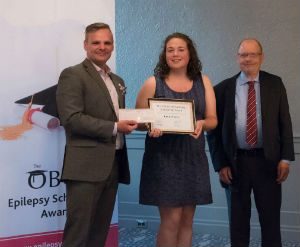
Emily Hoover is pictured here receiving her $1,500 Osler Epilepsy Scholarship with Epilepsy Ontario executive director Paul Raymond (left) and Osler Business Consulting Ltd. president Lawton Osler (right) during a presentation in Toronto June 1.

Emily says she draws inspiration from British Paralympic swimmer Maggie McEleny, who is affectionately known as “Mad Maggie” for her strong will and competitiveness. McEleny, who is paralyzed from the waist down, has won 15 medals at four Paralympic Games. Like Emily, McEleny was diagnosed with epilepsy at a young age.

Emily says her life has many parallels with the swimmer.

“For one, the diagnosis came at a similar time in life: she was 11, while I was 12. For another, both of us chose to persevere, to just keep going, even when others would not, often to the point of confounding and amazing our doctors,” Emily says.

Emily had her first seizure at school on April 19, 2010. Since then, she has gone through many tests and taken several medications to control her idiopathic epilepsy.

“However, like McEleny, I do not let my diagnosis stop me from living my life the way I want to,” Emily says.

In September, Emily will take on a new challenge. She is enrolled in the advanced biotechnology program at Fleming College in Peterborough, Ont. The program condenses three years of study into 2 ½ years.

“With the valuable knowledge I’ll gain through this program, I hope to start a lifelong career in scientific research,” Emily says. “The brain is an obvious choice (of study) of mine, and I would like to endeavour to lower the percentage (of people diagnosed with idiopathic epilepsy). No one should have to go through what we have.”

Emily is one of the recipients of this year’s Osler Epilepsy Scholarship. The scholarship, formerly called the OBCL Epilepsy Scholarship, is being offered to four students this year. Aside from the name change, the scholarship committee also decided to up the award amount from $1,000 to $1,500.

Osler Epilepsy Scholarships are awarded each year to exceptional students who have confronted and overcome remarkable barriers in their academic and personal lives due to their epilepsy.

Applicants also submit a 600- to 900-word essay, about a famous person who has epilepsy and what that person’s life means to them.

If you have feedback on this story, or have a story of your own that you would like to share, please contact the newsroom at 1-800-294-0051, ext. 23, or e-mail deron(at)axiomnews.com. You can also leave a comment below.
Student with epilepsy draws on parallels with award-winning actor in her pursuit of success

June 23, 2016

By Deron Hamel

Heather Beckett says the person she draws inspiration from most is award-winning Australian film and stage actor Hugo Weaving. Heather, like Weaving, is living with epilepsy and both have overcome many obstacles in their pursuit of success.

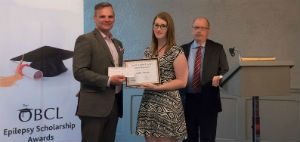
Heather Beckett is pictured here receiving her $1,500 Osler Epilepsy Scholarship with Epilepsy Ontario executive director Paul Raymond (left) and Osler Business Consulting Ltd. president Lawton Osler (right) during a presentation in Toronto June 1.

A recent graduate of the child and youth worker program at Sault College, Heather, 21, will be working towards her diploma in health care office administration at Durham College, starting in September.

Heather says although her condition has prevented her from pursuing her childhood dream of joining the military to help children living in poverty-stricken countries, she can still accomplish part of that dream as a child and youth worker. For this, she turns to Weaving for inspiration.

“By seeing (his) successes, I realize that there are ways I can achieve my dream,” she says. “I became a child and youth worker, and through attaining this office administration diploma, I can help in even more ways.”

Heather finds many parallels between her and Weaving. Both were living with their families during their teen years when they developed epilepsy; both do not drive because of their condition; and both have worked hard to not let epilepsy impede their ambitions.

She looks to how Weaving’s life has changed since the actor, now 56, was 40.

“Weaving has shared that since his first seizure at 13, he has experienced about one grand-mal (tonic-clonic) seizure a year,” Heather notes. “He also shared that he has been seizure- and medication-free since age 40. This gives me hope that one day I, too, can grow out of my seizures, as we both developed epilepsy in our teens.”

Through obtaining her health care office administration diploma, Heather says she hopes to make a difference in many people’s lives.

“I will have opportunities to work in hospitals, children’s mental health centres, residential treatment centres, youth detention centres and many other specialized clinics,” she says. “In this new direction, I will be able to help children and youth, while finding a way around the barriers that have emerged since being diagnosed with epilepsy.”

Heather is one of the recipients of this year’s Osler Epilepsy Scholarship. The scholarship, formerly called the OBCL Epilepsy Scholarship, is being offered to four students this year. Aside from the name change, the scholarship committee also decided to up the award amount from $1,000 to $1,500.

Osler Epilepsy Scholarships are awarded each year to exceptional students who have confronted and overcome remarkable barriers in their academic and personal lives due to their epilepsy.

Applicants also submit a 600- to 900-word essay, about a famous person who has epilepsy and what that person’s life means to them.

If you have feedback on this story, or have a story of your own that you would like to share, please contact the newsroom at 1-800-294-0051, ext. 23, or e-mail deron(at)axiomnews.com. You can also leave a comment below.

Epilepsy Ontario retreat focuses on helping agencies build capacity

June 16, 2016

A recent retreat hosted by Epilepsy Ontario for community-based epilepsy agencies was aimed at building knowledge capacity for executive directors and staff members throughout the province.

The retreat, which was funded by the Trillium Foundation of Ontario and held June 6-8 in Innisfil, Ont., brought together representatives from 11 of the 14 agencies Epilepsy Ontario works with.

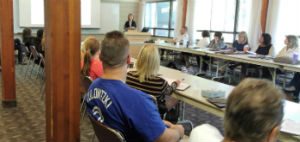
Attendees at the recent Epilepsy Ontario retreat listen to a presentation from Dr. Kathryn Hum of EpLink.

A major focus of the event was maximizing efficiency when delivering programs. There were also several guest speakers who discussed important research related to epilepsy in Ontario.

Paul Raymond, Epilepsy Ontario’s executive director, says many of Ontario’s epilepsy agencies may not have the resources to bring in experts to discuss program delivery, so he says he hopes the retreat filled a gap.

“We really hope that the executive directors and staff walked away with some knowledge and information that will help them provide better services to people with epilepsy at their agencies,” he says.

The retreat featured guest speakers from the Ontario Brain Institute and as well as experts in areas such as medical marijuana, fundraising techniques and strategies for supporting clients.

Based on feedback from the retreat, there was a lot of interest in the presentation on medical marijuana from Hanan Abramovici of Health Canada, who provided updates on the federal government’s stance on the subject. Suzanne Nurse, Epilepsy Ontario’s director of client services, and Arthur Schafer, director of the University of Manitoba’s Centre for Professional and Applied Ethics, also addressed the issue.

The issue of using cannabidiol (CBD), a non-psychoactive substance derived from the marijuana plant, to treat seizures has been a topic of much debate in the epilepsy community in recent years.

“It was an important session,” Raymond says. “There was a lot of discussion and it was ranked the highest in the evaluation after the retreat. This is something (people said) they found helpful to go back to their agencies and talk to their clients about, because a lot of agencies just aren’t sure how to talk about it.”

If you have feedback on this story, or have a story of your own that you would like to share, please contact the newsroom at 1-800-294-0051, ext. 23, or e-mail deron(at)axiomnews.ca. You can also leave a comment below.