
Author Archives: DHamel

Never let epilepsy stand in your way: Kate Selway turns to nurse-triathlete for inspiration

June 9, 2016

By Deron Hamel
Burlington, Ont. Grade 12 student Kate Selway says her inspiration comes from Glenna Fraumeni, a Toronto nurse and triathlete who, like Kate, is living with epilepsy.

Sports are an important part of Kate’s life. She plays soccer, badminton, field hockey, volleyball and swims on her school’s team. Though her doctor recommended she give up sports because of her condition, Kate is determined to not let epilepsy dominate her life.
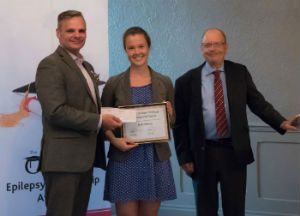
Kate Selway is pictured here receiving her $1,500 Osler Epilepsy Scholarship with Epilepsy Ontario executive director Paul Raymond (left) and Osler Business Consulting Ltd. president Lawton Osler (right) during a presentation in Toronto June 1.

She cites Glenna as an example of how people can overcome challenges brought on by epilepsy.

“She is a triathlete and her life is actually quite similar to mine,” Kate says. “She suffers from the same three types of seizures that I do: focal, dyscognitive and grand-mal (tonic-clonic). When she was diagnosed with epilepsy in 2007, she did her absolute best to keep participating in the endurance sports she loved. Like my doctors, hers told her to stop participating in those sports due to the danger.”

But Glenna did not stop doing what she loved, and her determination is serving as a light to guide Kate, the student says.

Living with epilepsy can pose challenges, but by facing those challenges and finding ways to deal with them is what allows her to live her life the way she wants.

For example, when Kate swims on her school’s team she wears a pink cap, while her teammates wear yellow caps. This is so Kate can always be seen. If Kate has a focal seizure during band class, she will keep holding her flute to her lips and her fingers moving until she can work her mouth again.

Kate says she takes her cue from Glenna, whose philosophy is to live her life the way she wants in spite of having epilepsy and to figure out ways that minimize her condition’s impact on her life.

“She treats her condition as something to work with and help her along, not (as) something that stops her from doing something she loves,” Kate says.

Kate’s perseverance has paid off. Kate earned the Athlete of the Year award in Grade 10 at her school and she was recruited to the all-star field hockey team in her league. She has also been on the honour roll every year at high school.

Kate, who wants to be a French immersion teacher, plans to start her post-secondary studies in September. She has been accepted into three universities: York, McMaster and Brock.

Kate is one of the recipients of this year’s Osler Epilepsy Scholarship. The scholarship, formerly called the OBCL Epilepsy Scholarship, is being offered to four students this year. Aside from the name change, the scholarship committee also decided to up the award amount from $1,000 to $1,500.

Osler Epilepsy Scholarships are awarded each year to exceptional students who have confronted and overcome remarkable barriers in their academic and personal lives due to their epilepsy.

Applicants also submit a 600- to 900-word essay, about a famous person who has epilepsy and what that person’s life means to them.

If you have feedback on this story, or have a story of your own that you would like to share, please contact the newsroom at 1-800-294-0051, ext. 23, or e-mail deron(at)axiomnews.ca. You can also leave a comment below.
Aspiring artist with epilepsy draws inspiration from Van Gogh

June 3, 2016

By Deron Hamel

Vincent Van Gogh has a special place in Emily Greer’s heart.

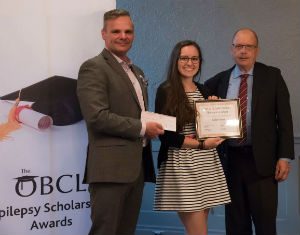
Emily Greer is pictured here receiving her $1,500 Osler Epilepsy Scholarship with Epilepsy Ontario executive director Paul Raymond (left) and Osler Business Consulting Ltd. president Lawton Osler (right) during a presentation in Toronto June 1.
Emily Green is pictured here receiving her $1,500 Osler Epilepsy Scholarship with Epilepsy Ontario executive director Paul Raymond (left) and Osler Business Consulting Ltd. president Lawton Osler (right) during a presentation in Toronto June 1.

Emily, who is studying fine art at OCAD University in Toronto, says Van Gogh is her favourite artist. But she also feels a connection to Van Gogh on another level.

Emily is living with epilepsy. Many historians (and even Van Gogh’s personal physician) have believed the Dutch painter had the condition.

One of Van Gogh’s most famous paintings is The Starry Night. While many art scholars see the halos around the moon and stars depicted in the painting as having religious significance, Emily says she sees something else.

“When I study this painting, I am reminded of the auras I experience before seizures,” Emily says. “(As a person with epilepsy), it is possible Van Gogh experienced colourful auras, which then found their way into his paintings.”

Auras are commonly felt by many people living with epilepsy just before a seizure begins. As Emily explains, auras are a perceptual disturbance that can be manifested as a “strange light.”

As an artist, Emily says she sees an upside to having epilepsy. She points to a research paper by Steve Schachter from Harvard Medical School, called Sparks of Creativity: The Influences of Epilepsy in Visual Art. The study argues that people living with focal epilepsy often have increased creative potential.

Emily says she agrees with this argument.

“While epilepsy is not always easy to live with, the impacts are not entirely negative,” she says. “Epilepsy can contribute to creativity. Having seizures and experiencing auras is part of who I am, and as an aspiring artist, (auras) affect many aspects of my work.”

Emily, who will be entering her second year of studies in September, is one of the recipients of this year’s Osler Epilepsy Scholarship. The scholarship, formerly called the OBCL Epilepsy Scholarship, is being offered to four students this year. Aside from the name change, the scholarship committee also decided to up the award amount from $1,000 to $1,500.

Osler Epilepsy Scholarships are awarded each year to exceptional students who have confronted and overcome remarkable barriers in their academic and personal lives due to their epilepsy.

Applicants also submit a 600- to 900-word essay, about a famous person who has epilepsy and what that person’s life means to them.

If you have feedback on this story, or have a story of your own that you would like to share, please contact the newsroom at 1-800-294-0051, ext. 23, or e-mail deron(at)axiomnews.ca. You can also leave a comment below.

Epilepsy should not stand in the way of your aspirations: OPPA president and CEO

May 26, 2016

By Deron Hamel

In November, Rob Jamieson, a 21-year veteran of the Ontario Provincial Police (OPP), was elected to a two-year term as president and CEO of the union representing 9,200 uniformed officers and civilians working for the police force. He is also living with epilepsy.

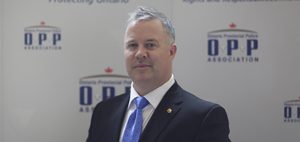
Ontario Provincial Police Association president and CEO Rob Jamieson

Jamieson’s new position with the Ontario Provincial Police Association (OPPA) is the result of many years of hard work and support from his family, friends and OPP colleagues. He is also an example of how people living with epilepsy should not let their condition stand in the way of their aspirations. This is the message he wants to send to people living with epilepsy.

“I want that young kid who has epilepsy to read this and be inspired; I want to reduce the stigma (of epilepsy),” Jamieson says.

Jamieson says if asked 10 years ago if he envisioned himself as head of one of the largest police unions in Canada, his answer would have been no. However, he is committed to helping others, so it’s not a complete shock either.

“Did I see myself specifically in this position? No. But did I see a role something like this, or did I see something like this happening through hard work and support? Yeah, anything is possible, as long as I am in that role of helping others,” he says.

When Voices of Epilepsy first spoke with Jamieson in April 2015, he recounted the challenges he has faced in his career because of epilepsy. What made a difference, he says, is the OPP’s supportive culture, which helped him work through those challenges.

When he lost his driver’s licence for a year after being diagnosed in 1997, the OPP put him on foot patrol for a time. When it came to working overnight shifts, the Barrie detachment scheduled him to work until 3 a.m. rather than to 7 a.m. because working until dawn negatively impacted his circadian rhythm, the changes in mental and physical characteristics occurring in our bodies during a 24-hour period.

Jamieson suffered his first two seizures in November 1996 and February 1997. After suffering a tonic-clonic seizure at home in December 1999, he began taking a new medication, Epival. This switch in medication reduced Jamieson’s seizures. Once the optimal dosage was determined by his doctor, the seizures stopped – permanently.

He has not had a seizure since 2004.

Jamieson says he was also inspired to contact Voices of Epilepsy to talk about the medication shortage and how Epival has been integral to dealing with his condition – and his ability to have a successful career.

The Epival shortage has him concerned. Like others taking the medication, he would like to see action taken to avoid shortages of the anti-seizure medication, which helps improve quality of life for many people living with epilepsy.

“I can’t tell you how disconcerting (the Epival shortage) is,” he says. “I have enough for the next three months, but I wanted to add my voice to this. I want to do everything I can to support people with epilepsy.”

If you have feedback on this story, or have a story of your own that you would like to share, please contact the newsroom at 800-294-0051, ext. 23, or e-mail deron(at)axiomnews.com. You can also leave a comment below.

Gov’t needs to take a proactive response to stem drug shortages: Epilepsy Ontario

May 19, 2016

By Deron Hamel

One of the greatest frustrations Epilepsy Ontario deals with during shortages of seizure-control medications is when impending drug shortages are identified but Health Canada and the provincial drug programs do nothing to try to prevent them, says Suzanne Nurse.

DrugShortage793Nurse, Epilepsy Ontario’s director of information and client services, says that 2016 has been one of the worst years, so far, for shortages of medications needed by people living with epilepsy since shortages began about five years ago.


Pharmaceutical companies have gone into shortage on multiple anti-seizure drugs. Lack of information about the shortages as well as lack of processes to prevent and manage them is putting people at risk as well as creating serious anxiety for people living with epilepsy and their families, she adds.

“There seems to be a failure to recognize how drug shortages evolve,” Nurse says. “We can see when a serious shortage is coming, one that will have an impact on people with epilepsy. We just can’t understand why (Health Canada and the provincial drug programs) that are overseeing the drug-shortage response can’t see it.

“We evaluate a couple of key factors: Are there only a few suppliers of a drug? Is the shortage expected to last a long time? Are the major suppliers affected? If the answers are ‘yes,’ ‘yes’ and ‘yes,’ then it’s pretty clear a serious problem is heading our way.”

Currently, there are significant shortages of two common anti-seizure medications in Canada: divalproex sodium and clobazam.

“We had to wait until we were in the middle of a crisis to get a response to the divalproex shortage. We’re still waiting to even get an acknowledgement of the seriousness of the clobazam shortage.”

Apotex Inc. first posted shortages of divalproex sodium on drugshortages.ca in June 2015; however, a collaborative effort to address the shortage did not begin until March 2016. The good news is that the response co-ordinated by Health Canada helped turn this around and generic formulations of divalproex sodium are beginning to recover, starting with the 500 mg strength tablets. It will take longer for the brand-name tablets, Epival, to recover.

Just as we’re starting to get out of the woods on divalproex, clobazam is now developing into a major problem. Apotex first reported a clobazam shortage in December. The drug was supposed to be restocked in mid-April, but about a month before the shortage was expected to end the date was pushed back to September. It has since been pushed back to Nov. 30. Pharmacies are now having trouble obtaining generic clobazam as well as the brand name tablets (Frisium).

Epilepsy Ontario wants to see a proactive response to anticipated drug shortages to prevent them from happening in order to reduce the impact on people living with epilepsy. With both the clobazam and divalproex sodium shortages, federal and provincial agencies were contacted to inform them of the impending shortages, but no proactive action was taken, Nurse says.

The drug shortages, coupled with the erratic changing of restock dates, are putting people’s safety at risk, Nurse says.

“Any shortages of medication that control seizures are of serious concern because epilepsy is a condition that you need to maintain good control of – missing a dose of a drug or changing medications, any kind of change like that can affect seizure control, so any drug shortage is a serious concern,” she says.

“The clobazam shortage is an even greater concern than most of the drug shortages that we deal with for epilepsy. There is no other drug like clobazam that can replace it when it is in shortage.”

Follow alerts on the Epilepsy Ontario website for updates on these drug shortages:

Divalproex sodium (Epival) alert
https://epilepsyontario.org/alert/alert-divalproex-sodium/

Clobazam (Frisium) alert
https://epilepsyontario.org/alert/alert-clobazam/

If you have feedback on this story, or have a story of your own that you would like to share, please contact the newsroom at 800-294-0051, ext. 23, or e-mail deron(at)axiomnews.com. You can also leave a comment below.