Author Archives: DHamel

Mother says sending her son to Summerfest Camp helped her ‘let go’

September 5, 2016

By Deron Hamel

Iris Amaya says her decision to send her son Jeremy to Summerfest Camp for the first time six years ago was largely to provide her with a sense of well-being.

Summerfest300Jeremy, who is living with epilepsy, was six at the time. Iris says she made the decision to send her son to the camp for two weeks because she wanted him to enjoy the same experiences any child Jeremy’s age can have.

She didn’t want his condition to ever hold him back in life.

“At that time, it was not so much for him but more for me,” Iris says. “I learned to let go and not over-shelter him.”

Jeremy has always enjoyed being outdoors and learned to love camping, his mother says. His parents did not want Jeremy to have to give up these things because of epilepsy, Iris says.

“Yes, he has this condition, yes he will adapt to whatever the situation is, but he should be able to enjoy everything that everybody else does,” she says. “He is enjoying the same things kids his age should be enjoying.”

Held near Orillia at Camp Couchiching (affectionately called “Camp Cooch”) every summer, Summerfest Camp enables children aged six to 15 who are living with seizure disorders to attend camp with other children. The camp has the resources to meet the needs of children living with epilepsy and provides a setting where they can enjoy a carefree camping experience.

At camp, Jeremy enjoys the outdoor experience, including swimming, sailing, canoeing and kayaking, Iris says, adding he has made lots of friends through his years attending Summerfest Camp.

Today, Iris has no worries when Jeremy, now 12, attends Summerfest Camp. He now attends with his two older siblings.

“They look forward to going every summer,” Iris says.

Iris credits Camp Couchiching for doing an excellent job communicating with the parents of the campers. The first year Jeremy attended, Iris says the camp contacted her every 24 hours to let her know how Jeremy was doing.

“By the second week, he was doing well enough that I told them they didn’t have to call me every day,” Iris says.

Summerfest Camp was founded in 1994 by Anita Allen, a neurology clinic nurse at Toronto’s Hospital for Sick Children (SickKids). The camp enables children aged six to 15, who are living with seizure disorders, to attend camp with other children. Camp Couchiching provides a setting where children can forget about their epilepsy.

If you have feedback on this story, or have a story of your own that you would like to share, please contact the newsroom at 1-800-294-0051, ext. 23, or e-mail deron(at)axiomnews.com. You can also leave a comment below.
In death, Ottawa man with epilepsy is providing life

August 25, 2016

By Deron Hamel

Adam Prashaw went through life facing many challenges but always persevered. On Jan. 24, Adam, 22, tragically died after suffering a seizure in his hot tub at his Ottawa home. But his story doesn’t stop there.

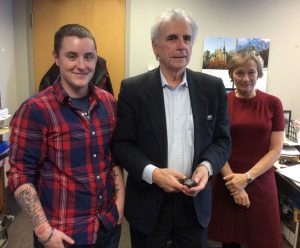
Adam Prashaw, far left, is seen here with neurosurgeon Dr. Andre Olivier and his assistant Monica Malecka.

One day later and more than 500 kilometres away, in Welland, Ont., a 53-year-old man was given a new chance at life, thanks to Adam’s generosity. Adam was a registered organ donor and the man received his heart during a transplant.

It’s fitting that a man received Adam’s heart. Adam began life as a baby girl, born Rebecca Prashaw on April 22, 1993. At the time of his passing, Adam was in the process of transitioning into a man.

Adam’s struggle with epilepsy began at age 5, when he was Rebecca. Rebecca was having lunch at home one day when she suddenly stopped eating and froze, Adam’s mother, Suzanne Corbeil, recalls. Suzanne could not get a response from Rebecca, who, after suffering the seizure, went into a deep sleep. Shortly after, Rebecca was diagnosed with an atypical form of epilepsy.

During the next several years, Rebecca’s doctors worked to find the best medication and dosage to help her cope with her epilepsy. By age 12, she was taken off medications. She was still having small seizures, but doctors said she could live a full life without taking medications.

But the seizures persisted. Throughout Rebecca’s teen years, she suffered scores of small seizures that impacted her social, work and academic life. Still, the teenaged Rebecca, a lifelong hockey fan, worked hard to lead the life she wanted to live. She was a goalie for a hockey team. She graduated from high school and later from Algonquin College.

“His epilepsy … lurked in the shadows, biting so much at a normal, healthy life,” Adam’s father, Rick Prashaw, wrote in a Facebook post the night Adam died. “But like everything in this kid’s life, he coped, summoned his courage and soldiered on.”

At 18, Adam began having tonic-clonic seizures. Doctors performed two brain surgeries – including one in November 2015 – to try to control the seizures.

Adam took measures to meet the challenges of his epilepsy. He wore MedicAlert bracelets and set alarms on his mobile phone to remind him when to take medications. He made sure his friends knew of his condition and what to do if he had a seizure.

“Adam, to his credit, with all his challenges, he led a pretty normal life,” his mother says. “Adam also had the complexity of being a transgendered child, so his world shifted and changed and there were so many things he had to figure out, who he was, what his identity was, how to live with this disability and feel like a valuable contributor to society.”

Sadly, Adam died at a transition point in his life. He was going through the transgender process, had changed his name and was attending counselling sessions. He was becoming the person he always had been inside.

John Dickhout is the man who received Adam’s heart. Adam’s parents have met him in person. The similarities between Adam and John are remarkable. John is a fan of theatre, loves to play golf and is a Montreal Canadiens fan. Adam was all these things, too.

“(Adam’s heart) was a match medically, but I also think it’s a match to carry on something that Adam would be so proud of,” Suzanne says.

As tragic as Adam Prashaw’s story is, a part of him lives on in a meaningful way. While nothing can ever replace Adam, his mother takes a small degree of comfort knowing that Adam is helping someone else live.

“Everything that led to the day that Adam died and the day that John received his heart were destined to be, whether I like that or not,” Suzanne says. “It was meant to be.”

When asked if there was anything else she wanted to tell Voices of Epilepsy about Adam for this story, Suzanne didn’t hesitate in her reply.

“I am told by professionals that Adam was amazingly lucky that his parents, his siblings, his grandparents, his extended family, all accepted him for who he was and surrounded and supported him with love,” she says. “It would be great if that message can come through in what you write.”

If you have feedback on this story, or have a story of your own that you would like to share, please contact the newsroom at 1-800-294-0051, ext. 23, or e-mail deron(at)axiomnews.com. You can also leave a comment below.
Agency works with media to bring supports to family of boy with epilepsy

August 18, 2016

By Deron Hamel

Epilepsy Halton Peel Hamilton communications manager Trevor Gordon was scanning online news stories in May when he came across a Global News article about a Mississauga family who was trying to find supports for the 5-year-old boy they had adopted who is living with epilepsy.

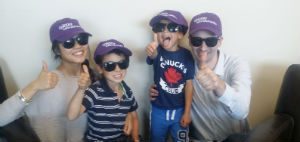
Epilepsy Halton Peel Hamilton recently connected with a family who have adopted a 5-year-old boy with epilepsy to help provide supports.

In May, Rosy Garcia and Andres Sosa adopted Jordan Sosa Garcia, who is from Colombia. Jordan’s mother, Rosy’s sister, was unable to care for the boy, so the couple brought him to Canada.

But caring for someone with epilepsy was a new experience for the couple and they didn’t know what supports were available to help.

When Gordon read the article, he contacted Angie Seth, the reporter who had covered the story, and offered the agency’s help.

“Right away when I read that article and saw that the family was in Mississauga, I thought, ‘I’m surprised that they don’t know about us (Epilepsy Halton Peel Hamilton) and vice versa,’” he says.

“I e-mailed the reporter and she was very quick to respond and was excited and I told her it would make a great third story for her, and it would, more importantly, help the family.”

Seth contacted the family and gave them the contact information for Epilepsy Halton Peel Hamilton. The family called the agency and Gordon put them in touch with Jasmine Morante, the Epilepsy Halton Peel Hamilton’s program manager.

An appointment was set up for the family to come in. Morante explained all the services the agency offers. She also gave them information on the Sunny Days Camp, a camping experience provided to children living with epilepsy and their siblings between the ages of five and 12, which Jordan attended with his brother.

Morante has also been providing education and advice to the family to help them learn about epilepsy.

“Jasmine was really good at explaining epilepsy 101 to the family and keeping them calm and positive,” Gordon says. “She is providing a great support system to the family.”

For his part, Gordon says he is happy to have been able to use the media and social media to create such a positive result.

“There is so much negativity in social media and the media in general, and I like the fact we used social media for something positive and it worked,” he says. “If people can learn from the techniques that we’ve used, hopefully that could spawn more ways of helping people.”

If you have feedback on this story, or have a story of your own that you would like to share, please contact the newsroom at 1-800-294-0051, ext. 23, or e-mail deron(at)axiomnews.ca. You can also leave a comment below.

Toronto man raises $332K for SickKids to buy laser surgery machine by climbing Kilimanjaro

August 11, 2016

By Deron Hamel

When Rick McGraw set out to climb Mount Kilimanjaro to raise money for Toronto’s Hospital for Sick Children (SickKids) to buy state-of-the-art laser surgery equipment, he had a goal of raising $300,000. Since completing the climb Aug. 1, he has raised $332,000, and the money is still coming in.

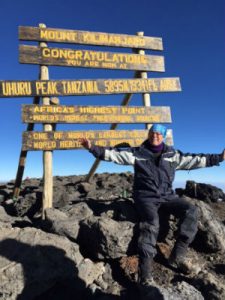
Rick McGraw is seen here atop Mount Kilimanjaro after completing a seven-day climb that raised $332,000 to help buy state-of-the-art brain surgery technology for Toronto's Hospital for Sick Children.
Rick McGraw is seen here atop Mount Kilimanjaro after completing a seven-day climb that raised $332,000 to help buy state-of-the-art brain surgery technology for Toronto’s Hospital for Sick Children.

Proceeds from McGraw’s climb are being used by SickKids to buy a laser surgery machine that will allow less invasive brain operations for children affected by epilepsy and cancer. Laser surgery with this machine will allow surgeons to operate on children using only small incisions and reduce time spent in hospital recovering.

SickKids will be the first Canadian hospital to have access to this technology.

McGraw, who has also climbed mountains in Mexico and Peru, says the decision to conquer Kilimanjaro came after seeing an advertisement for an expedition sponsored by Medcan, a Toronto health organization.

The Toronto resident liked the challenge of climbing Africa’s tallest mountain, but wanted to up the ante.

“Climbing Kilimanjaro was not on my bucket list, but it got on my bucket list very quickly, and I thought I could do something to make it more meaningful, so that’s how I ended up connecting with SickKids and identifying a project I thought was worthy,” McGraw tells Voices of Epilepsy.

“In the end, (raising money to buy the equipment) turned out to be more important to me than doing the climb.”

McGraw and his wife, Gayle, are matching every dollar donated to buy the equipment.

When McGraw decided to raise money for SickKids, he contacted the hospital and was provided with options of how money raised through his climb could benefit children. The laser surgery machine piqued McGraw’s interest because of the way it can improve quality of life for children with epilepsy and brain cancer.

“I was told (the hospital) had been lobbying the government for years to get this technology, but to this point the government has refused to pay for it,” McGraw says.

“(With this technology) the accuracy is increased. Some of the issues with epilepsy can occur in the centre of the brain, and there’s no way to access that with a scalpel, but with this equipment they will be able to.”

The climb to Kilimanjaro’s 19,341-foot summit took seven days and was physically gruelling but emotionally satisfying, McGraw says.

McGraw says he’s thankful for the support his fundraising project has received.

“In the end, we had 280 donors, which is quite amazing,” he says.

Click here if you would like to make a donation in support of McGraw’s climb.

If you have feedback on this story, or have a story of your own that you would like to share, please contact the newsroom at 1-800-294-0051, ext. 23, or e-mail deron(at)axiomnews.ca. You can also leave a comment below.