
Author Archives: DHamel

Criminal charges for actions committed during seizures underscores need for better police training

October 27, 2016

By Deron Hamel

In June, two Edmonton men living with epilepsy were arrested and charged with assaulting police officers while having seizures in separate incidents, only a few days apart.

car300While the charge against one man has been dropped, the other man, Neil Ryley, is in negotiations with the Crown to have his case thrown out.

These incidents are not isolated. This summer, Epilepsy Ontario collected scores of stories from people living with a seizure disorder about their experiences with police and first responders. Some were positive. Many were not.

For example, one woman recounted how she woke up in a police station cell after having a sensory complex partial seizure outside a nightclub. She had no idea where she was and no memory of what had happened. Although she had not been drinking, police officers had arrested her for public intoxication.

Fortunately, the charge was thrown out and the woman received an apology from a justice of the peace after she and her mother went to the courthouse with the woman’s medical files.

These incidents underscore the need for more police training in how to work with people who are having seizures.

Marcel Allen, a constable with the Ottawa Police Service, is working to provide that training. Allen has created a training program called Recognition and Response to People Having Seizures. He wants to see it become mandatory training for police services across Canada.

Allen has first-hand knowledge of the need for more police to be trained in how to respond to people having a seizure. On Aug. 8, 2010, Allen was off duty and sitting in his car in traffic with his children in downtown Ottawa when he went into seizure. As he was coming out of the seizure, a nearby RCMP officer responded, followed by city police.

While in a postictal state he struggled with officers, a common reaction, but it resulted in Allen being Tasered by an officer.

Allen decided to focus his frustration from the incident on producing a video to better educate law enforcement on assessing situations involving people with seizure disorders.

In an interview with the CBC, Allen said he was troubled by the news of the two Edmonton men. In Ryley’s case, his family had called 9-1-1 when he began having a seizure. When police arrived, Ryley alleges they beat him.

“Their thought in this case should be the well-being of that home and the well-being of that person,” Allen told the CBC. “So how that results in that person being assaulted, I don’t understand.”

When interviewed by the CBC, Ryley said he was surprised to learn there is a seizure training video available to the Edmonton Police Service. The video was submitted by the Edmonton Epilepsy association, however, a spokesperson for the police said officers have not been able to find it.

“It’s frustrating that they have access to (a training video), but they don’t use it and they deny even having it,” Ryley told the CBC. “Because there’s lots of people that have epilepsy. And I think they should be concerned about what can happen.”

If you have feedback on this story, or have a story of your own that you would like to share, please contact the newsroom at 1-800-294-0051, ext. 23, or e-mail deron(at)axiomnews.com. You can also leave a comment below.

Summerfest Camp benefits teen and his parents, dad says

October 20, 2016

By Deron Hamel

Attending Summerfest Camp for the past four years has been a benefit to both 15-year-old Jack Moller and his parents, says Jack’s dad, Tim.

Summerfest300For Jack, Summerfest Camp has been an opportunity to become more independent; for his parents, the two-week camp has provided a venue where they feel comfortable letting Jack be away from home for an extended period of time, Tim says.

The Mollers learned about Summerfest Camp through Epilepsy Ontario’s newsletter. When they heard about it four years ago, they encouraged Jack to attend the one-week introductory camp session.

When Jack returned home, he said he had such a good time he wanted to attend the following summer.

“This was something he had never done; he had never been away from home for any extended period of time, so it was something new for him to try, to be somewhere on his own without us,” Tim explains.

“The introductory week went well, so he’s been going there ever since.”

By attending Summerfest Camp, Jack has found a forum where he can be among others his age, be independent, and “figure things out on his own,” his dad says.

“There is a variety of things he can do at the camp – there are all types of different sports to keep him occupied all the time,” Tim says.

“Being able to fit into the crowd also helps. He likes to feel that he is helping out and that he can do things for people, so they let him help with little jobs around the camp, and he really likes that aspect of it.”

Summerfest Camp has nurses and counsellors trained to work with people living with epilepsy, and this is a comfort for Jack’s parents.

“It has been great to see that he enjoys it so much and that it’s a place where he can go without us and that we can be comfortable leaving him there,” Tim says.

“If he does have a seizure there, we know that they know what is going on and they can take care of it.”

Held near Orillia at Camp Couchiching every summer since 1994, Summerfest Camp enables children aged six to 15 who are living with seizure disorders to attend camp with other children. The camp has the resources to meet the needs of children living with epilepsy and provides a setting where they can enjoy a carefree camping experience.

If you have feedback on this story, or have a story of your own that you would like to share, please contact the newsroom at 1-800-294-0051, ext. 23, or e-mail deron(at)axiomnews.com. You can also leave a comment below.

You can support people with epilepsy while being an MI-6 agent for a night Oct. 20

October 14, 2016

By Deron Hamel

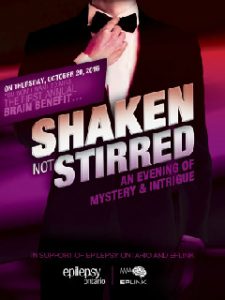
Whether you’re someone who loves a good mystery or you just like to have fun, you don’t want to miss a fundraising gala hosted by Epilepsy Ontario and EpLink on Oct. 20.Shaken350

The event, called the Shaken, Not Stirred gala, will be held in Toronto and will feature a James Bond theme that promises “an evening of mystery and intrigue” in the form of spy-themed table challenges. The black-tie event also includes a martini cocktail reception, a three-course meal and a silent auction.

This is the first time Epilepsy Ontario and EpLink have partnered on a large-scale fundraising event. Money raised will be split between the organizations. Epilepsy Ontario and EpLink plan to co-host fundraisers each year.

The table challenges will be provided by Escape from the 6, a company that creates interactive games and hosts “escape rooms,” team-building challenges where people have to collaborate to gather clues and overcome obstacles.

“I can’t tell you too much about the puzzles because I don’t want to give anything away, but they will be entertaining and really scrape your brain,” says Andrew Sturridge of Escape from the 6.

“They are puzzles similar to what you would encounter in an escape room, but instead of trying to escape, players will be racing to unlock a secret. … The James Bond theme is really awesome because, really, who doesn’t want to be an MI-6 agent for a night?”

Sturridge says these type of events are also “a nice introduction to meeting people at your table” as well as collaborating with others in a fun atmosphere while raising money for a good cause.

Epilepsy is a condition affecting an estimated one in every 100 Canadians. Of the 300,000 Canadians living with epilepsy, one-third experience uncontrolled seizures. Money raised through the gala will help improve the care and quality of life for people living with epilepsy.

The gala will be held Oct. 20 in the Grand Banking Hall at the One King West Hotel in Toronto from 6 p.m. to 11 p.m. Click here for more information.

If you have feedback on this story, or have a story of your own that you would like to share, please contact the newsroom at 1-800-294-0051, ext. 23, or e-mail deron(at)axiomnews.ca. You can also leave a comment below.

People with focal onset seizures asked to share experiences with gov’t to determine value of new drug

October 6, 2016

By Deron Hamel

The Ontario government is asking for input from people who have had experience living with uncontrolled focal onset seizures for an upcoming assessment of a new anti-seizure drug.

300An expert committee, established by the province to review medications, will assess this input along with clinical trial data and an economic evaluation of the drug. Input from people with epilepsy and their family members is an integral part of the review process.


The committee’s recommendation will be used by the executive officer of Ontario’s public drug programs to decide if Brivlera (brivaracetam) should be added to the list of medications covered by provincial drug plans.

Health Canada has approved Brivlera as an add-on anti-seizure drug to treat focal onset seizures in people aged 18 and older who have not achieved satisfactory seizure control with other therapies.

The provincial government accepts patient input submitted by a registered patient group. Epilepsy Ontario’s role is to collect and compile people’s feedback so their voice is heard. The organization will use a survey to gather feedback. People can also contact Epilepsy Ontario by calling 1-800-463-1119 if they would prefer to share their feedback in other ways, such as through a phone interview.

Anyone who has lived with or cared for someone with uncontrolled focal onset seizures can provide input.

“The government wants to know what people’s experience has been, what it’s like to live with uncontrolled seizures and what types of experiences people have had with treatments that are already available,” explains Epilepsy Ontario director of information and client services Suzanne Nurse.

Epilepsy Ontario is particularly hoping to hear from people who have been prescribed Brivlera (brivaracetam) during the five months since the drug was approved by Heath Canada in May, or from people who participated in a clinical trial before the drug was marketed.

Health Canada examines the safety and effectiveness of every new medication it approves. However, the agency does not look at whether or not the drug is cost-effective or if it should be covered by private health insurance or provincial drug programs.

This is where people who have had experience living with difficult-to-control focal seizures can help. By sharing their experiences people with focal onset seizures can help the province determine the cost-effectiveness and value of the medication.

“People’s experience with focal epilepsy and the treatments for this neurological disease are important for the expert committee to understand. What are the aspects that matter to them? What is good about available treatments? What is challenging for people with epilepsy and their families?”

“If someone has taken Brivlera, what has their experience been? If they haven’t taken this drug, what do they hope it will offer patients like them,” Nurse says.

“They’re looking at people  – especially those with uncontrolled seizures – (to determine) what that experience is like, how (epilepsy) affects people’s lives and quality of life, and how it affects their families – the things that aren’t necessarily in a clinical trial research paper.”

The survey can be completed online or by telephone. Click here for more information and to share your perspective.

If you have feedback on this story, or have a story of your own that you would like to share, please contact the newsroom at 1-800-294-0051, ext. 23, or e-mail deron(at)axiomnews.com. You can also leave a comment below.