
Author Archives: eCreative Studios

Mother’s advocacy for sons aided by Epilepsy Ontario webinars

May 17, 2013

One thing Kelly Cvijanovich has discovered about having two sons who have epilepsy is that when it comes to obtaining supports and resources it’s important to be proactive and become an advocate for your children.

This is exactly what she has done for her sons Dylan, 7, and Cameron, 3.
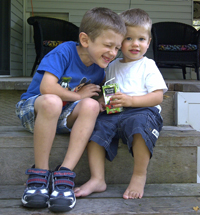
Dylan and Cameron Cvijanovich

Doctors don’t know what has caused her sons’ seizure disorders. Cvijanovich says discovering that her children had epilepsy was “completely scary and devastating” initially, but the greater question was what she should do when it came time for them to attend day care and primary school.

“You don’t know where to turn,” says Cvijanovich. “There were no resources offered by the neurologist or doctors, and I thought I needed to take a proactive approach to this.”

What she did was take action herself.

“Literally, I just went on the computer and searched epilepsy organizations, and Epilepsy Ontario and Epilepsy Toronto were the first to come up, and I sent them an e-mail, offering to volunteer,” says Cvijanovich.

Epilepsy Ontario accepted her offer to volunteer, which proved to be a turning point in Cvijanovich’s mission to advocate for her children.

Through her volunteer work at Epilepsy Ontario, Cvijanovich garnered important connections through the organization. One of those connections came when Epilepsy Ontario executive director Rozalyn Werner-Arcé introduced Cvijanovich to epilepsy information specialist Suzanne Nurse, who had developed webinars to train teachers how to identify and respond to seizures in the classroom.

The webinar also introduces information related to the impact that epilepsy can have on the social, emotional and academic development of children. Having this information is important, given that between 10,000 and 20,000 Ontario students have epilepsy, and approximately 1,000 will be diagnosed with epilepsy each year.

Armed with the training information, Cvijanovich was able to approach her children’s school and day care to instruct teachers on what to do if her children ever had a seizure. She explained everything step by step.

“Basically, it was, ‘Here’s the protocol to follow if there’s a seizure that happens at school and this is what you need to do,’ ” she says.

Having her children’s teachers trained in identifying and responding to seizures has given Cvijanovich a measure of comfort, which is largely why Nurse developed the training.

In an interview in November, Nurse said the webinars were not only valuable for keeping children safe in the classroom, they also provide comfort to parents.

“The benefits are enormous for children who have epilepsy,” she said. “If they’re going to a school where all of the staff are trained and knowledgeable about epilepsy, it makes the students and the families feel much more comfortable about the environment.”

Click here for more information on the epilepsy training webinars.

If you have feedback on this story, or have a story of your own that you would like to share, please contact the newsroom at 800-294-0051, ext. 23, or e-mail deron(at)axiomnews.ca. You can also leave a comment below.

Writer: Deron Hamel

* If you wish to reprint this story, please include following notice: “This story originally appeared on the Epilepsy Ontario website.”

MEDICATION ALERT: Shortage of APO-Gabapentin (600 mg tablets)

May 15, 2013

ApoGabapentin_600 mgApotex Inc. has reported a shortage of Apo-Gabapentin 600 mg tablets. The estimated resupply date for this medication is June 15, 2013.


If you take Apo-Gabapentin, 600 mg tablets, contact your pharmacy for more information and ask if the medication is in stock. For more information about drug shortages, see Epilepsy Ontario’s list of frequently asked questions.

For additional information and updates visit the Canadian Drug Shortage Database, or contact Apotex Inc., Customer Service Department 1-877-427-6839.

If you have any updates about the availability of gabapentin, or if you have additional questions about drug shortages, contact Epilepsy Ontario: 1-800-463-1119.

Finding your right epilepsy medication can be trial and error

May 9, 2013

Finding a patient’s correct epilepsy medication and dosage can be a matter of trial and error for doctors, but there are things people living with seizure disorders can do to assist in the process.

Dr. Peter Carlen
Dr. Peter Carlen

The first challenge for doctors is often making the right diagnosis, says Dr. Peter Carlen, a neurologist at Toronto Western Hospital’s Krembil Neuroscience Centre.

Different types of epilepsy respond differently to medications, says Carlen. For example, primary generalized epilepsy, is made worse by certain anticonvulsants, such as Tegretol.

However, secondary generalized seizures, which begin as partial seizures that evolve into generalized seizures, typically respond well to most anticonvulsants.

In the process of determining if a person should even be on a medication it’s important to rule out emotional seizures, or seizures brought on by anger, fear or happiness, says Carlen. Medications typically don’t work in these cases.

“The first thing is to make the right diagnosis,” explains Carlen. “Even after you make the right diagnosis some patients still don’t respond, so you have to try different drugs.”

When a person with epilepsy continues having seizures after two or more antiepileptic medications have been taken during a one-year period, their seizures are categorized as “medically refractory,” according to the Ontario Health Technology Advisory Committee (OHTAC) epilepsy expert panel.

A free online tool, developed in Canada, can help physicians determine when it is appropriate to refer their patients for an evaluation at a comprehensive epilepsy centre.

For those people living with epilepsy who experience side effects from medication it’s important to make their doctor aware of the situation.

If side effects are severe, the medication needs to be cut back if possible, says Carlen.

“However, cutting back the drug could make seizures worse, so it’s a difficult problem with no easy answer,” he says.

Carlen also recommends that people with epilepsy who are experiencing possible medication side effects to keep a seizure diary to chart the frequency of seizures. Seizure diaries can be obtained from epilepsy agencies and from doctors.

“Epilepsy agencies also provide information and support to help people with epilepsy talk to their family and friends about epilepsy and seizures,” notes Epilepsy Ontario executive director Rozalyn Werner-Arcé.

It’s also important for people to engage family members and friends about their seizure disorder so they understand what a seizure looks like. Sometimes a person is having a seizure and they don’t know it, and making others aware of the condition can be helpful in determining seizure frequency, says Carlen.

While there can be challenges determining the correct medication and dosage to treat seizures, Carlen says he’s hopeful about the future possibilities of medical science.

“We don’t have the (technology) yet to take someone’s blood and say, ‘This will be the drug for you.’ We’re not there yet, but that should be the way of the future,” he says.

If you have feedback on this story, or have a story of your own that you would like to share, please contact the newsroom at 800-294-0051, ext. 23, or e-mail deron(at)axiomnews.ca. You can also leave a comment below.

Writer: Deron Hamel

* If you wish to reprint this story, please include following notice: “This story originally appeared on the Epilepsy Ontario website.”

Horse rider’s determination trumps epilepsy, says stable owner

May 2, 2013

May 2, 2013 — Susy Niles says she wasn’t scared the first time she saw Lia Turner have a seizure while riding her horse — to the contrary, she understood what was happening.

Lia Turner is seen here riding her horse, Echo.

Niles, the owner of Iron Horse Equestrian, where Turner rides, says she was able to remain calm during the episode because Turner and her mother had explained that the 16-year-old horse rider has epilepsy and how they should react if she has a seizure while riding.

Since Turner can feel a seizure coming on, she stops the horse, dismounts and finds a safe place, while others stay with her, says Niles.

Turner’s horse, Echo, reacted calmly to the situation and stopped immediately the first time Niles witnessed Turner having a seizure, she adds.

“It wasn’t scary because of the nature of the horse that she owns — which is a very good horse,” says Niles. “Animals can sense danger with humans and they’re pretty good at reacting.”

Niles says Turner, whom she characterizes as “an excellent rider,” has had strong communication with her to help work around any issues arising from her epilepsy. For example, she only rides at specific times of the day, because she can be more prone to seizures at certain hours.

Niles has also taken time to educate herself about seizure disorders because she has a relative with the neurological disorder, she says noting that everyone at Iron Horse is comfortable with the fact that one of their riders has epilepsy.

There’s a valuable lesson to be learned by Turner’s example and that’s that if a person has epilepsy or another disability there’s no reason they can’t follow their passions and interests, says Niles.

All they have to do is make others aware and help them understand.

“We completely understand (Turner’s epilepsy) and I have no doubt at all that we would never be in a dangerous situation, because Lia has a good grasp on epilepsy and how it affects her, and so does her mother and so do we.”

But it has been Turner’s determination to follow her passion is that has truly enabled her to be able to ride, Niles says.

“It was largely because of Lia and her mother’s determination to try to stabilize (her epilepsy) and work with it — they are the ones that are determined, they’re not the quitters.”

Click here for a related story.

If you have feedback on this story, or have a story of your own that you would like to share, please contact the newsroom at 800-294-0051, ext. 23, or e-mail deron(at)axiomnews.ca. You can also leave a comment below.

Writer: Deron Hamel

* If you wish to reprint this story, please include following notice: “This story originally appeared on the Epilepsy Ontario website.”