
Author Archives: eCreative Studios

Mom applauds Summerfest for enhancing daughter’s independence

July 11, 2013

Nicole Graham first realized the positive impact Summerfest brings to children living with seizure disorders when she picked up her daughter, Alexa, from a week-long stay at Camp Couchiching five years ago.

When Alexa was met by her family, who had driven nearly seven hours to the Orillia-area camp from their Timmins home, the then-five-year-old’s response surprised her mother, who admits she was “nervous” about being separated from her daughter the entire week.
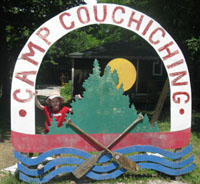
Alexa Graham
Alexa Graham

“She looked at us and said, ‘How come you guys are here to pick me up? Everybody else here is staying two weeks — how come I can’t stay two weeks?’ ”

Alexa, now 10, is currently at Summerfest, having attended the camp each year since her first visit in 2008. Nicole says Summerfest provides Alexa with an opportunity to meet new friends from across Ontario while having a good time in a fun atmosphere.

For Alexa, Summerfest is enriching and it’s something she looks forward to, her mother says.

“She wants to go back every year,” Nicole says, adding her daughter is outgoing and the camp is a good fit for her personality. “Alexa is very friendly and very determined.”

Summerfest also gives Alexa increased independence, says Nicole. As the mother of a child with epilepsy, Nicole says she often supervises Alexa in many of her daily activities. However, when she’s at Summerfest, she does those activities on her own — and wants to continue doing so when she returns home.

“There’s a lot of personal development that happens at Camp Cooch,” says Nicole.

Summerfest is offering four, two-week sessions from June 30 to Aug. 31 this year. A one-week camp option is offered to first-time campers or children who have complex-care needs.
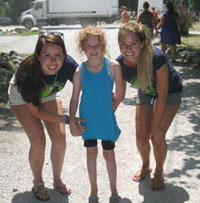
Alexa Graham poses with two counsellors at Camp Couchiching.

Summerfest was founded in 1994 by Anita Allen, a neurology clinic nurse at Toronto’s Hospital for Sick Children (SickKids). The camp enables children aged six to 15, who are living with seizure disorders, to attend camp with other children. Camp Couchiching provides a setting where children can forget about their epilepsy.

Summerfest also provides respite to parents and gives them a chance to spend time with each other or with their other children. Since the camp has experienced counsellors and offers on-site nursing professionals who are well-versed in working with people who have seizure disorders, parents enjoy peace of mind knowing their children are safe and in good hands.

“Epilepsy Ontario is awesome in helping supply nurses and in training the staff to make sure they know how to deal with seizures, so when Alexa goes there she has great summers,” says Nicole.

If you would like to donate to the Summerfest camp program, please click here.

Writer: Deron Hamel

If you have feedback on this story, or have a story of your own that you would like to share, please contact the newsroom at 800-294-0051, ext. 23, or e-mail deron(at)axiomnews.ca. You can also leave a comment below.

* If you wish to reprint this story, please include following notice: “This story originally appeared on the Epilepsy Ontario website.”

[Event] Richardson Charity Golf Tournament

July 9, 2013

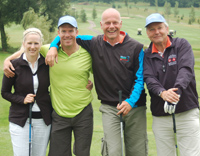
Terra Richardson, Ian Richardson, Onno van Buren and Gary Meers are all smiles at the 2011 charity golf tournament.

When the sun is shining, the golf course is calling! Why not play for a meaningful charity this year? Since 2006, the annual Richardson charity golf tournament has been generously helping Epilepsy Ontario improve the quality of life for people living with epilepsy.

Proceeds go to Epilepsy Ontario’s programs like Summerfest Camp. With your help, kids can enjoy all the activities that Camp Couchiching has to offer while having access to appropriate nursing care.

You can show your support by signing up or making a donation today. (Learn more about donating to Epilepsy Ontario by clicking here.) With raffles to enter and prizes to win, you won’t want to miss this year’s golf tournament. The annual Richardson Invitational takes place at the Ariss Valley Golf Club near Guelph. Spaces are limited so register early. We hope to see you there ready to tee off!

Click here to register for or donate to the 2013 charity golf tournament.

Special thanks to our corporate donors. This annual event would not be possible without generous contributions from these past sponsors:

  • Suncor/Petro-Canada
  • Casa Loma
  • The King West Hotel & Residence
  • Theatre Passe Muraille
  • Cineplex Odeon Movie Theatres
  • Commodities Handlers Inc.
  • Estates Winery Legends on the Lake
  • Factory Theatre
  • Gardiner Museum
  • Burger King
  • Rogers Communications
  • Golf Town
  • Ontario Science Centre
  • Marble Slab
  • HMV
  • M&M Meat Shops
  • The Keg
  • Flat Rock Cellars
  • S&H Health Food
  • Fairmont (Royal York)
  • Legends Estates Winery
  • GoodLife Fitness
  • Toronto Symphony Orchestra (TSO)

How did this charity tournament come into being? Read the story in Voices of Epilepsy.

For more events, click here.

Student wants to give back to hospital that changed her life

July 4, 2013

Katelyn Lewis has been seizure-free since having surgery to control her epilepsy in December 2009. Since then, her life has changed dramatically for the better, and she’s preparing to enter Confederation College in the autumn.

Katelyn, the recipient of an OBCL Epilepsy Scholarship Award for 2013, is planning to attend Confederation College’s one-year medical assistant (MLA) program in September and is on the waiting list for the college’s practical nursing program.

Katelyn Lewis
Katelyn Lewis

She plans to work for a year or two and then apply again for the nursing program. The reason she wants to be a nurse is simple: she wants to someday give back to University Hospital in London, Ont., where she had her life-changing surgery.

“My ultimate goal in life is to be a nurse and work in the epilepsy unit where I got my new life so that I can encourage others who feel the same way I felt the majority of my life,” Katelyn says.

Katelyn, a Thunder Bay resident, was diagnosed with epilepsy when she was 16 months old. She lived most of her life having as many as five tonic-clonic seizures per day, until she was 16.

That’s when the journey to her new life began.

Having been homeschooled — her mother felt this was the best option because Katelyn’s epilepsy posed learning challenges for her — and unable to participate in a lot of physical activity, Katelyn reached a point where she would no longer let her seizure disorder control her life.

This culminated on Sept. 18, 2008, when Katelyn had a status epilepticus, a series of seizures that happened one after another for four hours. She was taken to hospital but doctors and nurses were unable to stop the seizures and she ended up on life support.

Katelyn awoke the next morning to be told she had suffered brain damage and that, despite only being in Grade 9, would have to stop her education.

Katelyn did what she could to improve her situation, working on puzzles and word games, but eventually she tired of not having a social life because of her epilepsy.

That’s when she approached her doctor for a referral to the epilepsy unit at University Hospital to see if she could receive brain surgery to stop her seizures.

“I told him that I was sick of living this life, especially at 16, not having a social life, total lack of independence, and just plain sick of epilepsy in general,” says Katelyn.

She was referred to the hospital, where tests showed her seizures were coming from the right side of her brain. She was given the option of having a right temporal lobectomy, which would remove the right temporal lobe, and, hopefully, give her a seizure-free life.

On Dec. 3, 2009, Katelyn had the surgery and has not had any seizures since. This has given her a new lease on life, and she’s doing as much as she can to help others with epilepsy.

A noteworthy accomplishment for Katelyn was completing the Run for Epilepsy in Thunder Bay on Sept. 18, 2011 — three years to the day she suffered the status epilepticus.

“My half marathon raised over $8,000, which was donated to Epilepsy Ontario to be forwarded to the epilepsy unit in London so that patients like me could continue to be helped,” she says.

The OBCL Epilepsy Scholarship Awards were presented June 4 to six students in the province this year.

OBCL has been supporting students with epilepsy through the scholarship awards since 2006. Every year, up to 10 Ontario students win a $1,000 scholarship for post-secondary education. As part of their application package, students must submit a personal essay under that year’s theme.

Writer: Deron Hamel

If you have feedback on this story, or have a story of your own that you would like to share, please contact the newsroom at 800-294-0051, ext. 23, or e-mail deron(at)axiomnews.ca. You can also leave a comment below.

* If you wish to reprint this story, please include following notice: “This story originally appeared on the Epilepsy Ontario website.”
Latest innovations in epilepsy research, treatment developments, highlight IEC

June 28, 2013

Suzanne Nurse says the best thing about attending the recent International Epilepsy Conference (IEC) in Montreal was the opportunity to learn about the latest developments in epilepsy research and treatment of seizure disorders.

Nurse, an epilepsy information specialist with Epilepsy Ontario, says the discussions from expert panels about research into the genetic and immune-mediated causes of epilepsy and developments in epilepsy treatment — such as new surgical approaches and medication and diet treatments — give her the most hope for improving the lives of people living with the neurological disorder.

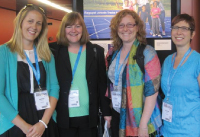
International Epilepsy Congress conference participants from Ontario are seen here. From left to right, Nicole Zwiers, Mary Secco, Melanie Jeffrey and Nikki Porter.

“Hearing about all the exciting things that people are doing within Canada and in other countries, as well as sharing what we are doing, is something that invigorates and re-energizes me,” says Nurse.

She adds: “I can’t wait to get back and work even harder on Epilepsy Ontario projects and initiatives.”

Other highlights of the event Nurse found enriching include meeting people from across the globe working in clinical settings and research labs who are dedicated to improving the lives of people with epilepsy, as well as discovering the campaigns people are working on to end stigmas associated with epilepsy.

Sessions and panel discussions explored a myriad of important topics; from the challenges facing people with epilepsy living in the developing world to the relation of epilepsy and stress to paediatric epilepsy.

Scientist and epilepsy advocate Melanie Jeffrey also attended the conference. Jeffrey presented a research poster she created with other graduate students, professors and doctors.

“My poster described some unexpected anticonvulsant effects of the hormone progesterone that our lab discovered in the past year,” she explains. “I hope this research will help us understand relationships between seizures and hormones, which affect men and women with epilepsy.”

Jeffrey adds that attending the conference has been beneficial in many ways for her.

“New ideas are swirling in my mind about the huge amount I have learned over the last five days,” she says. “Meeting potential collaborators, sharing ideas and being exposed to new ideas about epilepsy were inspiring for me as a person, an advocate and a scientist.”

Of note, Jeffrey says a session on how legislation and advocacy in other countries has improved lives of people with epilepsy without costing more was a great learning experience she can take home.

“I can explain why specialized epilepsy care for people with epilepsy and their families is necessary in Ontario, and save the health care system and our province money,” she says.

Hosting the IEC in Canada for the first time in more than 30 years was advantageous to Canadians working and volunteering with epilepsy associations nationwide because it gave more people easier access to an important event where they could learn about a broad range of topics related to epilepsy, says Nurse.

“It is a great honour for Canada to host the International Epilepsy Congress. . . . Canadian epilepsy researchers, clinicians and advocates are leaders in the international epilepsy community, so it is wonderful for us to be the host country,” she says.

Nurse adds that having Montreal and Canada hosting the event was of particular significance.

“Montreal has a great history as a site of innovation and discovery in epilepsy dating back to the first half of the 20th century and the work of neurosurgeon Dr. Wilder Penfield,” she says.

“There are epilepsy specialists all over the world who have done some, or all, of their epilepsy training in Canada.”

Writer: Deron Hamel

If you have feedback on this story, or have a story of your own that you would like to share, please contact the newsroom at 800-294-0051, ext. 23, or e-mail deron(at)axiomnews.ca. You can also leave a comment below.

* If you wish to reprint this story, please include following notice: “This story originally appeared on the Epilepsy Ontario website.”