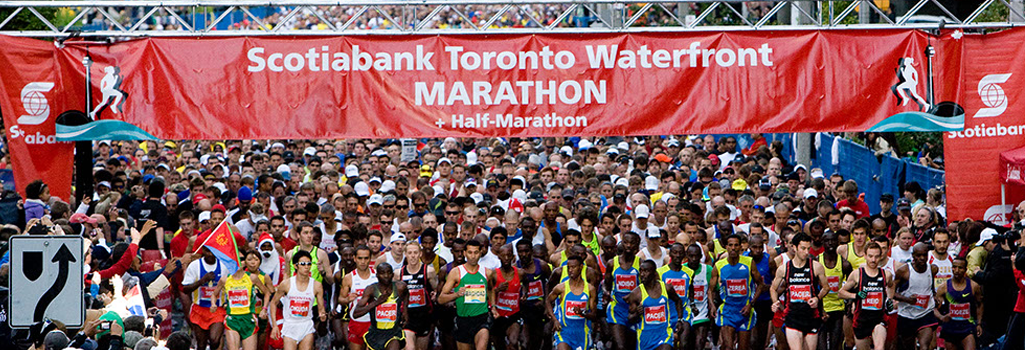
Pull up your lucky socks and double knot your favourite running shoes. The Scotiabank Marathon hits Toronto again this year on Oct. 20, 2013. Thousands will run or walk the race course that stretches along the city’s waterfront. Participants can choose from the 5K, half marathon or full marathon.
Are your feet itching to join in? Why not make your walk or run more meaningful? Epilepsy Ontario is partnering with Epilepsy Simcoe County and Epilepsy York as one of the official charities in this year’s Scotiabank Charity Challenge. You can dedicate your race to a loved one or simply use this opportunity to raise awareness about epilepsy.
As a member of our team, you can raise money to help us continue to serve Ontarians living with epilepsy. Contact Epilepsy Ontario at [email protected]before you register for the race to get your discount code.
To register, please visit the Scotiabank Toronto Waterfront Marathon registration page.
Not much of a runner? You can still make a difference by sponsoring our team and help us reach our goal of $10,000. Every donation counts. Thanks to the generosity of people like you, Epilepsy Ontario is able to:
Provide client services such as referrals to local agencies
Educate the public by distributing information through pamphlets, our website and our 1-800 line
Organize provincial programs including Summerfest Camp for kids with epilepsy
Engage community leaders in advocacy initiatives to empower people with epilepsy
Trevor and Katie Lewis accomplished their goal of raising enough money to launch an epilepsy agency in Thunder Bay during last year’s inaugural Run for Epilepsy, and the father-and-daughter team is planning to direct proceeds from this year’s marathon to build upon that success.
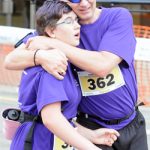
Trevor and Katie Lewis embrace after completing the 2011 Thunder Bay Marathon. (Photo courtesy of Thunder Bay Chronicle-Journal/Brent Linton. Used by permission.)
The 2012 Run for Epilepsy raised about $17,000, which helped open the Northwestern Ontario Epilepsy Association, an Epilepsy Ontario affiliate. Money raised from this year’s Run for Epilepsy, to be held in Thunder Bay Aug. 11, will help continue support for the agency.
Opening the Northwestern Ontario Epilepsy Association was a crucial success, as there had not been an agency in northwestern Ontario to provide supports or advocacy to people living with seizure disorders.
“Now that the Northwestern Ontario Epilepsy Association is opening up, there is now a place where people can go where there’s going to be a support group, where there’s going to be some advocacy, where people can reach out and talk to people (in similar situations),” says Trevor.
Already, the agency has a paediatrician and an adult neurologist on its steering committee, creating a direct tie to the medical community for both adults and children with seizure disorders.
Trevor and Katie, who are both living with seizure disorders, note this achievement speaks to the power of what people can do at the grassroots level. In fact, the success Trevor and Katie have garnered from the Run for Epilepsy has inspired others — people from the Niagara Falls region and Kingston have expressed interest in starting their own runs next year.
“We want to get as many people on board as possible to make that a reality,” Trevor says.
The idea for the Run for Epilepsy was sparked by Katie in 2010. After watching her dad train for and compete in a run to raise money for a local children’s music festival that year, she asked Trevor if the pair could train together for a run to raise money for Epilepsy Ontario, which would then be given to the epilepsy unit at University Hospital in London, Ont., where Katie had life-changing brain surgery.
Running under the banner of Epilepsy Ontario, the pair raised $8,000 during the 2011 Thunder Bay Marathon.
After that success, the Running Room contacted them to discuss collaborating to launch a run dedicated solely to raising money for epilepsy causes, and the rest is history.
“This is a classic case of how one person can make a difference,” Trevor says.
He and Katie have not set a fundraising goal for this year’s Run for Epilepsy — just to raise “as much as possible,” as Katie puts it.
One thing Trevor and Katie say they learned from organizing last year’s event is the value of patience. They admit they were concerned about the turnout because registration numbers were initially low. However, the number of entries quickly increased in the two weeks before the run. By the time the big day arrived, 304 people had registered — including about 50 people who signed up that morning.
“We’re looking at that exact same pattern happening again this year, (but we have) more patience watching the registrations this year and we anticipate about the same numbers,” says Trevor, adding runners have registered from as far away as southern Ontario and Manitoba.
The 2013 Run for Epilepsy will be held in Thunder Bay on Aug. 11, with participants meeting at the Confederation College Fitness Centre at 9 a.m. The event features three distance categories: a 2.5-kilometre and a five-kilometre “run, walk or roll” event and a 10-kilometre fun run. Click here for more information on the 2013 Run for Epilepsy.
Click here to join the Run for Epilepsy Facebook page.
Twitter: @RunForEpilepsy
Writer: Deron Hamel
If you have feedback on this story, or have a story of your own that you would like to share, please contact the newsroom at 800-294-0051, ext. 23, or e-mail deron(at)axiomnews.ca. You can also leave a comment below.
* If you wish to reprint this story, please include following notice: “This story originally appeared on the Epilepsy Ontario website.”
Suzanne McGuire is hoping to turn her epilepsy diagnosis into an opportunity to help others affected by seizure disorders by pursuing a degree in applied health sciences from Brock University.
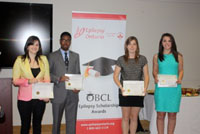
OBCL Scholars (Left to right): Suzanne McGuire, Alexander Johnson, Kirsten Leusink and Chloe Gallagher.
Upon completing her studies, McGuire, a St. Catharines native, plans to educate people about epilepsy through advocacy work and, possibly, working in health-care administration and policy decision-making.
McGuire’s life changed on Oct. 26, 2009. That afternoon, she was writing her fourth-year biomechanics midterm exam at Brock University when she suddenly woke up on the floor surrounded by her classmates and a paramedic, who explained she had a seizure.
After officially being diagnosed with epilepsy in January 2010, McGuire was presented with many challenges to complete her undergraduate degree.
When her seizures began, McGuire was taking a kinesiology course that largely centred on the physical, psychological and social dimensions of illness. Upon being diagnosed with epilepsy, she missed two months of classes, however, because the subject of her coursework was reflective of her personal challenges with epilepsy, her professor, Dr. Jarold Cosby, invited her to write a research paper to make up for classes she’d missed.
This led to an opportunity.
“After reviewing this paper, Dr. Cosby was very impressed and then asked if I wanted to complete an undergraduate thesis under his supervision, then, consequently, a master’s degree with him,” explains McGuire, who has been a graduate student at Brock since 2011.
“This was fantastic, as at the time I had no idea what I wanted to do with my life beyond university.”
Today, McGuire’s seizures are largely controlled by medication. She is also active in the epilepsy community, having run independent epilepsy campaigns for Purple Day (March 26) in 2011 and 2012. She also serves on the board of Epilepsy Niagara.
While epilepsy has caused some hardships in her life, McGuire is quick to note that good things have happened since her diagnosis three and a half years ago.
“There is no doubt that epilepsy has affected my life vastly in both positive and negative ways, but if anything, it has made me a better person, has helped me find a true passion in my life, and makes me want to help other people living with and being diagnosed with epilepsy so that they may live full and happy lives,” she says.
In June, McGuire won OBCL’s continuing studies award. She was presented with the award June 4 at a ceremony that saw five other students recognized with scholarships.
OBCL has been supporting students with epilepsy through the scholarship awards since 2006. Every year, up to 10 Ontario students win a $1,000 scholarship for post-secondary education. As part of their application package, students must submit a personal essay under that year’s theme.
Writer: Deron Hamel
If you have feedback on this story, or have a story of your own that you would like to share, please contact the newsroom at 800-294-0051, ext. 23, or e-mail deron(at)axiomnews.ca. You can also leave a comment below.
* If you wish to reprint this story, please include following notice: “This story originally appeared on the Epilepsy Ontario website.”
For Deb Fawcett, a special moment will happen on July 28. After bicycling more than 500 kilometres, she will complete the six-day Cycle for Olly that will take her and three other cyclists from Montreal to Toronto to raise awareness about sudden unexpected death in epilepsy (SUDEP).
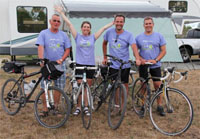
Last year’s Cycle for Olly bike-riders, from left to right, Paul Jeffs, Deb Fawcett, David Himsworth and Brian Kennedy.
Her 15-year-old daughter, Jordan, passed away from SUDEP in 2010, and it’s for Jordan and other people living with epilepsy that she’s cycling in the event.
“When I cross that finish line, I’m doing it for Jordan,” Fawcett says. “That’s what makes me want to do it. It helps me to share her awesomeness by, hopefully, giving life to others who live with epilepsy, because with more awareness there will be more knowledge and understanding and, hopefully, more research.”
Tamzin Jeffs will be cheering on the bike-riders during the second Cycle for Olly, which is named in honour of Jeffs’ sister, Olivia Mullin, who passed away at age 31 as a result of SUDEP in 2007.
Jeffs is co-founder of SUDEP Aware, an organization dedicated to raising awareness and understanding of SUDEP, an unexpected and unexplained death occurring in people with epilepsy.
Jeffs and her father, Paul, started the Cycle for Olly in 2012 to honour Olivia on the fifth anniversary of her passing. As with last year’s event, Paul will be travelling from his home in Serbia to be one of the four cyclists.
While donations for SUDEP Aware will be accepted during the Cycle for Olly, the main objective of the event is to raise awareness of SUDEP and educate people, say Jeffs and Fawcett.
Both say there is not enough understanding in the public about what SUDEP is, its prevalence, and what measures people can take to avoid SUDEP.
“Hopefully, (as a result of the event) more people will know about SUDEP and start talking about it,” Jeffs says.
With a rate of approximately one death in 1,000 people affected by epilepsy per year, SUDEP is more common than many perceive. When the rate of SUDEP is calculated to include only people with uncontrolled epilepsy, or seizures not regulated with medication, the number spikes to about one in 100. SUDEP can be related or unrelated to a seizure.
The four riders will be joined by a support team of 11 people, four of whom are travelling from the U.K. and one from France, to cheer them on. Two epilepsy agencies, Epilepsy Kingston and Epilepsy Durham Region, will host meet-and-greet events as the riders and support team pass through their areas.
The 2013 Cycle for Olly is happening July 23-28.
Writer: Deron Hamel
If you have feedback on this story, or have a story of your own that you would like to share, please contact the newsroom at 800-294-0051, ext. 23, or e-mail deron(at)axiomnews.ca. You can also leave a comment below.
* If you wish to reprint this story, please include following notice: “This story originally appeared on the Epilepsy Ontario website.”