
Author Archives: eCreative Studios

OTN staff show support for Epilepsy Ontario

June 20, 2013


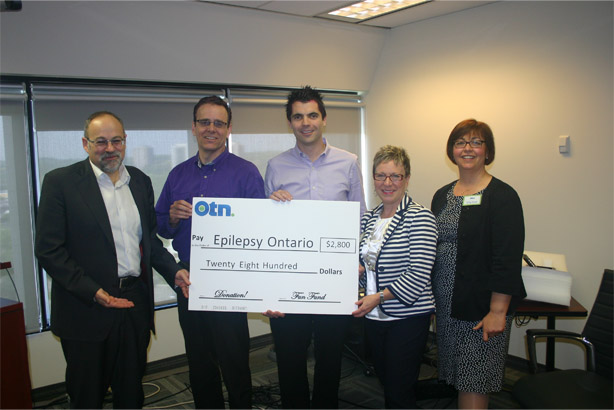
Epilepsy Ontario executive director Rozalyn Werner-Arcé accepts a cheque for $2,800 from the Ontario Telemedicine Network. OTN raised the money during a two-month campaign focused on epilepsy awareness.

Paula Ashley says she came away with a reinforced feeling of what a “caring and passionate” organization she works for, following the Ontario Telemedicine Network’s (OTN’s) two-month campaign to raise money for epilepsy causes and spread awareness about the neurological disorder.
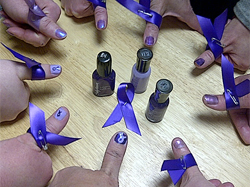
Timmins OTN staff celebrating Thumbs up for Epilepsy!

OTN, an organization providing telemedicine solutions for health-care stakeholders across Ontario, selects one charity or community organization to fundraise for each year. The sudden passing last summer of an OTN staff member who was living with a seizure disorder was the catalyst for team members choosing Epilepsy Ontario for this past year’s initiative, says Ashley, OTN’s employee engagement and communication specialist.

During the campaign this spring, OTN raised more than $2,800 to help Epilepsy Ontario raise awareness of seizure disorders. OTN also developed initiatives to educate staff members at its five regional offices.

When the campaign began, OTN worked with Epilepsy Ontario to obtain pins, bracelets, stickers and information packages to enhance awareness of epilepsy during weekly events hosted at its offices.

Events OTN hosted included a popcorn day, where Epilepsy Ontario’s logo was put on bags of popcorn; and a “purple thumb day,” which saw senior leaders painting staff members’ thumbs purple, the colour that represents epilepsy internationally.“Because we were doing this in memory of a colleague, it was quite amazing to see how our organization rose to the occasion with such passion and fervour,” says Ashley.
“We ended up raising more money than we had ever raised before, and that really said a lot about the people who work at OTN.”Approximately one in every 100 Canadians are living with a seizure disorder. Given the neurological disorder’s prevalence, Epilepsy Ontario executive director Rozalyn Werner-Arcé says it’s important that organizations follow OTN’s example of educating people.“OTN has set a wonderful example, not only through its fundraising, but also by educating people about epilepsy,” she says.“The funds raised by OTN during its awareness campaign will be put to good use educating people about epilepsy and seizure disorders.”Writer: Deron HamelIf you have feedback on this story, or have a story of your own that you would like to share, please contact the newsroom at 800-294-0051, ext. 23, or e-mail deron(at)axiomnews.ca. You can also leave a comment below.* If you wish to reprint this story, please include following notice: “This story originally appeared on the Epilepsy Ontario website.”

Educating people about epilepsy a major part of dad’s advocacy

June 13, 2013

When we think of people who advocate for children who are living with epilepsy, we often think of mothers, but in many cases fathers are the unsung heroes when it comes to peer networking and searching for ways to enhance their children’s quality of life.

In recognition of June 16 being Father’s Day, Voices of Epilepsy recently spoke with one such father.  Meet Carl Weatherell. Carl’s 10-year-old daughter, Alyssa, is living with Dravet syndrome, a form of intractable epilepsy.

Carl and Alyssa Weatherell

Carl has been involved with the epilepsy community since Alyssa was diagnosed with Dravet syndrome as an infant. He has joined support groups, been involved with peer networking and advocated for Alyssa by educating people about Dravet syndrome and seizure disorders.

Education, says Carl, is a crucial part of epilepsy advocacy for the simple reason that most people don’t recognize the seriousness of seizure disorders. Explaining the seriousness of epilepsy to people he knows, as well as to the people connected to Alyssa, such as teachers, is an important way Carl advocates for his daughter.

Carl says when he explains the serious impact seizure disorders have, many are surprised. Unfortunately, most people mistakenly believe epilepsy is little more than a neurological disorder where people occasionally have seizures, but then come out of the seizure and everything is fine.

“(Epilepsy) is catastrophic and people need to understand that; the impact on society and families is massive,” he says, adding epilepsy does not just affect people on a physical level — for instance, a large number of people with epilepsy live below the poverty line.

A testament to Carl’s advocacy work is his connection to Dravet.ca, an online portal for families and caregivers of people with Dravet syndrome to connect and find support. Carl was one of several parents of children living with Dravet syndrome in the Ottawa area who recently launched the site.

Carl became connected to the grassroots group through peer networking on Facebook. Dravet.ca is the Canadian arm of U.S.-based Dravet.org.

With about one in every 100 Canadians living with epilepsy, the disorder is also a lot more prevalent than most people realize.

“The number of people (affected by epilepsy) is roughly the same as the number of women who have breast cancer, yet the amount of support for (epilepsy) is (much) less,” Carl says.

“The challenge is getting people to believe these numbers. As a parent, I didn’t believe the numbers until they were given to me.”

Writer: Deron Hamel

If you have feedback on this story, or have a story of your own that you would like to share, please contact the newsroom at 800-294-0051, ext. 23, or e-mail deron(at)axiomnews.ca. You can also leave a comment below.

* If you wish to reprint this story, please include following notice: “This story originally appeared on the Epilepsy Ontario website.”

Six persevering students earn OBCL scholarship awards

June 6, 2013
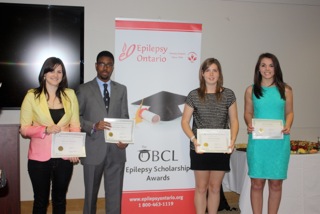
Left to right: Suzanne McGuire, Alexander Johnson, Kirsten Leusink, Chloe Gallagher
OBCL Scholars (Left to right): Suzanne McGuire,
Alexander Johnson, Kirsten Leusink, and Chloe Gallagher.
The OBCL Epilepsy Scholarship Awards were presented June 4 to six students who all have one thing in common – they are living with epilepsy but they’re not letting it interfere with their future plans.Chloe Gallagher is one of the scholarship recipients. Gallagher will be pursuing a degree in nursing at McMaster University, and has her sights set on eventually attending medical school to achieve her goal of specializing in pediatrics.
Chloe Gallagher poses with her OBCL Epilepsy Scholarship Award on June 4. She will be using the award towards obtaining a nursing degree at McMaster University.


She has already participated in a co-op placement at Joseph Brant Memorial Hospital in Burlington, where she got her first taste of a health-care career through her work with doctors and nurses in the hospital’s surgery department.

Gallagher, who graduated from Aldershot High School in 2012, has had her share of challenges along the way. In 2010 she suffered a brain aneurysm rupture, resulting in her having seizures.Experiencing frequent seizures afterwards, Gallagher was forced to give up some of the things she loved, including go-karting – she holds the distinction of being the first Canadian female go-kart driver to race in the DD2 shifter class, racing at speeds in excess of 120 km/h – and many sports.She went through several surgeries during this time and today has her seizures controlled with medication.While Gallagher says she has accepted that she will have challenges in life, she is prepared to face them head-on.“I know that these obstacles will continue to pop up throughout my life, but I have worked hard to overcome everything life has thrown at me thus far, so I am confident I can continue this path,” she says.

In fact, Gallagher says the challenges she’s already faced have provided her with the tools needed for a successful medical career.“I also believe that my first-hand experiences will really help me in this field, not only because of all the time I’ve spent in hospitals and learning about the (health-care) environment, but also because I will be able to relate to patients and understand what they are going through,” she says. Alexander Johnson is another OBCL scholarship winner.

Like Gallagher, Johnson has had to face the challenges that come with epilepsy. Diagnosed with the neurological disorder at 13, Johnson says what has helped him persevere is his personal motto: “Never give up.”

Prior to his diagnosis, Johnson was active in sports and played on his school’s soccer team, until a seizure forced him to give up the sport. Still, his “Never give up” motto came into play, and Johnson took on a managerial role for his team for a couple of years, until repeated seizures forced him to step down.

The continued challenges his seizure disorder presented for Johnson brought him to consider other interests.

Music was a natural creative outlet for him to think about; having spent nine years playing various instruments he felt he “could do something more with that talent.”

Johnson began putting his strengths as a musician to good use. He has written songs for Alzheimer’s patients, and has played in his high school’s tour band, which has performed at two Canadian Cancer Society fundraisers and at events at a local church.

“I managed to keep motivated – never giving up – and despite not being seizure-free, I have found that a lifestyle that will create a long and winding road to help me ascend on what was once a foreign mountain,” he says.

Johnson will be using his scholarship to pursue a bachelor of arts degree in professional writing from York University.  

OBCL has been supporting students with epilepsy through the scholarship awards since 2006. Every year, up to 10 Ontario students win a $1,000 scholarship for post-secondary education. As part of their application package, students must submit a personal essay under that year’s theme.Here’s a list of this year’s scholarship winners. Watch for further stories about the OBCL Epilepsy Scholarship Award recipients.

OBCL Epilepsy Scholarship Awards:
Alexander Johnson
Kirsten Leusink
Katelyn Lewis

Continuing Studies Award
Suzanne McGuire

President’s Award of Distinction
Chloe Gallagher
Tori Gleason

If you have feedback on this story, or have a story of your own that you would like to share, please contact the newsroom at 800-294-0051, ext. 23, or e-mail deron(at)axiomnews.ca. You can also leave a comment below.

Parent of children with epilepsy highlights importance of having an understanding employer

May 23, 2013

Kelly Cvijanovich recalls one year how she had used up all her sick days to be with her two sons who are both living with epilepsy — and it was only August. She knew she would need more days off. Her employer’s response? Don’t worry about it; take the time off you need.

It’s this type of supportive environment that’s essential to cushion the impact of the challenges that come from having children with seizure disorders, says Cvijanovich.

Dylan and Cameron Cvijanovich

Being the parent of young children with epilepsy presents many challenges, and given the amount of time parents often need to take off work to be with their children during medical emergencies, it’s crucial to have an understanding employer, she says.

In this respect, Cvijanovich finds herself fortunate.

Cvijanovich has worked 15 years for Scotiabank. Since the time her sons, Dylan, 7, and Cameron, 3, were diagnosed, the organization has been supportive, she says.

Cvijanovich, a manager at the bank’s head office in Toronto, says communicating her challenges to her employer wasn’t easy, but once she made the move to explain the issues that come with having children who are living with epilepsy her bosses were understanding.

“Right from the onset, they were behind me 100 per cent,” she says. “We had a lot of hospitalizations our first year, and by the time I was out of sick days, my boss said, ‘This is not even something to think about right now.’ ”

Scotiabank also recognized Cvijanovich as a valuable employee. When she sat down with her manager to go over the hours, it was realized that Cvijanovich took lots of work home with her, which was counted as days worked. They also allowed her to borrow sick days from the next year.

As a result of Scotiabank’s support, everything worked out, Cvijanovich says.

But there was one more issue. Cvijanovich lives in Hamilton and works in downtown Toronto. She was becoming increasingly concerned about being so far away from Dylan and Cameron every day. Given the choice between her children and her job, Dylan and Cameron had to come first.

Again, Scotiabank understood that Cvijanovich’s children had to be top priority, so other arrangements were made.

“They said, ‘We don’t want to lose you, so we’re going to create an alternate work arrangement,’ ” Cvijanovich.

The “alternate work arrangement” meant Cvijanovich could work from home two to three days per week during the time her children needed increased medical attention. She still has the flexibility to do this when needed.

Epilepsy Ontario executive director Rozalyn Werner-Arcé is applauding Scotiabank and other employers who help ease the challenges parents of children living with epilepsy face.

“No one should have to choose between their children and their job,” she says. “When employers are willing to accommodate employees who have children living with epilepsy, like the way Scotiabank has for Kelly, it sets a wonderful example for others.”

If you have feedback on this story, or have a story of your own that you would like to share, please contact the newsroom at 800-294-0051, ext. 23, or e-mail deron(at)axiomnews.ca. You can also leave a comment below.