
Author Archives: eCreative Studios

Online toolkit will make workplaces more inclusive for people with epilepsy

November 14, 2013

An e-learning resource toolkit developed by Epilepsy TorontEmployment200o and funded by the Accessibility Directorate of Ontario to help company managers, human-resources personnel and employees better understand epilepsy and how to react if a person has a seizure in the workplace is slated to be released in mid to late winter.

Epilepsy@work is intended to be rolled out across Ontario to make workplaces more inclusive for people living with a seizure condition. It will also provide employers with information pertaining to their rights and obligations when hiring people with epilepsy, says employment consultant Tim Nourse.

Epilepsy@work, which will use slides, photos and videos to educate people, is not just directed at making workplaces more inclusive and safer for staff members and managers; it’s also beneficial to know what to do should a customer have a seizure, Nourse notes.

There are three components to the toolkit: one for managers, one for employees and one that’s a users’ manual for human-resources departments to describe how to use the toolkit.

The component aimed at employees will serve as a training course to help workers understand epilepsy. For example, if a supermarket’s customer had a seizure while shopping and employees handled the situation poorly, epilepsy@work could be used as a resource to better train staff, Nourse says.

“The manager could say, ‘here’s this resource and I want all my employees to take this course online,’ and then they do a little test at the end and show the boss a certificate, so the next time somebody comes in and has a seizure the employees will act much more appropriately and will keep that customer,” he explains.

“Or, it just might be used by an employer who just wants to do the smart thing and have a more diverse workforce and is thinking about hiring someone who has epilepsy because they want to learn more about it; they want to know how to accommodate, they want to know how to talk to co-workers about epilepsy and they want to know what their obligations are.”

The second component will be for hiring managers. This segment will use case studies, checklists, flow charts and questionnaires that will help people who do recruiting and hiring understand their rights and obligations as well as the rights of employees who have a seizure condition.

Epilepsy@work will also feature a first-aid simulator. This video feature will give the viewer a camera-lens view of what it’s like to witness someone having a tonic-clonic seizure. Throughout the video there will be pauses that are an interactive feature. The first pause will take place right after the person falls to the ground and starts to convulse. Questions will pop up on the screen. What do you do? Call 9-1-1? Time the seizure? Run away?

“Instead of seeing a video about tonic-clonic seizures and telling you what to do, this gives users the opportunity to be interactive,” Nourse says.

Epilepsy Toronto and the Accessibility Directorate of Ontario have been working together to identify key audiences for epilepsy@work. The hospitality and retail sectors top the list of employers that the rollout will be aimed at attracting.

“This is going to be amazing; there’s nothing like this out there and we’re excited about it and the province is excited about this, too,” Nourse says.

Writer: Deron Hamel

If you have feedback on this story, or have a story of your own that you would like to share, please contact the newsroom at 800-294-0051, ext. 23, or e-mail deron(at)axiomnews.ca. You can also leave a comment below.

EpLink researcher says team is ‘quite close’ to finding Lafora disease cure

November 7, 2013

By Deron Hamel

Dr. Berge Minassian says he believes scientists are “getting quite close” to finding a cure for Lafora disease, characterized as the most serious form of epilepsy, with inroads made possible by the Ontario Brain Institute’s (OBI’s) EpLink research program.

Dr. Berge Minassian
Dr. Berge Minassian

Minassian is one of more than 25 researchers at nine university and hospital sites across Ontario involved with EpLink.

Minassian has been studying Lafora disease for many years, and through his research he has found two mutated genes that cause the condition. These genes produce an abnormal form of starch-like glycogen which brain neurons cannot process.

Lafora disease is a rare seizure disorder, occurring in fewer than one in 200,000 people. It typically strikes young people in their early teens when they begin having uncontrolled seizures and dementia. This progressive form of epilepsy usually leads to death in about five to 10 years.

The build-up of glycogen overtakes neurons, causing severe seizures and dementia.
Funding for the EpLink project has had a major impact on his research team’s progress in finding a cure for Lafora disease, Minassian tells Voices of Epilepsy.

“It means quite a lot because this is quite a rare disease,” he says. “It’s usually hard to get funding for research for rare diseases, and EpLink has allowed us to get important funds to move us forward to (allow us) to keep doing our work.”

Much of Minassian’s research in the past year and a half has focused on lab work with mice. His team has been able to cure Lafora disease in mice through genetic changes, so they now know this is the way to cure it in humans. However, curing Lafora disease in humans would require different genetic manipulations.

Minassian says the next step in the path to finding a cure is to develop medications that can create the needed genetic changes.

“We are actively looking for medications that will do the same thing that the genetic manipulations did in the mice as a treatment for our patients, and we’re doing this in part with the EpLink funding,” says Minassian, who also credits leadership from EpLink co-directors Dr. McIntyre Burnham and Dr. Jorge Burneo as an important component to his team’s success.

On March 5, the province committed to injecting $100 million over five years to OBI, which, in turn, means five more years of EpLink funding.

If you have feedback on this story, or have a story of your own that you would like to share, please contact the newsroom at 800-294-0051, ext. 23, or e-mail deron(at)axiomnews.ca. You can also leave a comment below.
Education key to eliminating epilepsy stigma, say panelists

October 31, 2013

TORONTO – In the documentary On the Edge: Living with Epilepsy, Bill Maier shares his story about having a seizure at school and then being reprimanded by his teacher for his “behaviour.” For people who have the neurological condition and those working for epilepsy support agencies, Maier’s story is a common theme.

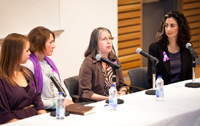
Panelists, from left to right, Lia Turner, Tina Turner, Suzanne Nurse and Dr. Elizabeth Donner are seen here discussing the documentary On the Edge: Living with Epilepsy following its Canadian premiere in Toronto Oct. 23.

During a panel discussion following the Oct. 23 Canadian premiere of the documentary, Epilepsy Ontario epilepsy information specialist Suzanne Nurse said Maier’s story is typical of the anecdotes she hears from people affected by seizure disorders.

“The themes that were highlighted in the film are exactly the same circumstances that we hear at Epilepsy Ontario when we speak with people who have epilepsy,” she said.

“There was a lot of emotion in his description of what his experiences were like, and we hear that same sort of story from a lot of people that we speak to; there was a lot of pain there.”

Fear of epilepsy and fear of those who are living with the condition is a root cause of negative stigmas people with seizure disorders face, Nurse said. However, she offers a solution to overcoming fear: education.

And On the Edge is precisely the type of tool that can be used to educate people about epilepsy, Nurse said. Because the film delves into people’s personal experiences with seizure disorders in a heartfelt way, those watching the film garner a strong sense of empathy for the people interviewed.

On the Edge was written and directed by Louis Stanislaw, a U.S. filmmaker who has coped with epilepsy his whole life. The film tells the painful truths, misunderstandings and difficulties of living with epilepsy at every turn; from family life to school, to leaving home, and starting a career and forming lasting bonds.

Another panelist, Dr. Elizabeth Donner, a neurologist at Toronto’s Hospital for Sick Children, agrees that educating people about epilepsy is crucial to eliminating stigmas. For her, listening to people’s experiences in the film was a reminder of how much work there is to be done.

“I know there are a lot of people trying to reduce the stigma of epilepsy, but then when I watch the film I see that we may not be making the impact that we need to make with regards to (eliminating) stigma,” she said.

For people who are affected by epilepsy, the film sends the message that there is a large community of people dealing with the same issues as themselves — and that’s a good thing, says Epilepsy Ontario executive director Rozalyn Werner-Arcé.

“By knowing that there is a community of people with epilepsy out there, and that support is available through local epilepsy agencies, it helps build strength and resilience for those facing difficult challenges and isolation,” she said. “(The film will also help) bring voices together around advocacy and break down stigma.”

Writer: Deron Hamel

If you have feedback on this story, or have a story of your own that you would like to share, please contact the newsroom at 800-294-0051, ext. 23, or e-mail deron(at)axiomnews.ca. You can also leave a comment below.

Documentary delivers powerful messages aimed at erasing epilepsy stigma

October 24, 2013

TORONTO – Epilepsy is a reminder that none of us has complete control over our bodies. That’s one of the powerful messages driven home during the Canadian premiere of On the Edge: Living with Epilepsy, a documentary about the neurological condition, told by people who are living with it.

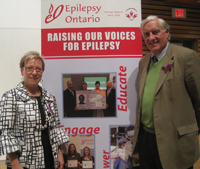
Epilepsy Ontario executive director Rozalyn Werner-Arcé and Joe Stanislaw, father of On the Edge writer-director Louis Stanislaw, are seen here after a the documentary's Canadian premiere.
Epilepsy Ontario executive director Rozalyn Werner-Arcé and Joe Stanislaw, father of On the Edge writer-director Louis Stanislaw, are seen here after a the documentary’s Canadian premiere.

Think about it: we have all caught colds, had headaches or some other malady that was beyond our control. In that sense, epilepsy is no different. People living with epilepsy have no more control over the condition than anyone else has when they, for example, catch a seasonal virus.

Despite this, there’s a stigma attached to epilepsy. It frightens people who are unfamiliar with the condition, and this has a detrimental trickle-down effect on those living with epilepsy.

This stigma can cost people their jobs and friendships, which can lead to other conditions, most notably depression and anxiety, the film explains.

On the Edge was written and directed by Louis Stanislaw, a U.S. filmmaker who has coped with epilepsy his whole life. The film tells the painful truths, misunderstandings and difficulties of living with epilepsy at every turn; from family life to school, to leaving home, and starting a career and forming lasting bonds.

Perhaps most importantly, the film puts faces to the condition, which is meant to inject a better sense of empathy into those listening to the many personal stories unfold.

While Stanislaw was unable to attend the Oct. 23 screening of his film at the Li Ka Shing Knowledge Institute in downtown Toronto, his father, Joe, was on hand.

Joe Stanislaw said the most important aspect of the documentary is that it encourages people to talk about the condition. Being transparent and educating others about epilepsy is a major step in eliminating stigma, he said.

“Transparency makes a difference; it creates understanding. If you don’t have transparency, you don’t have understanding — instead, you have suspicion and you have fear,” he told Voices of Epilepsy, following the screening.

Joe Stanislaw noted that many people living with epilepsy hide their condition from others. The reluctance people with epilepsy have about disclosing their condition is also explored in On the Edge.

In fact, 40 per cent of people interviewed for the documentary shared a story about epilepsy they had never told anyone before, Joe Stanislaw said.

During his address to the audience following the screening, Joe Stanislaw underscored the importance of people sharing their personal stories about epilepsy to others. It was through people’s willingness to discuss the condition openly that made the film possible.

He also commends his son for his strength in making the film to help erase preconceived notions about epilepsy.

“His strength is your strength; you helped him do this.”

Epilepsy Ontario hosted the screening and panel discussion that followed the event.

Writer: Deron Hamel

If you have feedback on this story, or have a story of your own that you would like to share, please contact the newsroom at 800-294-0051, ext. 23, or e-mail deron(at)axiomnews.ca. You can also leave a comment below.