Author Archives: eCreative Studios

Life changes for Kerry Jenkins, one year after surgery to control epilepsy

January 7, 2014

Kerry Jenkins is living proof of the difference successful surgery can make in the life of a person who has epilepsy.

Since having deep brain stimulation (DBS) surgery in December 2012, Jenkins, who was once described by doctors as having one of the most severe cases of epilepsy in the world, has had her seizures reduced by half and her tonic-clonic seizures have disappeared.
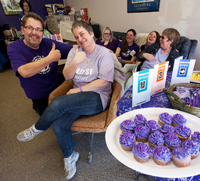
Kerry Jenkins is seen here during Purple Day 2013.

For Jenkins, the journey with epilepsy has been on a road rife with challenges. Her marriage ended because of her condition, which also strained her relationship with one of her two children. She lost her driver’s licence because of her epilepsy, which presented transportation challenges for her, as she was living in Lindsay and having to travel more than 40 kilometres to her job in Peterborough every day.

With the challenges presented by her condition adding up, Jenkins says she saw little hope for the future. Clinical depression set in and became so severe that on two occasions she almost committed suicide.

But things would change for the better.

Now 45, Jenkins began having petit-mal seizures at seven, with up to 100 per day. Because these episodes only lasted two or three seconds and looked like quick pauses, her parents didn’t know they were seizures. It wasn’t until several years later she was examined by a physician for her seizures.

In August 2000, Jenkins had her first tonic-clonic seizure. The seizures progressed to an average of 15 per month. She was diagnosed as having both generalized seizures and temporal-lobe seizures.

In November 2010, she had an electroencephalogram (EEG) to examine her temporal lobe. Thirteen months later, upon recommendation from her neurologist, Dr. Richard Wennberg, Jenkins underwent deep brain stimulation (DBS) surgery. This operation involves implanting a “brain pacemaker” which sends electrical impulses to the brain.

Prior to the DBS surgery Jenkins was on several medications, but she was having allergic reactions and severe side effects — including glaucoma and asthma — to most medications.

The DBS surgery, says Jenkins, was the major game-changer in her life. Since the surgery, the number of seizures Jenkins experiences has declined from 15 to eight per month, with no more generalized seizures.

Jenkins credits Wennberg, neurosurgeon Dr. Taufik Valiante and her current neurologist, Dr. Danielle Andrade, for their tireless compassion and diligence which ensured she received the treatment she needed to change her life.

The fact that her seizure condition was so severe she almost ended her life because of it is the No. 1 reason Jenkins says she wants to share her story with the Voices of Epilepsy.

“Even if I can inspire one person to turn around and not (harm themselves),” she says. “It is not worth it; you can fight if you keep trying and you get the help you need.”

— More to come

Writer: Deron Hamel

If you have feedback on this story, or have a story of your own that you would like to share, please contact the newsroom at 800-294-0051, ext. 23, or e-mail deron(at)axiomnews.ca. You can also leave a comment below.
Epilepsy agency hosting Grand Canyon climb to raise $45,000 to support families

January 6, 2014

Epilepsy agency hosting Grand Canyon climb to raise $45,000 to support families

Epilepsy Durham Region is gearing up to embark on an “epic” fundraiser next year to help support people living with a seizure disorder and their families — and it’s like no fundraiser the agency has ever had.

Alex Shiels is seen here with her seven-year-old son, Cameron. Cameron has been seizure free since having surgery, and his mother says Epilepsy Durham Region played an important role providing supports. The agency is getting ready to host a Grand Canyon climb in October 2014 and funds raised from the event will provide family supports.

The agency recently announced that executive director Dianne McKenzie and partners Mike Finnegan of Pursuit Training and Ray Richardson of Motorcity Mitsubishi will join as many as 12 others in Arizona to climb the Grand Canyon in October 2014 to raise money to support families and to raise epilepsy awareness.

The goal is to raise $45,000, with every penny going to Lora’s Legacy Fund.

The fundraiser, called Epic Climb, will see participants scale 4,500 feet — equivalent to climbing the CN Tower 2 ½ times.

To prepare for the vigorous 12-hour climb, McKenzie and the four other people who have signed on for the event began training in October and will continue training for the next 11 months. She has already completed two 15-kilometre hikes and is working out twice per week.

Adding to the money raised by the climb, Epilepsy Durham Region outreach co-ordinator Jessica Scheffee will be running 21 kilometres Oct. 19 in the Scotiabank Toronto Waterfront Marathon.

McKenzie tells Voices of Epilepsy she’s looking forward to climbing the Grand Canyon.

“I am very excited about the awareness this will raise, and I think there is such great momentum happening in our province and in our country about epilepsy and this just takes us to a new level,” McKenzie says.

McKenzie adds that she’s encouraged by the interest the fundraiser is already gaining, noting when the agency hosted a press conference Dec. 3 to make the announcement one gentleman attending was so excited he signed up on the spot to join the climb.

“What’s most exciting is that he does not have a connection to epilepsy; that’s really inspiring,” McKenzie says.

In the past year, Epilepsy Durham Region has supported 39,000 individuals with epilepsy and their families, and Lora’s Legacy Fund has been a large part of that support. Money raised helps provide supports that are important to families, says Alex Shiels, whose seven-year-old son, Cameron, is living with enhanced quality of life after having brain surgery.

“It’s now time to raise awareness to a new level,” Shiels says. “Our son is now seizure free after having brain surgery, but his journey is far from over. Epilepsy Durham Region has been with us every step of the way.”

For more information or to register for the climb, please contact Epilepsy Durham Region at 905-430-3090, or visit www.epilepsydurham.com.

Writer: Deron Hamel

If you have feedback on this story, or have a story of your own that you would like to share, please contact the newsroom at 800-294-0051, ext. 23, or e-mail deron(at)axiomnews.ca. You can also leave a comment below.

17-year-old’s epilepsy experiences inspire film crew to raise awareness through video

January 6, 2014

The creators of a 3-½-minute YouTube video filmed during Epilepsy Ontario’s screening of a documentary about seizure disorders were so taken by people’s stories about living with epilepsy that they’ve volunteered to take on another project centred on one of the people who spoke at the event.

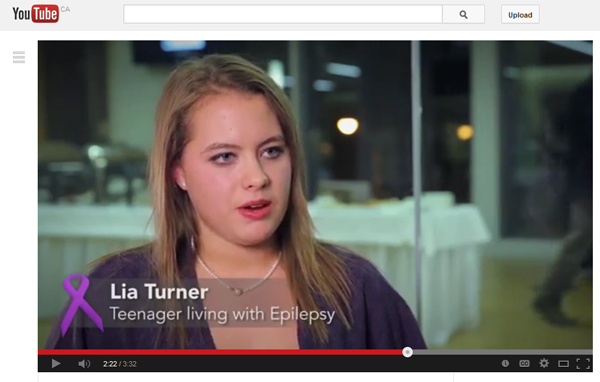
Seventeen-year-old Lia Turner inspired filmmakers to make a short film focused on how she has not allowed epilepsy to control her life.

Editorial director Todd Phillips says he and his crew from Universus Media Group Inc. were touched by 17-year-old Lia Turner’s story about living with a seizure disorder and how she has not let her condition dictate her life.

Lia and her mother Tina were panelists in a discussion that followed the Oct. 23 screening of On the Edge: Living with Epilepsy. During the discussion, Lia explained how she has never allowed her condition to prevent her from her passion — riding horses — or from pursuing her educational aspirations (she’s planning to attend university in Ottawa when she completes high school next year).

“(Lia) is not afraid to share her experiences in a very personal way,” Phillips tells Voices of Epilepsy, adding Lia’s personality was endearing to the filmmakers.

“We found her very courageous and very mature.”

On the Edge was written and directed by Louis Stanislaw, a U.S. filmmaker who has coped with epilepsy his whole life. The film tells the painful truths, misunderstandings and difficulties of living with epilepsy at every turn; from family life to school, to leaving home, and starting a career and forming lasting bonds.

Perhaps most importantly, the film puts faces to the condition, which is meant to inject a better sense of empathy into those listening to the many personal stories unfold.

Phillips says the experience of watching the documentary, listening to the panel discussion, and interviewing those living with epilepsy and experts following the event opened the filmmakers’ eyes to the realities of epilepsy — and gave them ideas about what they could do to help.

“Both myself and the members of my team were really enlightened by what we saw; both in the film and in the panel discussion, and certainly in the interviews we did with the participants after,” Phillips says, adding the prejudice people with epilepsy face was “eye-opening” for the crew.

“What we saw was a lot of people striving to lead ordinary lives and to not be bound by the limitations of what other people may put on them,” Phillips says.

“It was eye-opening to hear just how many people live with the fear that the prejudice and the stigma that’s out there with this particular disease is something that drives them to want to remain silent.”

By making a video focused on Lia and how she lives with a seizure disorder, Phillips says he hopes viewers will have the same experience he and his crew had by hearing her story and that a ripple effect of awareness of epilepsy will transpire.

“Because this is such a personal story, we really want to have people meet Lia and get to know her,” Phillips says. “She really has a very elegant and honest approach to (discussing her condition); she’s very likeable and she’s charismatic and we’re really hoping that that will radiate through.”

The YouTube video includes highlights from the event and interviews with people affected by epilepsy and their families. Click here to watch.

Writer: Deron Hamel

If you have feedback on this story, or have a story of your own that you would like to share, please contact the newsroom at 800-294-0051, ext. 23, or e-mail deron(at)axiomnews.ca. You can also leave a comment below.

Disclosing seizure condition at work crucial for safety, fostering understanding

November 21, 2013

When Marcel Allen began eating less and appeared confused at work in June, a colleague at the Ottawa Police Service knew immediately that something wasn’t right.

Her assumption was correct — Allen would have a major seizure a short time later. But the fact his colleague knew the symptoms people with epilepsy experience prior to a seizure and understood that Allen’s changing behaviour was a precursor to a seizure ensured someone was looking out for him.

Marcel Allen
Marcel Allen

While the seizure didn’t happen right away, Allen’s co-worker was able to provide him supports, for example, encouraging him to eat when she noticed he had gone without food all day.

This, Allen says, is why it’s important for people who have a seizure disorder to disclose their condition to their employer and colleagues. He understands that some employers are not as open-minded about staff members who have seizure disorders as the Ottawa Police Service has been.

However, everyone has the right to employment, and if people with epilepsy are forced to keep quiet about their condition it can risk their safety if co-workers don’t know how to respond, should a seizure occur at work, he says.

Allen says there have been positive aspects to disclosing his seizure condition to his employer.

“You can explain things to your colleagues and those who understand will be there to help you,” he says.

Given that police accompany ambulances to emergency calls, Allen estimates that most of his colleagues have responded to situations where a person is in seizure. As a result of knowing about his condition, Allen says his fellow officers are more cognizant of epilepsy and how to respond to a person who is having a seizure.

Another benefit of Allen disclosing his condition to co-workers is that many officers can now distinguish between responding to a person who is having a seizure and a person with mental-health issues. Sometimes, he notes, people who have just had a seizure will display characteristics similar to those seen in people with mental-health issues, but the two situations need to be handled differently.

Because he’s able to educate his co-workers, many of Allen’s colleagues are more empathetic to people affected by epilepsy.

“There are a lot of officers who have encountered people who have had seizures who are now saying, ‘I didn’t realize that you were going through all this.’ ” he says. “I am seeing a lot more empathy.”

Allen is also working on an epilepsy educational video with the Ottawa Police Service’s Professional Development Centre that will be used for officer training.

Writer: Deron Hamel

If you have feedback on this story, or have a story of your own that you would like to share, please contact the newsroom at 800-294-0051, ext. 23, or e-mail deron(at)axiomnews.ca. You can also leave a comment below.