Author Archives: eCreative Studios

SEAC webinar to address needs of students with epilepsy

January 17, 2014

Epilepsy Ontario is presenting a free information webinar Jan. 23 aimed at developing clear messaging about the kind of educational supports children with epilepsy need.

The webinar will bring together Special Education Advisory Committee EO-SEAC Jan 2014 webinar registration FINAL(SEAC) representatives from across Ontario, including many who will be advocating for the creation of protocols outlining supports that should be made available to students with epilepsy and their families.

There are epilepsy representatives on SEACs throughout Ontario but this is their first opportunity to convene at the same time with other SEAC representatives.

“This is an attempt to bring those SEAC representatives together to discuss their roles as well as how to be an effective SEAC representative, and it’s also the first step towards creating a provincial education agenda for those epilepsy SEAC representatives,” explains Epilepsy Ontario executive director Rozalyn Werner-Arcé.

Every Ontario school board is mandated by the Ministry of Education to have a SEAC. SEACs advise school boards on special education for children with all types of special learning needs, including epilepsy.

Aside from SEAC representatives, the webinar will benefit parents of students with epilepsy and other special needs and anyone else interested in the education system.

The webinar will help participants better understand:

– The role of SEACs and their members
– How SEACs can influence decisions and policy at the local school board level
– How to become a more effective SEAC member, including how to bring forward issues related to students with epilepsy

Lynn Ziraldo, executive director of the Learning Disabilities Association of York Region and respected education advocate, will give webinar participants insight into SEACs and how to bring the epilepsy agenda to the forefront.

Werner-Arcé says the best possible outcome from the webinar would be to continue the conversation about creating a clear picture of what children with special needs and their families should expect from the education system.

“Hopefully, people will find value in coming together and want to continue to meet to start to develop an epilepsy agenda,” she says.

Please e-mail [email protected] to book your registration.

Ziraldo is willing to take questions before the webinar and address them during the session. Please forward your questions to: [email protected].

To join the webinar, go to http://ontariobraininstitute.adobeconnect.com/seac/ to login. You can call in at 416-764-8662/1-888-884-4534, participant code: 7605062#.

Writer: Deron Hamel

If you have feedback on this story, or have a story of your own that you would like to share, please contact the newsroom at 800-294-0051, ext. 23, or e-mail deron(at)axiomnews.ca. You can also leave a comment below.
[Event] Summerfest 2014

January 10, 2014

Nothing says summer like spending a week (or two!) at camp. Fun in the sun away from home is a tempting prospect for any kid, including kids living with epilepsy.

 If your child has epilepsy, we understand your concerns about safety when it comes to registering your child for an unforgettable summer camp experience. With Summerfest however, you can rest assured knowing your child’s safety is a priority at camp!

At Camp Couchiching in Longford Mills (90 minutes outside Toronto), kids aged six to 15 build lasting friendships while participating in all sorts of activities from canoeing to rock climbing. Epilepsy Ontario ensures nurses are on site at all times to ensure your child gets the care they need.

Give your child a summer to remember! Spaces are limited, so sign up for Summerfest today. Sponsorships may be available. Contact us for more information.

Want to participate in the Summerfest Camp?  Spaces are limited, so sign up for Summerfest today. Sponsorships may be available. Contact us for more information. Here are the forms you need to get started!

Film screening inspires James Burnett to share story of living with epilepsy

January 10, 2014

While attending the Canadian premiere screening of On the Edge: Living with Epilepsy in October, James Burnett said he wanted to write a letter to Epilepsy Ontario detailing what life with a seizure disorder has been like for him and to share helpful coping mechanisms.

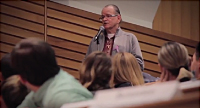
Jim Burnett speaks during the Canadian premiere of On the Edge: Living with Epilepsy on Oct. 23.

Burnett’s decision to share his story was well timed. On the Edge: Living with Epilepsy was written and directed by Louis Stanislaw, a U.S. filmmaker who has coped with epilepsy his whole life. The film tells the painful truths, misunderstandings and difficulties of living with epilepsy at every turn; from family life to school, to leaving home, and starting a career and forming lasting bonds.
 
Perhaps most importantly, the film puts faces to the condition, which is meant to inject a better sense of empathy into those listening to the many personal stories unfold.

Upon seeing the film, Burnett decided to put his face to epilepsy, which he has had for nearly 60 years. He recently made good on his commitment to share his story with its many interesting and inspiring footnotes with Epilepsy Ontario.

While in Grade 9, Burnett began having what he describes as “sensations” in his head. At first, he and his family didn’t put much stock in these “sensations” which didn’t amount to much more than an odd feeling. Later, he discovered he was having seizures without recognizing them as such.

Eventually, Burnett was diagnosed with petit mal seizures, now called absence seizures. A doctor at Toronto’s Mount Sinai Hospital discovered scar tissue on Burnett’s brain that he believed was causing the seizures. Burnett believes the scarring came from hitting his head during a fall as a youngster.

Upon being diagnosed with epilepsy as a young man, Burnett says the first thing he did was tell himself he was not “going to let epilepsy control my life.”

“(I also) knew that there were people who had more serious seizures than I did, so when I felt a sensation coming on I just prayed to God that I could accept it on behalf of someone else who may have a more severe one,” Burnett writes.

He also found a unique way of controlling seizures. Whenever he felt the “sensations” in his head, he would immediately sing Keep Right on to the End of the Road by Sir Harry Lauder. He later changed this to singing When You Walk Through a Storm.

“I believe that singing these songs helped me to keep going, not necessarily every time, but just once or twice is a blessing,” Burnett says.

“I really believe that having seizures, to some extent, is a case of mind over matter. The more occupied mentally I am the less likelihood that my brain would allow time for a seizure to interrupt my train of thought.”

True to his commitment to himself, Burnett has not let epilepsy dominate his life. He married, held jobs and sings in his church choir.

Reflecting on living with epilepsy, Burnett recalls hearing a suggestion recently that the condition needs a name change to something “more acceptable.” Pondering this notion, he offers a final thought.

“Well, sugar is sweet until you put diabetes after it,” he says. “In short, you can change the name but not the illness.”

Writer: Deron Hamel
 
If you have feedback on this story, or have a story of your own that you would like to share, please contact the newsroom at 800-294-0051, ext. 23, or e-mail deron(at)axiomnews.ca. You can also leave a comment below.

Surgery has provided Kerry Jenkins with new lease on life

January 8, 2014

Peterborough resident Kerry Jenkins says the deep brain stimulation (DBS) surgery she had in December 2012 has offered her a new lease on life. While the surgery reduced the number of seizures she was having by nearly half, what has helped her in her journey has been the support of her husband and in-laws and the time she’s spent helping others.

Before her surgery, Kerry, 45, had coped with tonic-clonic seizures since August 2000. She says the condition had a devastating effect on her physical and mental health as well as her personal life.

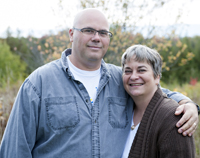
 Kerry Jenkins is seen here with her husband, James, who has been a pillar of support.
Kerry Jenkins is seen here with her husband, James, who has been a pillar of support.

For Kerry, like so many others with epilepsy, life has been a road with many obstacles. Her marriage ended because of her condition, which also strained her relationship with one of her children. She lost her driver’s licence because of her epilepsy, which presented transportation challenges for her, as she was living in Lindsay at the time and had to travel more than 40 kilometres to her job in Peterborough every day.

With the challenges presented by her condition adding up, Kerry says she saw little hope for the future. Clinical depression set in and became so severe that on two occasions she almost committed suicide.

After several trials and surgeries, Kerry’s tonic-clonic seizures stopped and she had approximately eight temporal lobe seizures per month. Of these, there were four different types of seizures. The DBS surgery has stopped two of the four types of seizures completely and reduced the number of seizures to approximately three per month.

Following her surgery, Kerry wanted to do something to make a difference in her community. She began volunteering with the Special Olympics in Lindsay. Her volunteer work opened her eyes to the fact many people are accepting of her condition.

This came to light during a Special Olympics bowling tournament where she was volunteering. Kerry had a seizure during the event. Afterwards, she called the event organizer, offering to stop volunteering out of concern that her seizure upset the event’s athletes and attendees.

“(The organizer) said to me, ‘Are you kidding? You’re coming back — I’ve had calls from athletes and their families to find out if you’re OK.’ They picked me up that next Friday night and every one of those athletes lined up and hugged me,” Kerry recalls.

Another important part of Kerry’s new life has been the support she has received from her second husband, James, whom she wed five years ago. Kerry says James and everyone in his family understands her condition and is accepting; in fact, her husband’s former wife had epilepsy.

When the two began dating, Kerry was living with her mother because her condition made living alone dangerous. As a show of support, James moved in with Kerry and her mother to help the couple adapt to living together.

Looking back on how her life has transformed thanks to her surgery and her supportive family, Kerry says she has an important message for others living with a seizure disorder.

“No matter how bad it gets, it can always get better, you just have to keep going,” she says. “Even though you have to go through a lot . . . things do get better — you just have to keep trying.”

Writer: Deron Hamel

If you have feedback on this story, or have a story of your own that you would like to share, please contact the newsroom at 800-294-0051, ext. 23, or e-mail deron(at)axiomnews.ca. You can also leave a comment below.