Author Archives: DHamel

Living with epilepsy has inspired Sierra Spence to make a career of helping others

December 9, 2019

By Deron Hamel

Volunteering and giving back to her community has always been important to Sierra Spence, so it’s no surprise she plans to pursue a career helping others once she completes her studies.
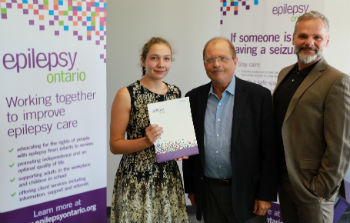
Sierra Spence, one of the six recipients of this year’s Osler Epilepsy Scholarship, is seen here holding her award alongside OBCL president Lawton Osler and Epilepsy Ontario executive director Paul Raymond.

Sierra lived with seizures from the time she was 10 months old until December 2016, when she underwent brain surgery which partially removed a rare ganglioglioma tumour.

Since her surgery, Sierra has not had any seizures, but it was her experience of living with epilepsy that inspired her to want to help others, she says.

“My life journey with epilepsy has motivated me to always focus on moving forward and helping others to overcome their challenges,” Sierra says.

To give back to her community, Sierra has volunteered with senior citizens, children with special needs and children with disabilities. Sierra has also volunteered at the Niagara Children’s Centre and with the Brock Niagara Penguins, a swimming and gym program for youths and adults with disabilities.

Sierra has also been active in raising epilepsy awareness and has volunteered at Epilepsy Niagara for several years. She has mentored children living with epilepsy and has participated in fundraising events. In high school, Sierra organized epilepsy awareness events and even shared information about first aid for people with seizure disorders.

“These opportunities to work with, learn from and support members of our community have made me realize how strongly each of us can positively impact the lives of others,” she says.

Sierra is currently enrolled in an educational program to provide supports to children with special needs. Eventually, her goal is to work with children who have special needs, she says.

“My experiences living with epilepsy and working with others have motivated me to continue to be actively involved, show initiative and to see the value in taking a leadership role to influence change and make the world a better place for everyone to live in,” she says.

Sierra is one of the recipients of this year’s Osler Epilepsy Scholarship. The $1,500 scholarship, formerly called the OBCL Epilepsy Scholarship, is being offered to six students this year.

Osler Epilepsy Scholarships are awarded each year to exceptional students who have confronted and overcome remarkable barriers in their academic and personal lives due to their epilepsy.

As part of this year’s application process, students submitted a 600- to 900-word essay focused on how they could see themselves helping an epilepsy association or another charitable organization in the future, based on their personal experiences.
Epilepsy should not stop you from doing what you want: student

November 8, 2019

By Deron Hamel

Megan Sherwin was diagnosed with epilepsy at age 9. She’s also living with cerebral palsy. But living with these conditions does not control her life. In fact, Megan says she finds herself inspired to show others that she can do anything she wants.

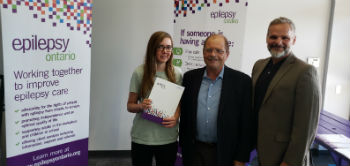
Megan Sherwin, one of the six recipients of this year’s Osler Epilepsy Scholarship, is seen here holding her award alongside OBCL president Lawton Osler and Epilepsy Ontario executive director Paul Raymond.

“I have faced many challenges growing up, but that did not stop me from giving up at all,” Megan says.

“The biggest obstacle I think I have had to face is adversity. I’ve always had to show people that even though I have a disability and seizures, I can do anything I set my mind to.”

Megan describes herself as someone who likes to lead by example. At school, she played soccer and basketball. She also took piano lessons and has worked as a summer camp counsellor, a swimming instructor and lifeguard. She has played hockey and is an accomplished para-swimmer who has competed at a national level.

“Although all these achievements may not seem like obstacles, getting to them was,” she says.

“People doubted me when I tried out for teams or started a new activity. They would take a look and say, ‘Why is she here? She won’t be any good.’

“So, I had to push past all the negativity and try out for the things that I wanted to, whether I was any good at them or not. … I believe that because I’ve done all these things, it’s made me the person I am today and the person I want to be in the future.”

Looking ahead, Megan says whichever career path she decides on, she wants to be able to help others and make a difference in people’s lives.

She especially hopes to inspire children living with epilepsy and help them understand that they can accomplish their goals, Megan says.

“My vision is that one day people will forget that they even (have) epilepsy because they are living their best life to the fullest,” she says.

Megan is now in her second year of study in the recreation and sport business program at the University of Waterloo. She is also one of the recipients of this year’s Osler Epilepsy Scholarship. The $1,500 scholarship, formerly called the OBCL Epilepsy Scholarship, is being offered to six students this year.

Osler Epilepsy Scholarships are awarded each year to exceptional students who have confronted and overcome remarkable barriers in their academic and personal lives due to their epilepsy.

As part of this year’s application process, students submitted a 600- to 900-word essay focused on how they could see themselves helping an epilepsy association or another charitable organization in the future, based on their personal experiences.
Student hopes to raise epilepsy awareness through film

October 15, 2019

By Deron Hamel

Alexandra Law says she hopes to one day use the power of film to help people understand what living with epilepsy is like.

Alexandra, who is currently a student in the media fundamentals program at Sheridan College, says that her goal is to become a fiction writer and she also plans to use her writing talents to create a screenplay about living with epilepsy.

“I would like to shed light on a condition that is very misunderstood,” she says. “Many people fear (epilepsy) and think it’s a one-size-fits-all thing or that it’s untreatable.”

Now 19, Alexandra was diagnosed with infantile spasms when she was seven months old. Alexandra says she has multiple seizures every day.

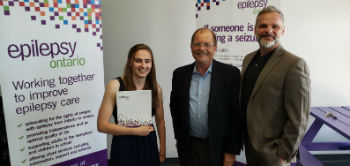
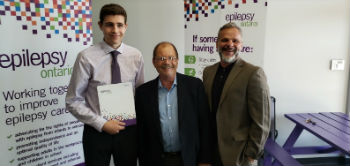
Alexandra Law, one of the six recipients of this year’s Osler Epilepsy Scholarship, is seen here holding her award alongside OBCL president Lawton Osler and Epilepsy Ontario executive director Paul Raymond.

Living with epilepsy has given Alexandra experiences many others will never know, she says. Living with epilepsy also means Alexandra has not experienced things other people have, she adds.

But one thing Alexandra says she wants people to understand is that having epilepsy is not what defines her. She says she hopes that a film about life with epilepsy would raise awareness of how having a seizure disorder does not have to dominate a person’s life.

“It is simply a part of who I am,” she says. “I want to share my story and the stories of others living with epilepsy through film and get the message out there that people live very full lives with epilepsy.”

Alexandra says what drives her to want to make a film about people’s experiences with epilepsy is the care she has received from doctors, who have tried to understand her epilepsy and control her seizures, as well as the family support she has always had.

“This is an important story to be told,” she says, “and I want to be a part of it.”

Alexandra is one of the recipients of this year’s Osler Epilepsy Scholarship. The $1,500 scholarship, formerly called the OBCL Epilepsy Scholarship, is being offered to six students this year.

Osler Epilepsy Scholarships are awarded each year to exceptional students who have confronted and overcome remarkable barriers in their academic and personal lives due to their epilepsy.

As part of this year’s application process, students submitted a 600- to 900-word essay focused on how they could see themselves helping an epilepsy association or another charitable organization in the future, based on their personal experiences.

From experiences with epilepsy, student sees opportunity for mobile app to help others

September 23, 2019

By Deron Hamel

An old proverb states that necessity is the mother of invention.

Logan Place wants to someday develop a mobile application to track issues related to epilepsy to help doctors better manage the condition for patients – something he says would have been helpful to his doctors and family when he was being treated for seizures.

Logan Place, one of the six recipients of this year’s Osler Epilepsy Scholarship, is seen here holding his award alongside OBCL president Lawton Osler and Epilepsy Ontario executive director Paul Raymond.

Logan, who is entering his first year as a student in the computer science program at Sheridan College, is driven by his own experiences living with epilepsy.

Diagnosed with epilepsy at age 6, Logan can attest to the trial and error that comes with trying to control a seizure disorder. After his diagnosis, Logan went through many tests to determine the cause of his seizures, and he was put on several medications to help manage his epilepsy.

But this process may have been easier for Logan, his parents and doctors if there had been a way for his family to better track daily occurrences related to his epilepsy, Logan says.

“When I look back on the years of trial and error through various medications and the difficulties keeping accurate records of what happened and when, it occurred to me that being able to record exactly what was happening and how I was feeling on a regular basis would be helpful for my family and the doctors,” Logan says.

Logan has been seizure-free for nearly three years. When Logan was 14, doctors discovered that the cause of his seizures was a brain lesion. After more than a year of further testing, doctors at SickKids in Toronto performed a successful operation on Logan to correct the issue.

But leading up to this was several years of his father tracking information related to Logan’s epilepsy by making notes that were supplied to doctors.

The app Logan hopes to develop would electronically track information, such as medications and their dosages, number of seizures, pain levels, and alertness and fatigue, and make it readily available for doctors to access.

“In my case, these recorded details would have made it much easier for the doctors to get complete and accurate information in a timely manner, rather than relying on my father’s scribbled notes at our next appointment that may be months away,” Logan says.

Logan is one of the recipients of this year’s Osler Epilepsy Scholarship. The $1,500 scholarship, formerly called the OBCL Epilepsy Scholarship, is being offered to six students this year.

Osler Epilepsy Scholarships are awarded each year to exceptional students who have confronted and overcome remarkable barriers in their academic and personal lives due to their epilepsy.

As part of this year’s application process, students submitted a 600- to 900-word essay focused on how they could see themselves helping an epilepsy association or another charitable organization in the future, based on their personal experiences.