
Author Archives: DHamel

Don’t let epilepsy stand in the way of your goals, says scholarship recipient

May 24, 2023

By Deron Hamel

Alexa Graham has never been one to let epilepsy stand in the way of her dreams.

Alexa Graham, pictured above, is one of four students to receive an Epilepsy Ontario scholarship this year.

The recent high-school graduate from Timmins, Ont. was diagnosed with the condition as a young child. From that time, Alexa says she and her family were told she would never be able to “lead a normal life” because of epilepsy.

But Alexa has not only led a normal life, she has thrived. This is due to what she says is her greatest strength: her ambition.

“My biggest strength is that I don’t let anyone or anything get in the way of achieving my goals in life,” Alexa says, adding she has “always fought very hard” to make sure epilepsy doesn’t control her life.

“When the doctors said I would never ride a bike, I did. When they said it was unlikely for me to ever be able to read, I did. Same thing was said about skiing and driving, and here I am, doing all of these things despite the odds not being in my favour.”

Alexa is one of four recipients of Epilepsy Ontario’s annual scholarship. Now that she has completed high school, Alexa will be attending college to train to become a physiotherapy and occupational therapy assistant.

For more than 15 years, Epilepsy Ontario has been providing scholarships to exceptional students who have confronted and overcome remarkable barriers in their academic and personal lives due to their epilepsy.

Asked how she would like to impact the epilepsy community, Alexa says she would like to help others “embrace their condition, rather than live in fear of it,” as she has done.

“Epilepsy is only a single aspect of a person; it does not define who they are, nor should anybody have to live in fear or with limitations of the condition,” she says.

As she looks towards her future, Alexa says she will continue to set her sights on her goals and achieve them.

“Because another one of my strengths is that I never give up, no matter what obstacles present themselves,” she says.

UPLIFT program improving quality of life for people with epilepsy struggling with depression or anxiety

January 6, 2022

By Deron Hamel

People living with epilepsy often find themselves battling stress, anxiety and depression related to their condition, and these mental health issues can be exacerbated when they live in a region that does not offer adequate resources to help them.

But thanks to a new cognitive behavioural therapy program offered by Epilepsy Ontario, people with epilepsy who are also dealing with depression or anxiety related to their seizure disorder can now meet virtually to get the help and support they need.

Epilepsy Ontario began offering a free support program called UPLIFT – an acronym for “using practice and learning to increase favourable thoughts” – in June as a way to help people living with epilepsy address mental health issues they face and meet others who share similar experiences.

The organization began running UPLIFT to address the needs of people with epilepsy living in areas that do not have a local epilepsy agency, especially in parts of northern Ontario, says Holly O’Neill, Epilepsy Ontario’s UPLIFT provincial program co-ordinator.

O’Neill says the program has garnered lots of interest and took off immediately. While UPLIFT helps people deal with anxiety and depression related to epilepsy, the opportunity to meet others living with epilepsy has been the program’s main attraction, O’Neill says.

“People really wanted to be able to meet other people living with epilepsy, I think that’s the main thing that draws them into it,” she says.

“(UPLIFT helps) people to connect with each other and (allows them) to hear the experiences of other people who have epilepsy, because a lot of people who have epilepsy don’t know other people who have epilepsy, so that’s one of the main things people get out of it.”

Through UPLIFT, participants learn coping strategies to help deal with mental health issues that are often associated with epilepsy. Participants meet through teleconferencing each week. A new coping skill is worked on each time the group meets and participants practise that skill. They return to share their experiences with the group.

“It’s meant to build a group atmosphere of support and helps people (understand) that they are not alone with the stresses that they have,” O’Neill says.

“People love that they are able to connect with others, and they like being able to know that they’re not alone in this situation and that other people have epilepsy, and these situations are common with people who have epilepsy.”

There has also been a lot of positive feedback from those participating in UPLIFT.

“Taking part in the UPLIFT program through Epilepsy Ontario was a fantastic experience,” says one participant.

“UPLIFT provided me with highly useful tools to better deal with the anxiety and doubt which revolves around living with epilepsy. The program administrators and facilitators were kind, supportive and knowledgeable of the program content but also of epilepsy and resources in general.”

Another participant applauds the program for the skills they have learned.

“I’m happy to be able to say I am in a much better place with the tools I have gained from this program,” says participant No. 2.

“If I am having a hard day (or) my seizures aren’t behaving themselves, I am able to fall back on the exercises learned through UPLIFT that work for me which allow me to carry on with my day in a positive state of mind.”

Click here to learn more about UPLIFT.

E-letter campaign encouraging province to fund epilepsy supports that also ease burden on health system

June 25, 2021

By Deron Hamel

Epilepsy Ontario is calling on the Ministry of Health to increase core funding to epilepsy agencies across the province to enhance education and supports to help people living with seizure disorders manage their condition while saving the province money by reducing hospital visits.

The organization is launching an e-letter campaign and asking people living with epilepsy and their families to sign their names to show support for the initiative.

Educational programs provided by epilepsy support agencies are not funded by the government. A large focus of these programs is to help people recently diagnosed with epilepsy and their families manage the condition.

For example, one of the things people learn through these programs is when to go to hospital and when not to following a seizure.

Educational sessions provided by Epilepsy Ontario train people who have been recently diagnosed with epilepsy and their families to learn when it’s necessary to call 9-1-1 and when it’s not.

When people have this knowledge, visits to emergency rooms decline, notes Drew Woodley, Epilepsy Ontario’s director of government relations.

“Those kinds of improvements to the health-care system can more than pay for the cost of funding these programs,” he tells Voices of Epilepsy.

“Since some areas of Ontario don’t have local epilepsy support agencies, this funding would (also) allow us to increase the overall level of service across the province, if the Ministry of Heath were to finance it.”

As we slowly begin to come out of the COVID-19 pandemic, the health-care system is backed up by more than a year due to many procedures being delayed for the past 15 months.

As a result, the timing is right for the province to fund an initiative to reduce hospital visits, Woodley says.

“Anything the Ministry of Health can do to relieve pressure on hospitals is going to be that much more beneficial to the overall health-care system,” he says.

“Epilepsy educational programs can be a part of that approach. You are relieving pressure on hospitals and you’re providing people with epilepsy with the tools they need to better manage living with seizures.”

Click here to sign your name to the e-letter.

Boxer wants children with epilepsy to know they can turn negative experiences into positive ones

November 3, 2020

By Deron Hamel

Turning negative experiences into positive action has been an important theme in Jeff Tabrizi’s life.

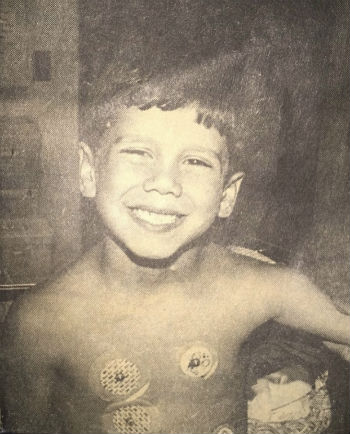
Pictured above, a young Jeff Tabrizi smiling for the camera.

The 29-year-old boxer from Burlington has had his share of battles – inside and outside of the ring. But looking back, Tabrizi says those battles made him stronger and helped shape him into who he is today.

At age four, he began having seizures. At one point, he was having nearly 20 seizures a day. It was later discovered he had a benign brain tumour.

While the tumour was successfully removed, Tabrizi says other children bullied him and singled him out as “the weird one and not like everyone else” because of the conditions he lived with.

“I would get made fun of a lot and that’s what I believe made me really tough, even up until today,” he says. “All that hardship I had to go through then, it just gave me a lot of strength now, and it has made me strong mentally and physically.”

And there’s a lesson children living with a seizure disorder can learn from him, Tabrizi says, and that’s to not let personal hardships get the better of you.

In fact, people can use those challenges to their advantage, he says.

Because of the bullying he endured at school, Tabrizi says he often found himself having to defend himself with his fists. It was something he proved to be good at, so he decided to channel his fighting abilities into something constructive.

Boxing was a natural fit, and he figured this out at a young age.

“At 7, 8, 9 years old, I was already having the mindset that I wanted to become a fighter, I wanted to become a boxer,” he says. “When I was asked what I wanted to be when I grew up, it was always to be a boxer and to inspire (others) and tell my story.”

Tabrizi also credits Steve Nelson, a North Hollywood, California-based gym owner, who passed away earlier this year, for helping him with his boxing career.

Nelson learned about Tabrizi after watching one of his boxing matches on YouTube in 2015 and flew him to California to help him train and advance his career.

“He saw the positive side of my story and he was touched by it,” Tabrizi says. “He was able to see a side of my life that I never really believed in.”

Tabrizi says he’s hoping children living with epilepsy will hear his story and be able to find their own strengths.

“My advice to them would be to stay strong, stay positive through the hard times, no matter what, and (they should know) there’s a bigger picture,” he says.

“They’ll be able to get through things, just keep your head up (because) there’s a bigger picture than the suffering.”