
Author Archives: DHamel

Epilepsy Awareness Month sparking a social-media frenzy

March 21, 2019

By Deron Hamel

Businesses and municipalities across Ontario are getting involved with Epilepsy Awareness Month, and Trevor Gordon is promoting their activities, encouraging dialogue about epilepsy and prompting people to help spread the word about a condition that affects one in every 100 Canadians.

Trevor, Epilepsy Ontario’s manager of social media platforms, says he’s seeing lots of involvement with this year’s awareness campaign. There are galas dedicated to epilepsy awareness. Schools and businesses are being decorated with purple, the official colour of Epilepsy Awareness Month.

Several Ontario landmarks have been lit purple in honour of Epilepsy Awareness Month in March. Clockwise from top, the Toronto sign at Nathan Phillips Square, the CN Tower and Niagara Falls.

Ontario landmarks, including Toronto’s CN Tower, the Toronto sign at Nathan Phillips Square, Niagara Falls and the Port Credit Lighthouse are all being lit up in purple, and this is attracting lots of attention on social media, Trevor says, adding some photos of these landmarks are getting as many as three million views, thousands of shares and hundreds of comments.

“The engagement on our social media right now has never been higher,” he says. “It’s so amazing to see. It’s so amazing that it’s getting people asking why are (there) not more things lit up (and) how do we get (landmarks) lit up.

“So we are encouraging them to contact the specific landmark, and if they need our help, we can assist.”

Supermarket chain Zehrs has been involved in Epilepsy Awareness month since 2012. Zehrs’ 42 stores are selling purple T-shirts embossed with the hashtag #ZehrsPurpleDay as well as asking for donations at cash registers to raise epilepsy awareness and to help support local epilepsy agencies.

Trevor says this campaign is also creating exciting conversations on social media.

“It’s just amazing to see the amount of people saying they bought the T-shirt and watching others tagging friends saying, ‘oh, when you’re by the store can you buy me four shirts?’ ” Trevor says.

“By them tagging the store where they bought it, they are promoting the bigger message and it just keeps going on and on. … Customers are even going into stores and showing the social media messages to Zehrs.”

Trevor notes that the energy behind the Epilepsy Awareness Month campaign is an example of positive outcomes that social media can produce.

“I am seeing such teamwork, and photos and messages are going viral – the amount of traffic our social media is getting right now is phenomenal.”

Epilepsy Awareness Month activities lead up to Purple Day on March 26. Purple Day was launched in 2008 by Cassidy Megan, a then-nine-year-old Nova Scotia girl who was diagnosed with epilepsy when she was seven. Cassidy had one goal for Purple Day: for people to come together globally to learn about epilepsy to reduce its stigma.

On March 26, epilepsy support agencies and people accessing their services will be attending the annual Purple Day at Queen’s Park event to speak with MPPs to raise awareness and discuss challenges.


Epilepsy Ontario proposes epilepsy educational programs to stem unnecessary ER visits after seizures

February 11, 2019

By Deron Hamel

Epilepsy Ontario has submitted a four-year proposal to the province’s health and finance ministers to include funding in the 2019-20 budget for education programs largely focused on helping people understand when a seizure is a medical emergency and when it’s not in an effort to stem hospital visits, reduce costs to the health-care system and help people better manage their epilepsy.

Epilepsy Ontario director of government relations Drew Woodley.

However, people living with epilepsy need to get behind this proposal, says Drew Woodley, director of government relations for Epilepsy Ontario.

Epilepsy Ontario is asking people connected to the province’s epilepsy community to sign an e-mail that will be sent to Health and Long-Term Care Minister Christine Elliott and Finance Minister Vic Fedeli showing support for the proposal.

These basic epilepsy educational programs, which would be provided through Ontario’s community epilepsy agencies, are aimed at people who have a seizure disorder, their families, schoolmates and co-workers, to help them understand when to call an ambulance and when not to if someone is having a seizure. In areas of the province without an epilepsy agency, Epilepsy Ontario would work to provide staff to those communities.

Managing epilepsy, the importance of taking medication and dealing with triggers that may cause seizures would also be discussed.

The provincial government has committed itself to reduce health-care costs and addressing hallway medicine, and Woodley says Epilepsy Ontario’s proposal would save the health system millions of dollars.

“By the end of the fourth year of funding, we are projecting savings in the $3-million range and those savings would continue after the fourth year of funding,” Woodley says.

Part of the proposal includes projections of how many people with epilepsy would avoid unnecessary emergency-room visits once they and their peers have an understanding of when it is appropriate to be sent to hospital following a seizure.

“There are thousands of visits per year to hospitals that aren’t going to happen (if people have this education), which creates space in the hospitals and reduces the number of unnecessary patients,” Woodley says.

“We have data from the Ministry of Health and Long-Term Care that shows a huge number of people (with epilepsy) go to emergency rooms and are sent home without any medical intervention – this is typical when someone has a seizure, someone around them has been scared and didn’t know what to do, so they call an ambulance.”

Click here to read the proposal.

Click here to send an e-mail showing your support for the proposal.

‘Nothing is impossible.’ Singer’s quote resonates with student living with epilepsy

December 5, 2018

By Deron Hamel

Sarah McKenzie-Kerr has one career goal: to work with children. It’s a goal she’s now pursuing, thanks in part to inspiration from a famous singer who, like Sarah, is living with epilepsy.

Susan Boyle, the Scottish singer who gained worldwide notoriety after performing I Dreamed a Dream from Les Miserables on Britain’s Got Talent in 2009, provided Sarah with a quote that has resonated with her.
“(N)othing is impossible. It can be downright difficult, but not impossible,” Boyle once told Britain’s Daily Mirror.

Sarah says that this remark from Boyle made her realize that living with epilepsy does not mean a person cannot achieve their ambitions. Above all else, Sarah says she “loves” helping others. A career working with children, she adds, “is something that over the years I’ve fallen in love with.”

Sarah is now mapping out a career and has taken the first steps to attaining her goal. She is studying child and family studies at Nipissing University and is looking forward to everything the future has to offer.

Sarah notes that Boyle has used her fame to help children living with neurological disabilities, and she has encouraged others living with epilepsy to speak publicly about their condition, which is also inspiring for the student.

“Susan’s fearlessness has helped me be more open and talk about my story,” Sarah says. “She became an amazing famous singer, and I will be the best child worker.

“Nothing is impossible.”

Sarah is one of the recipients of this year’s Osler Epilepsy Scholarship. The $1,500 scholarship, formerly called the OBCL Epilepsy Scholarship, is being offered to five students this year.

Osler Epilepsy Scholarships are awarded each year to exceptional students who have confronted and overcome remarkable barriers in their academic and personal lives due to their epilepsy.

Applicants also submit a 600- to 900-word essay, about a famous person who has epilepsy and what that person’s life means to them.

Student’s message to others: epilepsy does not define who you are

November 15, 2018

By Deron Hamel

If you are living with epilepsy, the condition should not define the person you are, says Olivia Tomchick. To persevere in life, you need to kick your fears to the curb and pursue your dreams, says the 19-year-old.

With this idea in mind, Olivia keeps pursuing her interests and doing the things she enjoys. She cites former U.S. Olympic hockey team goalie Chanda Gunn as an inspiration. Like Olivia, Gunn is living with epilepsy.

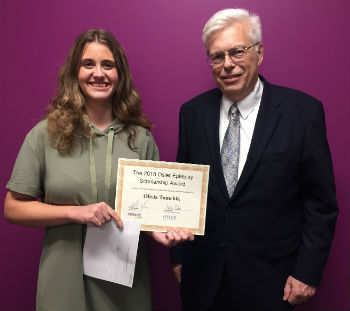
Olivia Tomchick is pictured here holding the certificate for her Osler Epilepsy Scholarship with Epilepsy Ontario committee member Jim Cheeseman.

Olivia, who hails from St. Thomas, Ont., was diagnosed with epilepsy in 2011, when she was 12. Since her diagnosis, life has been challenging at times, she says. Her condition has impacted the social, active and academic aspects of her life, she says.

An avid soccer player, Olivia recalls how her coaches, aware of her condition, would often cut down her playing time over concern for her well-being. They would constantly ask her if she “was OK.” All Olivia needed, she says, was a little reassurance.

“I understand they were worried about me, and they want me to be safe, but it was extremely annoying to constantly be asked if I was OK,” she says. “In a sense, it kind of discouraged me to play, since all they would ever do is doubt me and my ability to know my own body.”

While reading about Gunn’s career in sports, Olivia discovered that the goalie worked with the same type of over-protective coaches she had.

“It was easier to cope knowing that the same scenario that I was going through was also a struggle for an Olympic athlete,” she says.

As Olivia pursues her post-secondary education, the lessons she has learned on her own and through the example of others will continue to guide her in life, she says.

“(J)ust because you suffer epilepsy doesn’t mean that you should let that stop you from trying to pursue something you’re passionate about or let anything stand in the way of the happiness you truly deserve,” she says.

Olivia is one of the recipients of this year’s Osler Epilepsy Scholarship. The $1,500 scholarship, formerly called the OBCL Epilepsy Scholarship, is being offered to five students this year.

Osler Epilepsy Scholarships are awarded each year to exceptional students who have confronted and overcome remarkable barriers in their academic and personal lives due to their epilepsy.

Applicants also submit a 600- to 900-word essay, about a famous person who has epilepsy and what that person’s life means to them.