
Author Archives: DHamel

Student says a career as a paramedic will help her educate others about epilepsy

October 18, 2018

By Deron Hamel

Rebekah Pregent has a knack for helping others and educating people about epilepsy whenever possible. It’s fitting that she’s studying to become a paramedic, a career that will enable her to put her passions to work.
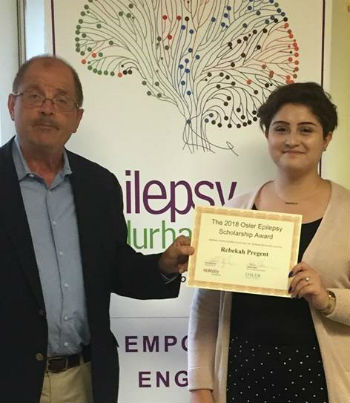
Rebekah Pregent is pictured here holding the certificate for her Osler Epilepsy Scholarship. She is standing alongside Lawton Osler of Osler Business Consulting Ltd., the company that sponsors the scholarship.

When applying for an Osler Epilepsy Scholarship this year, Rebekah was asked to write about a person who has inspired her and who, like herself, is living with epilepsy. She chose Susan Boyle, the Scottish singer who shot to fame after singing I Dreamed a Dream from Les Miserables on Britain’s Got Talent in 2009.

“The reason that Boyle has inspired me is because she never let epilepsy stand in the way of her dreams,” Rebekah says. “Regardless of the fact that she was bullied for being different, she did not let others tear her down and stop her from achieving her goals.”

Rebekah was diagnosed with epilepsy three years ago. Since her diagnosis, she has advocated for herself and made it a mission to educate others about what epilepsy is and how it affects people living with the condition. She has blogged about living with epilepsy and even worked last summer at Epilepsy Durham Region.

Rebekah notes that Boyle has also publicly shared her story about living with epilepsy which, she says, helps others living with the condition “feel less alone.”

“I believe that Boyle’s story is closely related to mine,” Rebekah says. “Although I was never bullied, I took every chance that I could to educate others about epilepsy. This was particularly the case when I was newly diagnosed.”

Having a career as a paramedic will provide Rebekah with a chance to further educate others about epilepsy, she says.

“As a paramedic, I will continue to help those living with epilepsy and seizure disorders while helping many others through their daily lives,” Rebekah says.

Rebekah is one of the recipients of this year’s Osler Epilepsy Scholarship. The $1,500 scholarship, formerly called the OBCL Epilepsy Scholarship, is being offered to five students this year.

Osler Epilepsy Scholarships are awarded each year to exceptional students who have confronted and overcome remarkable barriers in their academic and personal lives due to their epilepsy.

Applicants also submit a 600- to 900-word essay, about a famous person who has epilepsy and what that person’s life means to them.
Student with epilepsy says Lord of the Rings actor inspired him to maximize potential

September 20, 2018

By Deron Hamel

Eric Jose’s dream has been to enter the business world, and he has taken his first step towards achieving this as a student at the Smith School of Business at Queen’s University in Kingston. He also started experiencing absence seizures – which are seizures characterized by brief lapses in consciousness – at 13 and his condition has presented challenges, he says.

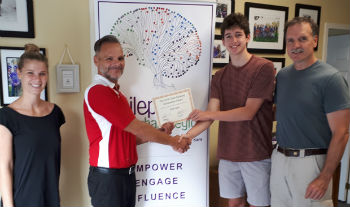
Eric Jose (middle-right) is pictured here receiving his Osler Epilepsy Scholarship award from Epilepsy Ontario executive director Paul Raymond.

Still, Eric has persevered, and he draws parallels between his life journey with epilepsy and that of renowned actor Hugo Weaving, who has appeared in such films as The Lord of the Rings, The Hobbit and The Matrix. Like Eric, Weaving has lived with epilepsy since he was 13.

Eric says Weaving’s “ability to thrive” while living with epilepsy has been an inspiration to him as he copes with the condition. He says that although he knew of Weaving when he first began experiencing seizures, he didn’t feel any connection with the actor until age 15 when he was at what he describes as “a low point” in his life.

“Despite (Weaving’s) many roadblocks and hindrances that stood in his way … or the constant side effects of his medication, he has been able to accomplish so much and gain international renown for his performances,” Eric says.

Like Weaving, Eric says he has struggled with the side effects of his medication. Another parallel between the student and the actor is that neither can drive a car due to their condition, Eric notes.

But there are other ties that bind Eric and Weaving that have nothing to do with the condition they have. Eric notes that they’re both outdoor enthusiasts, they both enjoy watching sports and they share a passion for travelling.

“After being inspired by Mr. Weaving’s own experience, I began to change my life around, coming to the realization that my epilepsy is not something to be feared,” he says. “Everyone I know is now aware of my condition, and the people I surround myself with are accommodating and supportive. …

“Hugo Weaving has had a transformative and impactful experience on me as a role model and personal guide for conducting life to the fullest despite the restraints of epilepsy.”

Eric is one of the recipients of this year’s Osler Epilepsy Scholarship. The $1,500 scholarship, formerly called the OBCL Epilepsy Scholarship, is being offered to five students this year.

Osler Epilepsy Scholarships are awarded each year to exceptional students who have confronted and overcome remarkable barriers in their academic and personal lives due to their epilepsy.

Applicants also submit a 600- to 900-word essay, about a famous person who has epilepsy and what that person’s life means to them.

Ottawa student won’t let epilepsy interfere with her dreams, says former U.S. president has inspired her

August 28, 2018

By Deron Hamel

Bronwyn Clifton is gearing up to start classes in the concurrent education program at Queen’s University in September, an accomplishment she didn’t think was possible nine months ago after suffering her first tonic-clonic seizure. But Bronwyn has lived with epilepsy for 12 years and has always persevered, sometimes looking to others for inspiration, she says.

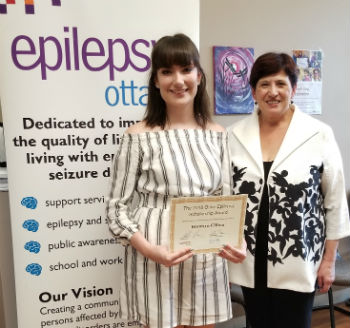
Bronwyn Clifton, one of five recipients of this year’s Osler Epilepsy Scholarship, is seen here holding her award alongside Elisa McFarlane, an Epilepsy Ontario volunteer and member of the Osler Epilepsy Scholarship selection committee.

Bronwyn was diagnosed with absence seizure epilepsy in autumn 2006, shortly after starting Grade 1. Her mother had noticed Bronwyn was having seizures and took her to the Children’s Hospital of Eastern Ontario, where it was discovered she was having absence seizures. Absence seizures are characterized by brief lapses in consciousness.

At such a young age, Bronwyn says she didn’t understand how her condition would affect her life. Growing up, she says she found herself limited to the activities she could participate in with friends. Swimming in the deep end of pools or bicycling without supervision were out of the question, she says.

“I felt different, weird, excluded,” she recalls. “I felt like I was missing out on the happiness and fun my friends were experiencing.”

This is where Bronwyn says she can relate to what life must have been like for Theodore Roosevelt, who served as the 26th U.S. president. Roosevelt also had epilepsy. He went through childhood during the 1860s and 1870s, a time when people were “condemned by society” if they had a seizure disorder, Bronwyn says.

The tie that binds, Bronwyn says, is that she and Roosevelt “lived (their) lives trying not to acknowledge a barrier which we experienced daily.”

Roosevelt, she notes, had many accomplishments before becoming U.S. president. He was a graduate of Harvard University and Columbia Law School. He was also a noted conservationist.

In November 2017, Bronwyn suffered her first tonic-clonic seizure. After this seizure, Bronwyn was concerned about her future. She had wanted to go to Queen’s for many years and now didn’t think she would be able to make the move to Kingston from her home in Ottawa. But then she turned to Roosevelt for inspiration, and things changed.

“Roosevelt did not let his epilepsy stop him, and I will never let mine stop me,” she says.

Bronwyn is one of the recipients of this year’s Osler Epilepsy Scholarship. The $1,500 scholarship, formerly called the OBCL Epilepsy Scholarship, is being offered to five students this year.

Osler Epilepsy Scholarships are awarded each year to exceptional students who have confronted and overcome remarkable barriers in their academic and personal lives due to their epilepsy.

Applicants also submit a 600- to 900-word essay, about a famous person who has epilepsy and what that person’s life means to them.

Meet Drew Woodley, Epilepsy Ontario’s new director of government relations

July 19, 2018

By Deron Hamel

Drew Woodley has been hired as Epilepsy Ontario’s director of government relations, a new role the organization has created to encourage on-going sustainable investment from the provincial government for epilepsy community agencies and support programs.

He started the position on a permanent basis in July.

Woodley comes to the role after working six years as director of communications for Epilepsy Toronto. He also has a background working in politics, so his new role draws on his expertise advocating for people with epilepsy and his experience working with government officials, he says.

Woodley says the most exciting part of his new role is that he will be engaging with community epilepsy agencies, discovering their needs and working towards helping agencies have their voices heard at Queen’s Park.

“The position really allows me to work with agencies and teams from all over the province who have different resources (and) different needs, and I can help support them in their work and to help drive home the message that Ontario really does need investment in epilepsy programs at the community level,” he says.

After Queen’s Park Action Day in 2017, the Epilepsy Ontario board decided there needed to be an epilepsy government relations strategy provincewide that would be long term.

While Woodley says community epilepsy agencies do an excellent job engaging MPPs, they often don’t have the resources to advocate as much as they could.

This is where he comes in.

Woodley’s new role will involve working in tandem with Epilepsy Ontario, the staff at community epilepsy agencies and people living with epilepsy, “and going out and talking to MPPs and calling on (the government) to really make epilepsy community programs a priority going into the next budget.”

“We are going to continue pushing this focus on the need for funding and resources for epilepsy education and support programs for the long term,” Woodley says.

“It’s really neat to be able to be on that kind of a project, not for a few weeks or a few months, but over the longer term. This is going to take some effort and some time. There is a goal in mind; it’s going to take a while, but we’re going to keep at it.”