
Author Archives: DHamel

New OHIP drug program will lessen financial burden for young epilepsy sufferers

January 15, 2018

By Deron Hamel

Thanks to a new Ontario Health Insurance Plan (OHIP) drug program, young Ontarians with chronic health conditions will no longer have to decide whether to fill needed prescriptions or pay their bills, says Meagan FitzGerald.

The program, called OHIP+, came into effect Jan. 1. OHIP+ will ensure that more than 4,400 drug products will be free for anyone under 25 who has a prescription and a valid OHIP card.

Meagan, the executive director of Epilepsy Simcoe County, recalls how the financial strain she faced after being diagnosed with juvenile myoclonic epilepsy at 20, during her second year at university, eventually became overwhelming.

Meagan had been experiencing seizures for a year before her diagnosis. Her seizures had taken a toll on her academic life, she recalls. After her diagnosis, she began taking seizure-control medications, but the side effects were also interfering with her life.

“It was difficult to attend class, difficult to keep up, and it just got harder and harder,” Meagan tells Voices of Epilepsy.

Eventually, the physical and emotional stress of living with epilepsy became so great that Meagan was forced to drop out of university. After leaving university, she moved into her own apartment.

While she was at university, Meagan was living with her parents and received medication coverage under her parents’ policy and the school’s drug plan.

Her medication coverage ended when she dropped out of university. Now living alone, Meagan found herself having to juggle paying rent, living expenses, tuition fees she still owed the university and buying expensive medication – up to $500 per month – to control her seizures.

“I went from paying rent and tuition to paying rent and tuition from that year because I had passed the drop-out date deadline, and what equalled to almost paying a second rent for my meds because they were so expensive,” she says.

“I was working crazy hours just to make ends meet, and I would work myself to the point where I would push myself too far and have a seizure at work, and I would have to take some time off work to recover, and that would leave me needing money again. It was a vicious cycle.”

Meagan, now 22, says the OHIP+ program is a step in the right direction and will ease the financial burden of having epilepsy and other chronic conditions for young Ontarians.

“If this program had been in place four years ago, there would have been way less (financial burden),” she says.

“Paying $500 a month for a 20-year-old girl who had to drop out of school because of a chronic illness was a lot of money. (This program) would have taken a lot of pressure off me.”

If you have feedback on this story, or have a story of your own that you would like to share, please contact the newsroom at deron(at)axiomnews.com.
Student draws uncanny parallels between her epilepsy experience and that of Mark Twain’s daughter

November 20, 2017

By Deron Hamel

Eighteen-year-old Vanessa Wadge has been living with epilepsy for 2 ½ years. She sees a parallel between her and the daughter of one of the world’s most celebrated writers, who was also diagnosed with a seizure disorder at age 15.

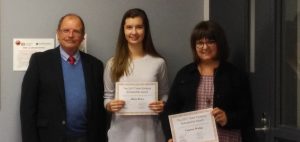
Vanessa Wadge (right) is pictured here holding the certificate for her Osler Epilepsy Scholarship. She is standing alongside Lawton Osler of Osler Business Consulting Ltd., the company that sponsors the scholarship, and another recipient of this year’s award, Mary-Katherine Rowe.

Jane Lampton “Jean” Clemens was the daughter of Mark Twain. Her father always felt his daughter’s epilepsy was caused by a head injury she had sustained when she was nine.

When Vanessa was about the same age, she suffered a head injury while playing on the monkey bars at her school. On May 6, 2015, Vanessa had her first seizure. Like with Jean Clemens, it was believed Vanessa’s epilepsy was caused by a head injury suffered years earlier.

This aspect of Jean Clemens’ life is interesting to Vanessa, she says.

“It is so unreal to read about someone who lived a life so similar to what I am experiencing at the moment,” Vanessa says.

Jean Clemens’ parents had always been supportive of their daughter and tried to improve her quality of life. This is something else Vanessa says she can relate to, noting that living in the northern town of Belle Vallée, Ont., made it challenging to see specialists.

“My parents spent 14 months trying to find medications that my body would not reject,” she says. “During that period, I was admitted into hospital at least once a week, airlifted three times out of town to more qualified physicians. … My parents were very comforting, always by my side, supporting me every day.”

In June 2016, Vanessa was airlifted to a hospital in Ottawa where it was revealed her continued seizures were the result of taking too much medication. Her neurologist also explained to Vanessa that she needed to “listen to my body” for auras and other indicators of an oncoming seizure.

“From that day, my life has been much better,” Vanessa says.

Vanessa, who is studying at Northern College in Haileybury, is one of the recipients of this year’s Osler Epilepsy Scholarship. The $1,500 scholarship, formerly called the OBCL Epilepsy Scholarship, is being offered to five students this year.

Osler Epilepsy Scholarships are awarded each year to exceptional students who have confronted and overcome remarkable barriers in their academic and personal lives due to their epilepsy.

Applicants also submit an essay about how epilepsy has impacted their lives as well as an outline of their future plans. Applicants also submit a 600- to 900-word essay about a famous person who has epilepsy and what that person’s life means to them.

If you have feedback on this story, or have a story of your own that you would like to share, please contact the newsroom at deron(at)axiomnews.com.

Student Heather Perl looks to former NHLer living with epilepsy for guidance on life

October 19, 2017

By Deron Hamel

Sports have always been an important part of Heather Perl’s life. So when the 18-year-old was diagnosed with epilepsy at age seven, after suffering her first seizure, it was a setback for her to have to stop participating in activities she loved.

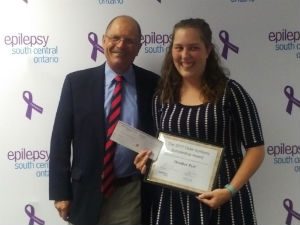
Heather Perl is pictured here holding the certificate for her Osler Epilepsy Scholarship alongside Lawton Osler of Osler Business Consulting Ltd., the company that sponsors the scholarship.

“As a kid, I was so outgoing. I don’t think there was a sport I didn’t play,” Heather says. “I played soccer, hockey, swimming, baseball and other fun sports with my schools, such as cross-country and ultimate Frisbee, to name a few.”

Heather grew up in a family of six – and everyone played sports. Her older sister was a swimmer, her brother played hockey, and Heather and her twin sister played hockey and soccer. Heather’s dad was also athletic. Her mother played baseball.

She remained athletic after her diagnosis, but Heather eventually had to stop playing hockey because she was experiencing seizures during games. Still, she managed to stay involved by being a timekeeper on the nights her sister played hockey and on weekends by timekeeping during house-league hockey games.

“This way I could still be involved with the game of hockey, which I loved to play,” she says.

Some people, Heather notes, look at their epilepsy as “an embarrassment.” But there is also a positive way of looking at the condition, she says.

She cites former NHL player Derek Morris as an example of someone who takes such an approach. It’s Morris’s career and outlook on life that Heather looks to for guidance.

Morris says he was prescribed Tegretol when he was a teenager to control his seizures, and this allowed him to play in the NHL from 1997 to 2014, amassing 424 points in 1,107 games as a defenceman for five teams.

“Morris said by experiencing it he got to learn more about epilepsy and also learned that he wasn’t the only one (living with the condition),” Heather says.

“Similar to my experience, the more research my parents and I did, I soon realized too that I also wasn’t the only one. Derek Morris showed me that even with having some challenges in your way, you can still reach your full potential and reach your dreams in life.

“Derek didn’t let seizures hold him back from going to the pros, so that shows me that I can do anything as well,” she says.

“Maybe one day I will find something to help control my seizures and help me reach my full potential.

“What Derek Morris is telling me is never give up. I will continue to learn what I can to better manage my epilepsy and be an advocate for myself and other people living with epilepsy,” she says.

Heather is one of the recipients of this year’s Osler Epilepsy Scholarship. The $1,500 scholarship, formerly called the OBCL Epilepsy Scholarship, is being offered to five students this year.

Osler Epilepsy Scholarships are awarded each year to exceptional students who have confronted and overcome remarkable barriers in their academic and personal lives due to their epilepsy.

Applicants also submit an essay about how epilepsy has impacted their lives as well as an outline of their future plans. Applicants also submit a 600- to 900-word essay about a famous person who has epilepsy and what that person’s life means to them.

If you have feedback on this story, or have a story of your own that you would like to share, please contact the newsroom at deron(at)axiomnews.com.

Student-athlete overcomes epilepsy’s challenges to pursue her dreams

September 21, 2017

By Deron Hamel

Mary-Katherine Rowe says living with epilepsy for the past five years has not been easy, but she has stood up to every challenge she has faced and has now entered her second year of pursuing a teaching degree at Nipissing University.Mary-Katherine was diagnosed with a seizure disorder in 2012, when she was in her first year of high school at Timiskaming District Secondary School, in Haileybury.

Mary-Katherine Rowe (centre) is pictured here holding the certificate for her Osler Epilepsy Scholarship. She is standing alongside Lawton Osler of Osler Business Consulting Ltd., the company that sponsors the scholarship, and another recipient of this year’s award, Vanessa Wadge.

When she entered university last year, Mary-Katherine says she had many obstacles to overcome – and the most prominent challenge she had to face was living in North Bay, far away from her family.

“Going through high school knowing that I could have seizures at any point was difficult, but going away to university was more difficult,” she says.

“Being away from my family, taking three types of medications and living in a new environment, where the staff and my fellow students did not know me like they did at home, made me nervous.”

But Mary-Katherine says she turned to another person living with epilepsy for inspiration; someone else who had lived with similar challenges and overcame them.

Chandra Gunn, who was the goalkeeper for the U.S. women’s hockey team at the 2006 Winter Olympics in Turin, Italy, is also living with epilepsy. Mary-Katherine says Chandra’s perseverance has set an example for her to follow.

Like Chandra, Mary-Katherine is also an athlete. In fact, Mary-Katherine made the cut last year and is now a member of Nipissing University’s women’s rowing team, while maintaining a full-time class schedule.

Mary-Katherine notes that epilepsy forced Chandra to temporarily withdraw from her studies when she was a student, but then she went back to university and became a renowned athlete.

“Chandra is an example of a person who is living to the fullest with epilepsy, proving that the condition does not have to prevent people from doing things they love to do,” Mary-Katherine says.

Mary-Katherine is one of the recipients of this year’s Osler Epilepsy Scholarship. The $1,500 scholarship, formerly called the OBCL Epilepsy Scholarship, is being offered to five students this year.

Osler Epilepsy Scholarships are awarded each year to exceptional students who have confronted and overcome remarkable barriers in their academic and personal lives due to their epilepsy.

Applicants also submit an essay about how epilepsy has impacted their lives as well as an outline of their future plans. Applicants also submit a 600- to 900-word essay about a famous person who has epilepsy and what that person’s life means to them.

If you have feedback on this story, or have a story of your own that you would like to share, please contact the newsroom at deron(at)axiomnews.com.