Tag Archives: Epilepsy

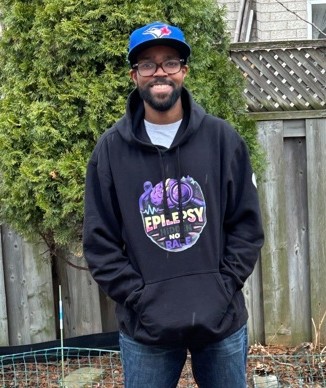
Hidden, not rare: Why Alex Johnson is using a sweater to raise epilepsy awareness

March 26, 2026

By Deron Hamel

For Alex Johnson, the phrase “Epilepsy: Hidden, Not Rare” resonated with him when he saw it printed across a sweater at the Epilepsy Shop, Epilepsy Ontario’s online store.

Alex, who is living with epilepsy, says he felt a personal connection with the message, which prompted him to buy the sweater.

“The message reminded me that lots of people couldn’t see (my epilepsy), but I knew it existed,” Alex tells Voices of Epilepsy. “This was a message that really caught me.”

There were shirts and sweaters with other messages, but Alex says that one stood out most for him.

“It was a message that people needed to see and understand; it’s a message that should be reaching the public,” he says. “It’s not necessarily me saying something about myself, but it is something I am saying to the public.”

The Epilepsy Shop was launched in 2020 and sells an array of colourful T-shirts and hoodies embossed with campaign names to help support local epilepsy agencies and raise awareness of seizure disorders.

Customers can find regular T-shirts, women’s cut T-shirts or hoodies in a variety of colours and sizes. Every item is created on demand to eliminate waste, and all profits support epilepsy services and programs.

Alex says he would like to see more apparel with messaging directed at the public at large, which he believes would be a helpful way to increase epilepsy awareness.

He suggests that adding phrases like “There are Many Different Types of Seizures” or “One in 100” – a reference to the number of Canadian adults estimated to be living with epilepsy – would further educate the public.

This sort of messaging, Alex adds, is prominent on social media or in pamphlets during March – Epilepsy Awareness Month – but not throughout the rest of the year.

“The other 11 months of the year, nobody will know, nobody will see it on social media, but there is an opportunity to (send these messages) with shirts,” he says.

Click here to visit the Epilepsy Shop.

Student using epilepsy experience to fuel advocacy and research

January 9, 2026

By Deron Hamel

Vivienne Le says that if she could speak to her younger self, the first thing she would tell herself is that having epilepsy will not make her “less capable” or “less worthy.”

The student from Ottawa, who is studying health sciences at Queen’s University, says when she was younger she felt “frustrated and alone,” and wanted to blend in with her peers without constantly having to worry about having a seizure or hiding her condition.

Looking back, Vivienne says the things about epilepsy that frightened her when she was young now give her strength.

“I would tell (my younger self) not to be afraid to speak openly about her experiences because sharing her story will connect her to others and help combat the stigma that once caused her pain,” Vivienne says.

“(I would tell her that) one day, she will use her voice and her lived experience to make a difference through volunteering, advocacy and even contributing to epilepsy research. Most importantly, I would tell her that epilepsy will shape her, but it will not define her limits. She will go to university, chase big dreams and prove to herself that she is more than her diagnosis.”

Vivienne says her experiences with epilepsy have shaped her outlook and helped her navigate her career path. Once she completes university, she plans to attend medical school and become a doctor specializing in neurology. She says she wants to contribute to research and health-care initiatives aimed at improving quality of life for people living with epilepsy.

“Growing up with epilepsy has given me both a personal connection and a sense of purpose in this field,” she says. “I want to combine clinical care with research to improve treatments, reduce stigma and advocate for those living with neurological conditions.”

Vivienne’s passion in this area has already led her to get involved in epilepsy research at BC Children’s Hospital and the Centre hospitalier de l’Université de Montréal, where she has contributed to projects, including an analysis of epilepsy surgery outcomes.

Vivienne says epilepsy has motivated her to strive for achievements outside of academics, adding she recently created Viv in Purple, a social media platform to share her story of living with epilepsy and creating a space for others to share their experiences.

“The messages I have received from people who found hope through my posts remind me why I am committed to advocacy,” Vivienne says.

“Ultimately, living with epilepsy has not limited me. It has given me purpose and shaped my determination to turn personal challenges into opportunities to help others, whether through research, health care or advocacy.”

Vivienne is one of four recipients of Epilepsy Ontario’s 2025 scholarship. For more than 15 years, the organization has been providing scholarships to exceptional students who have confronted and overcome remarkable barriers in their academic and personal lives due to epilepsy.

“This $1,500 scholarship will help cover tuition and research-related expenses, allowing me to dedicate more time to my advocacy work and academic goals,” Vivienne says. “By combining my lived experience, academic background, and community involvement, I hope to create a more compassionate and supportive environment for people with epilepsy.”

SECOND NOTIFICATION: Discontinuation of Frisium® (clobazam) Tablets in Canada

January 31, 2018

January 26, 2018

SECOND NOTIFICATION: Discontinuation of Frisium® (clobazam) Tablets in Canada

Dear Healthcare Professional and Epilepsy Patient Advocacy Organization,

As communicated first in July 2017, after careful consideration, Lundbeck has made the decision to discontinue the manufacturing of Frisium® (clobazam) Tablets in Canada. This decision was not triggered by a safety issue, but rather is based on the numerous generic clobazam alternatives available in Canada.

Due to an increased demand of Frisium in the second half of 2017, we now expect our current inventory to be depleted in the third quarter of 2018.

As mentioned before, Lundbeck first communicated this change well in advance to give healthcare professionals, patients and families as much notice as possible so that Frisium patients have ample time to successfully shift to an acceptable alternative clobazam therapy. Health Canada also was notified last summer. As well, we have listed our proposed discontinuation date on the drug shortages website in Canada.
As a company with a strong record of supporting the epilepsy community, Lundbeck is aware of the ongoing struggles many physicians and their patients experience in managing seizures. We are deeply committed to the epilepsy community, which is why we are taking several steps to ease this transition, including:

• Providing access to Lundbeck’s Medical Information team at 866 880 4636 to address questions or concerns. We will closely monitor responses from patients, their families and healthcare professionals and address concerns appropriately.

• Distributed two discontinuation letters to a comprehensive list of physicians, pharmacists and patient advocacy organizations throughout Canada in July 2017 and January 2018, providing more than a year’s lead time to enable a carefully thought-through treatment transition plan.
○ A final letter is scheduled for the summer of 2018.
○ Patient advocacy organizations will be encouraged to share all notifications for use in on and offline communications materials, as appropriate.

• Implementing allocation plans to ensure appropriate steady supply of the remaining Frisium tablets to the market based on historical demand.
• Conducting outreach to pharmaceutical wholesalers.

Again, please contact Lundbeck Medical Information at 866 880 4636 if you have any questions.
Sincerely,

Doug Williamson, MD
Chief Medical Officer, VP US Drug Development
Lundbeck

Gov’t needs to take a proactive response to stem drug shortages: Epilepsy Ontario

May 19, 2016

By Deron Hamel

One of the greatest frustrations Epilepsy Ontario deals with during shortages of seizure-control medications is when impending drug shortages are identified but Health Canada and the provincial drug programs do nothing to try to prevent them, says Suzanne Nurse.

DrugShortage793Nurse, Epilepsy Ontario’s director of information and client services, says that 2016 has been one of the worst years, so far, for shortages of medications needed by people living with epilepsy since shortages began about five years ago.

Pharmaceutical companies have gone into shortage on multiple anti-seizure drugs. Lack of information about the shortages as well as lack of processes to prevent and manage them is putting people at risk as well as creating serious anxiety for people living with epilepsy and their families, she adds.

“There seems to be a failure to recognize how drug shortages evolve,” Nurse says. “We can see when a serious shortage is coming, one that will have an impact on people with epilepsy. We just can’t understand why (Health Canada and the provincial drug programs) that are overseeing the drug-shortage response can’t see it.

“We evaluate a couple of key factors: Are there only a few suppliers of a drug? Is the shortage expected to last a long time? Are the major suppliers affected? If the answers are ‘yes,’ ‘yes’ and ‘yes,’ then it’s pretty clear a serious problem is heading our way.”

Currently, there are significant shortages of two common anti-seizure medications in Canada: divalproex sodium and clobazam.

“We had to wait until we were in the middle of a crisis to get a response to the divalproex shortage. We’re still waiting to even get an acknowledgement of the seriousness of the clobazam shortage.”

Apotex Inc. first posted shortages of divalproex sodium on drugshortages.ca in June 2015; however, a collaborative effort to address the shortage did not begin until March 2016. The good news is that the response co-ordinated by Health Canada helped turn this around and generic formulations of divalproex sodium are beginning to recover, starting with the 500 mg strength tablets. It will take longer for the brand-name tablets, Epival, to recover.

Just as we’re starting to get out of the woods on divalproex, clobazam is now developing into a major problem. Apotex first reported a clobazam shortage in December. The drug was supposed to be restocked in mid-April, but about a month before the shortage was expected to end the date was pushed back to September. It has since been pushed back to Nov. 30. Pharmacies are now having trouble obtaining generic clobazam as well as the brand name tablets (Frisium).

Epilepsy Ontario wants to see a proactive response to anticipated drug shortages to prevent them from happening in order to reduce the impact on people living with epilepsy. With both the clobazam and divalproex sodium shortages, federal and provincial agencies were contacted to inform them of the impending shortages, but no proactive action was taken, Nurse says.

The drug shortages, coupled with the erratic changing of restock dates, are putting people’s safety at risk, Nurse says.

“Any shortages of medication that control seizures are of serious concern because epilepsy is a condition that you need to maintain good control of – missing a dose of a drug or changing medications, any kind of change like that can affect seizure control, so any drug shortage is a serious concern,” she says.

“The clobazam shortage is an even greater concern than most of the drug shortages that we deal with for epilepsy. There is no other drug like clobazam that can replace it when it is in shortage.”

Follow alerts on the Epilepsy Ontario website for updates on these drug shortages:

Divalproex sodium (Epival) alert
https://epilepsyontario.org/alert/alert-divalproex-sodium/

Clobazam (Frisium) alert
https://epilepsyontario.org/alert/alert-clobazam/

If you have feedback on this story, or have a story of your own that you would like to share, please contact the newsroom at 800-294-0051, ext. 23, or e-mail deron(at)axiomnews.com. You can also leave a comment below.