
Tag Archives: Epilepsy

Can exercise reduce seizures in children with epilepsy? Study aims to find out

May 1, 2014

When most people talk about physical activity, they think of cardiovascular heThree young friends running on a path outdoors smilingalth. However, a body of evidence suggests exercise can also be an important factor in reducing seizures in children with epilepsy. This is the focus of an EpLink study led by Dr. Gabriel Ronen.

Ronen, a researcher from McMaster University, is conducting a study on the benefits of exercise for children living with epilepsy. The study is monitoring a group of children with epilepsy who are involved in a walking program and comparing their seizure numbers to children with epilepsy who are not participating in regular exercise.

The researchers’ hypothesis is that children with epilepsy who get regular exercise will have fewer seizures.

Existing studies indicate that people who exercise regularly show enhanced scores on perception when their cognition is tested, with improvements in concentration, verbal abilities, reading skills and arithmetic.

Studies also show increased exercise is particularly beneficial to children in primary and middle school. Research also indicates that increased exercise can decrease the impact of conditions such as depression and anxiety, both of which are known to contribute to seizures in some people with epilepsy.

As part of the ongoing study, about 70 children and youths aged eight to 15 are participating in a walking program hosted at McMaster Children’s Hospital and Children’s Hospital of Eastern Ontario. Participants walk with pedometers to measure the distance walked on an ongoing basis for six months, with seizures charted. For the next six months the children are monitored to see if there are sustained benefits.

Ronen and his team are trying to determine if exercise in children can change genetic functioning in the brain through a phenomenon called epigenetics. Through epigenetics, gene expressions can be manipulated, changing their function.  

“It seems that exercise may up-regulate certain gene expressions that improve certain brain factors,” Ronen tells Voices of Epilepsy. “We believe that exercise may have an epigenetic effect that certain positive brain substances increase and some of the deleterious effects on the brain decrease.”

There are existing studies suggesting increased physical activity in adults may improve medical and psychosocial aspects, but there are no such studies in children, Ronen says.

This is the gap he and his team are filling through their work.

Established by the Ontario Brain Institute (OBI), the EpLink program is unique in Canada. EpLink involves more than 25 researchers working at nine different university and hospital sites across Ontario. EpLink also encompasses five industry partners and five nonprofit advocacy groups.

On March 5, 2013, the province committed to injecting $100 million over five years to OBI, which, in turn, means the program will be funded until 2018.

Writer: Deron Hamel

If you have feedback on this story, or have a story of your own that you would like to share, please contact the newsroom at 800-294-0051, ext. 23, or e-mail deron(at)axiomnews.ca. You can also leave a comment below.


Agencies buzzing with activity to honour Purple Day

March 25, 2014

Epilepsy support agencies across Ontario are gearing up for Purple Day, the annual international event aimed at raising epilepsy awareness.purple-day-logo-low-res

Recognized every March 26, Purple Day was launched in 2008 by Cassidy Megan, a nine-year-old Nova Scotia girl who is living with epilepsy.

Since then, individuals and organizations worldwide have hosted events and campaigns to raise awareness of the neurological condition that affects more than 65 million people across the globe, including an estimated 300,000 Canadians.

The weeks leading up to Purple Day have been busy at Epilepsy Halton Peel Hamilton. On March 14, the agency was the featured charity at tenor Colm Wilkinson’s performance at Mississauga Living Arts Centre. Wilkinson addressed the audience of about 700 people to talk about March being epilepsy awareness month and informed the crowd of the programs the agency offers.

On March 28 the agency is hosting its annual Purple Gala. The fundraising event will be held at Credit Valley Golf and Country Club in Mississauga.

Among the many other initiatives Epilepsy Halton Peel Hamilton is working on in honour of Purple Day is a campaign to raise awareness of seizure disorders at schools. The agency has developed kits that include tattoos, pencils, bracelets and information packages to educate young people about epilepsy.

“The end goal is to connect with communities, raise awareness and build on upon that,” says Cynthia Milburn, the agency’s executive director.

Epilepsy and Seizure Disorder Resource Centre of South Eastern Ontario hosted its second annual Purple Pancake Breakfast in Kingston and Gananoque on March 22. All money raised from selling blueberry pancakes is going toward helping the agency fund its community education programs.

Like Epilepsy Halton Peel Hamilton, the resource centre is reaching out to school children. The organization will be attending school assemblies on Purple Day to provide information to students and teachers.

“I think the younger we can get people talking about epilepsy the better,” says executive director Susan Harrison. “Kids are very open to learning more and understanding. I don’t think I’ve been to a school yet where there wasn’t a student who had epilepsy, so they’re seeing it, but they’re not understanding it.”

Nikki Porter, the communications liaison at Epilepsy Support Centre’s Windsor/Essex branch, notes how 10 Tim Hortons stores in Windsor are going to be selling doughnuts with purple sprinkles on March 26. The doughnut shops have also hung Purple Day posters at their locations. The 10 stores are owned by one company which was approached with the idea by a Windsor/Essex branch member last year.

The agency, which covers a large catchment area across southwestern Ontario, is getting support from many others across the region. In Chatham-Kent, the Purple Pansy flower boutique is selling bunches of purple tulips and donating proceeds to the Epilepsy Support Centre.

In Elgin, the statue of Jumbo the elephant will be adorned with a 60-foot purple scarf on March 26.

Additionally, official Purple Day proclamations have been made by city councils in Windsor and Amherstburg.

Porter explains the difference she would like to see made from these campaigns.

“I would like to see (this awareness lead to) more acceptance of people with epilepsy in our communities,” she says.

Click here to learn more about Purple Day.

Writer: Deron Hamel

If you have feedback on this story, or have a story of your own that you would like to share, please contact the newsroom at 800-294-0051, ext. 23, or e-mail deron(at)axiomnews.ca. You can also leave a comment below.
Mother calls for more action to develop mandatory drug-shortage database

March 21, 2014

When Diana went to fill her daughter’s clobazam prescription last week, she was in for a big surprise when the pharmacy told her it couldn’t supply her with all the medication her daughter needed.
Empty pill bottle615
Diana was unaware there was a medication shortage.

With the help of Epilepsy Ontario, Diana was able to get an additional supply of clobazam for her daughter, but it still isn’t enough of the medication to last until the shortage is slated to end in early May.

Since then, Diana has been spending much of her free time phoning pharmacies asking if they have clobazam in stock. This causes another hurdle for Diana because if she has to switch pharmacies, she needs to go back to her daughter’s neurologist and get a new prescription. Once a patient is prescribed clobazam, it can only be switched once to another pharmacy.

Through her efforts, Diana was able to obtain another clobazam supply that her daughter can use until the start of April, but that still isn’t enough medication to last her daughter until the shortage ends.

“It’s very frustrating — I’m very anxious about this,” Diana says, adding she also finds herself checking the online Canadian Drug Shortage Database to see if updates on the shortage are posted.

Diana says the high level of stress she and other people go through during medication shortages could be averted if pharmaceutical companies were mandated by federal law to provide notices of impending drug shortages so people could get their medications ahead of time, or, if needed, ease off one medication and start on a new one.

Diana has a clear picture of what this should look like.

“If there were drug-shortage notices that went out to all pharmacies, patients who have, for example, a prescription for clobazam, could get a phone call or an e-mail notifying them that there is the possibility of a shortage coming up, and an outline would be given for what steps need to be taken,” she says.

Given that pharmacies already have systems in place to notify people when prescriptions are due to be refilled, Diana says she doesn’t see why existing systems can’t be updated to include shortage notices.

Diana is also taking the initiative to write her MP’s office to explain the need for a mandatory drug-shortage database — and she’s encouraging others to follow suit.
 
Clobazam, which is marketed by several pharmaceutical companies in Canada, is a common medication prescribed to people with seizure disorders. The medication is usually prescribed to work in tandem with other pharmaceuticals. While several companies manufacture the drug, some people with epilepsy can experience changes in their seizure control when they switch brands.

There have been multiple shortages of anti-seizure medications over the past few years, and this is at least the second clobazam shortage in 14 months. In January 2013 Epilepsy Ontario issued a notice that pharmacies had back orders of clobazam.

In September, new guidelines were established that have been developed by government, industry and other stakeholders clearly outlining the expectations, roles and responsibilities for all stakeholders during a medication shortage.

Adhering to these guidelines is important to ensure safety for people with chronic conditions requiring medications, says epilepsy information specialist Suzanne Nurse.

“When it comes to managing drug shortages, early notification from drug manufacturers is key,” she says.

Writer: Deron Hamel

If you have feedback on this story, or have a story of your own that you would like to share, please contact the newsroom at 800-294-0051, ext. 23, or e-mail deron(at)axiomnews.ca. You can also leave a comment below.

OBCL Epilepsy Scholarship Awards are back — and you can apply now

March 6, 2014

Are you a student living with epilepsy entering your first year of university in September? If so, you have an opportunity to apply for an OBCL Epilepsy Scholarship Award — and OBCL president Lawton Osler is hoping to see lots of applicants.

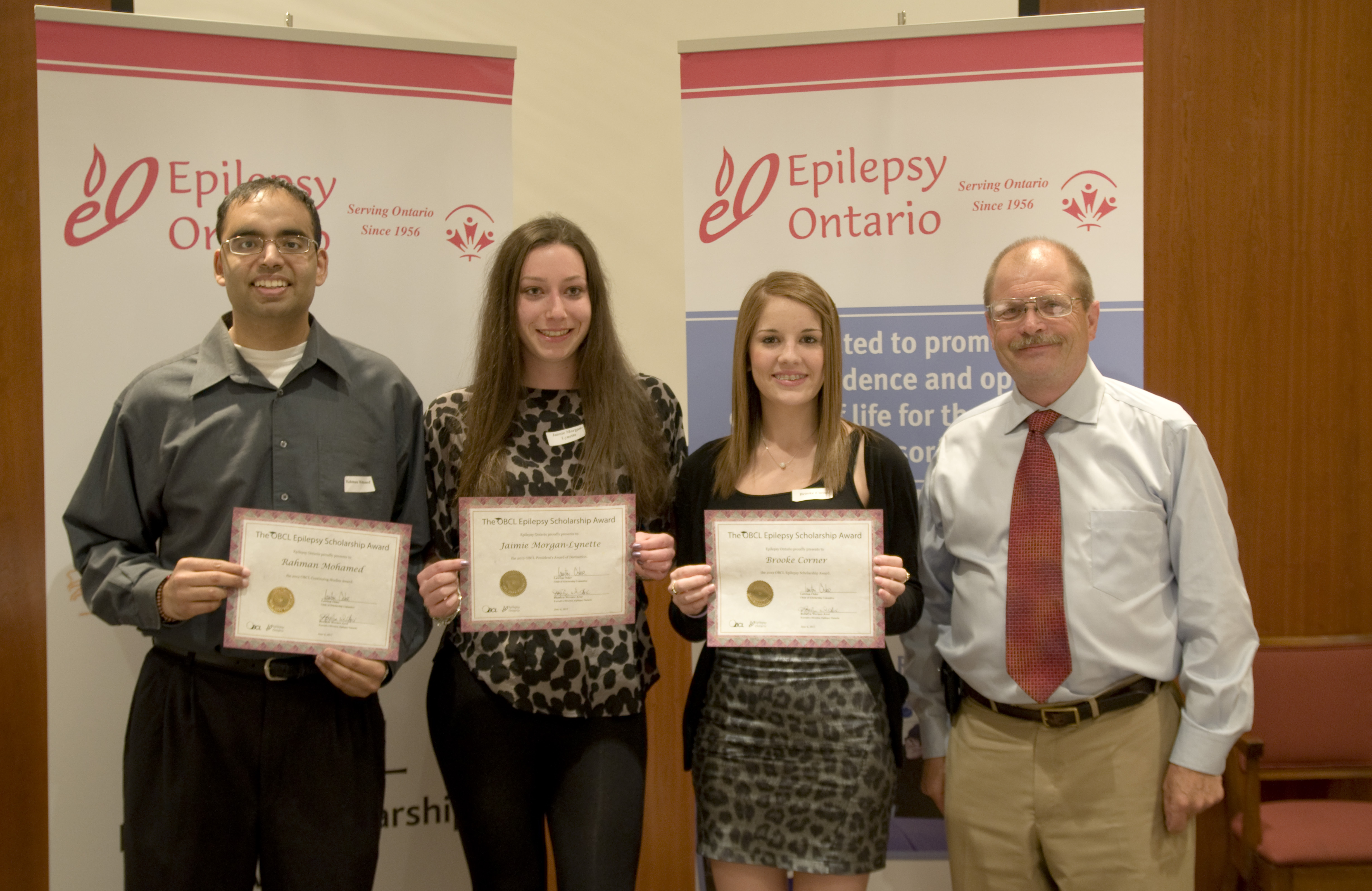
OBCL president Lawton Osler (far right) is seen here in 2012 after awarding OBCL scholarships to students (from left to right) Rahman Mohamed, Jaimie Morgan-Lynette and Brooke Corner.

“I’m looking for as many people as possible to apply,” Osler tells Voices of Epilepsy.

Osler is understandably proud, as his company sponsors the scholarships. Many students living with epilepsy face significant challenges stemming from their condition, coupled with the financial challenges many students face when having to pay for their education.

Receiving one of the six $1,000 scholarships can alleviate some of the financial burden that comes with pursuing post-secondary education, and is a step towards helping young people maximize their potential, Osler notes.

This, he says, is the No. 1 importance of the scholarships.

The scholarships have been sponsored by OBCL since 2006. Their history goes back to the early 2000s when two pharmaceutical companies — first Pfizer, then Lundbeck Canada — offered the scholarships.

Osler, a past Epilepsy Ontario president, was involved with the committee that judged the essays during this time. When Lundbeck stopped sponsoring the scholarship eight years ago, Osler saw a chance to help young Ontarians living with epilepsy finance their post-secondary education.

“I saw this as an awesome opportunity for me to give back,” he says.

The scholarships are being awarded to students who are graduating high school and entering their first year of post-secondary education.  The scholarships will be presented at a ceremony June 6. The deadline for application is May 1.

Last year’s scholarship recipients were Chloe Gallagher (Burlington), Tori Gleason (Smiths Falls), Alexander Johnson (Mississauga), Kirsten Leusink (Cambridge), Katelyn Lewis (Thunder Bay) and Suzanne McGuire (Niagara Falls).

Another past OBCL scholarship recipient is Melanie Jeffrey, an Epilepsy Ontario board member and an outspoken advocate for epilepsy awareness.

Every year, up to six Ontario students win a $1,000 scholarship for post-secondary education. As part of their application package, students must submit a personal essay under that year’s theme.

Students wishing to apply for a 2014 OBCL epilepsy scholarship must do so before May 1 by 5 p.m. You can print a copy of the scholarship application by clicking here.

Writer: Deron Hamel

If you have feedback on this story, or have a story of your own that you would like to share, please contact the newsroom at 800-294-0051, ext. 23, or e-mail deron(at)axiomnews.ca. You can also leave a comment below.