
Author Archives: eCreative Studios

CLAE conference will bring to light latest discoveries in epilepsy research

October 16, 2014

The upcoming Canadian League Against Epilepsy (CLAE) conference will be an opportunity for attendees to learn about the latest discoveries in epilepsy research, says its main250 organizer.

Neurologist Dr. Jorge Burneo, the CLAE’s director of education, says the conference is aimed at bringing together Canada’s epilepsy clinicians and researchers to share information and learn from one another about the latest breakthroughs in epilepsy care.

The conference will include a myriad of breakout sessions focusing on the latest developments, including neuroengineering, neuroimaging, video-EEG monitoring in critically-ill patients and genetic counselling.

“The meeting is mainly directed at neurologists and neurosurgeons as well as neurologists who are currently in training to obtain more specialization in epilepsy,” Burneo tells Voices of Epilepsy. “It’s also open to any health professional who cares for patients with epilepsy.”

On Day 3 of the conference, the Canadian Epilepsy Alliance (CEA) will be leading a plenary session, entitled Working Together to Improve Epilepsy Care in Canada. The CEA is a network of grassroots organizations focused on promoting quality of life for people with epilepsy and their families.

The session will be led by CEA president Gail Dempsey. Dempsey says she hopes attendees walk away from this session with a better understanding that the best way to enhance knowledge in epilepsy care is through collaboration.

“We’re having an open discussion to determine how we see that happening,” Dempsey says. “We see it happening in that when you go to the doctor’s office, the doctor really doesn’t have a whole lot of time to provide you with all the information that you need so that you can maintain the quality of life that you want. (The CEA is) more than happy to partner with the doctors to make sure that the education is provided.”

Burneo says the collaboration between the CLAE and CEA, which has been ongoing for several years, is also an important aspect of the conference.

“Every time we have a meeting, we have a special session for the CEA because we really believe that epilepsy care is improved when the organizations and the patients are involved in the care,” he says.

The 2014 CLAE’s biennial meeting is taking place in London, Ont. Oct. 17-19. Click here for more information, including how to register.

Writer: Deron Hamel

If you have feedback on this story, or have a story of your own that you would like to share, please contact the newsroom at 800-294-0051, ext. 23, or e-mail deron(at)axiomnews.com. You can also leave a comment below.

EpLink study aims to alleviate depression in people with epilepsy

October 9, 2014

A study undertaken as part of the Ontario Brain Institute’s (OBI’s) EpLink program is seeking to provide help to people living with epilepsy who are also experiencing symptoms of depression.

An estimated 30 to 40 per cent of people living with epilepsy experience depression that often goes unrecognized and untreated, says EpUp lead investigator Kathryn Hum. It’s a widespread issue, but there are few existing programs to intervene, she adds.250

With this in mind, EpLink saw a need for further investigation, so resources have been devoted to address depression and mood disorders in people living with epilepsy.

“The main purpose of this study is really to see if we can improve symptoms of depression in people with epilepsy,” explains Hum.

The EpUp study aims to examine how psychoeducation programs that provide people with a better understanding of epilepsy, emotions and coping skills can improve emotional health in adults affected by the condition.

The study is divided into two parts. The first involves sending participants online questionnaires. The second component sees participants attend an eight-week psychoeducation program which is conducted by telephone.

The two psychoeducation programs consist of weekly sessions that will take place starting in mid-October to December. Following programs will be run January to February and March to April.

It was decided to host the program via telephone to increase access, since many people affected by a seizure disorder do not drive and many will be living outside of Greater Toronto.

Each session of the program is one hour long, one day per week. Participants can expect to learn skills and strategies designed to improve their symptoms of depression.

“What we would specifically like to see is an improvement in their depressive symptoms following their participation in the psychoeducation program,” Hum says.

The EpUp study will compare results from two different programs offered. Groups will consist of six to eight people and will be led by a licensed mental-health facilitator as well as a co-facilitator who is living with epilepsy.

Information garnered from the study may help better support people with epilepsy affected by mood disorders.

If you are a person living with epilepsy and would like to participate in the study, please contact Kathryn Hum at 416-978-0779, or by e-mail at khum(at)uhnresearch.ca.

Writer: Deron Hamel

If you have feedback on this story, or have a story of your own that you would like to share, please contact the newsroom at 800-294-0051, ext. 23, or e-mail deron(at)axiomnews.com. You can also leave a comment below.
Gino Piazza setting sights to beat his marathon fundraising record

October 2, 2014

Last year, Gino Piazza was Epilepsy Ontario’s top fundraiser during the Scotiabank Toronto Waterfront Marathon, raising $3,252 for the organization. He aims to exceed that number during the fundraising campaign leading up to this year’s marathon on Oct. 19.

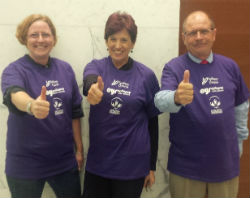
From left to right, Melanie Jeffrey, Elisa McFarlane and Lawton Osler pose with their Team Epilepsy Ontario T-shirts.

Piazza, Epilepsy Ontario’s president, says his role with the organization has provided him an opportunity to expand his network of people to whom he will send his fundraising challenge.

“I’m absolutely hoping to beat (my fundraising amount) this year,” Piazza tells Voices of Epilepsy, adding he hopes to raise $5,000.

“But what really matters is that we reach our collective goal for the organization.”

Piazza notes he’s not the only member of Epilepsy Ontario’s board participating in the event. Past president Elisa McFarlane and board member Lawton Osler will also be running in the marathon.

The Scotiabank Toronto Waterfront Marathon is an annual event where thousands of people run through Toronto to raise money and awareness for a myriad of organizations supporting worthy causes.

The event includes a 42-kilometre marathon, a half marathon and a five-kilometre run.

Money raised from the marathon, now in its 25th year, will go towards services, education and support for people living with seizure disorders and their families.

Piazza says he looks forward to this year’s marathon and plans to make it a family affair. He and his wife recently became the parents of triplets, he notes. “I hope to be pushing them in front of me,” he says.

Piazza says his passion for helping Epilepsy Ontario with fundraising and awareness stems from his family’s positive first-hand experiences with the organization after his youngest sister was diagnosed with epilepsy more than a decade ago.

“When we found out she had epilepsy, the first organization we reached out to was Epilepsy Ontario, and (our family) received tremendous support and information, and (the organization) helped us navigate the various corridors of the health system, which were pretty obscure at the time,” Piazza explains.

“It’s a blessing . . . that I can be a part of the organization that helped us.”

Click here to register for this year’s Scotiabank Toronto Waterfront Marathon or to learn more about the event.

Writer: Deron Hamel

If you have feedback on this story, or have a story of your own that you would like to share, please contact the newsroom at 800-294-0051, ext. 23, or e-mail deron(at)axiomnews.com. You can also leave a comment below.

Late sister’s legacy inspires student

September 25, 2014

Courtney Tobin’s life changed forever on May 19, 2012. It was the day her 23-year-old sister, Chelsea, passed away from sudden unexplained death in epilepsy (SUDEP). It was just before Chelsea was to graduate with a master’s degree from the State University of New York at Potsdam.

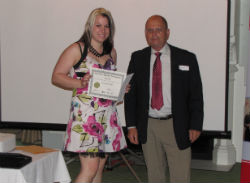
Courtney Tobin is seen here with OBCL president Lawton Osler after receiving her scholarship.

While Courtney, a Kingston, Ont. native, says the impact of Chelsea’s death will never leave her, she is determined to carry on her older sister’s memory. Courtney, who is also living with a seizure disorder, has become an advocate for epilepsy awareness.

“I have made it my mission to inform and educate as many (people) as I can about epilepsy and what they may be able to do to help,” Courtney says.

She adds that her sister’s legacy continues to drive her to overcome any challenges she faces as well as push her to new heights.

“Even now, so long after, it seems surreal at times; an event in my lifetime that will stay at the forefront of my mind forever,” Courtney says of Chelsea’s death. “That morning stands apart from all else, before or since, and I feel that I owe it to my amazing sister to continue to fight through the troubles I may face.”

Courtney, 23, is a recipient of an OBCL scholarship. Chelsea also received an OBCL scholarship in 2006, the first year the accolades were awarded. Every year, up to 10 Ontario students win a $1,000 scholarship from OBCL for post-secondary education.

This past spring, Courtney completed the pre-health sciences certificate course at St. Lawrence College. She is using her scholarship to help finance the program she’s taking at the college to become a medical laboratory technician.

Like other students living with epilepsy who have received an OBCL scholarship this year, Courtney is not letting her condition dominate her life.

“Epilepsy is part of who I am, but it is not what defines me,” she says. “I will remember the day that Chelsea left for now and for always, and continue to try to use the emotions that I continue to feel strongly even now as a means of self-reflection and growth.”

Writer: Deron Hamel

If you have feedback on this story, or have a story of your own that you would like to share, please contact the newsroom at 800-294-0051, ext. 23, or e-mail deron(at)axiomnews.com. You can also leave a comment below.