
Author Archives: eCreative Studios

New report on neurological conditions provides road map to improve lives

September 19, 2014

A first-of-its-kind report published Sept. 11 outlines the impact neurological conditions like epilepsy have on affected people, their families and the greater health-care system. The findings provide researchers, clinicians and policy makers with information identifying knowledge gaps and opportunities to reduce the negative impact of neurological conditions.logo

The report, entitled Mapping Connections: An Understanding of Neurological Conditions in Canada, is the result of the $15-million federally funded National Population Health Study of Neurological Conditions.

According to the report, more than 3.6 million Canadians are affected by neurological conditions, including 50 per cent of those living in long-term care homes or receiving home care. The study also found the unemployment rate of people with neurological conditions, excluding migraines, to be 12 times higher than that of the general population.

Additionally, people affected by these conditions are twice as likely to report symptoms of depression, compared to the general population. Affected people also use more health-care services than those living with other chronic conditions, the study finds.

Now that the study is complete, the findings can be used to help improve the lives of Canadians affected by neurological conditions, says Gail Dempsey, president of the Canadian Epilepsy Alliance.

“This study will help provide greater understanding of the impacts that living with a neurological condition can have on people and families; identify gaps where more research is needed; and foster continuing partnerships, with the ultimate goal of improving the quality of life for Canadians affected by a neurological condition,” she says.

“The information generated from this important study has paved the way to help us improve neurological care and to guide future research needs in Canada and beyond,” add researchers Dr. Nathalie Jette and Dr. Tamara Pringsheim in a statement.

Other key findings from the study include:

– Thirty-five per cent of adults with neurological conditions report experiencing a financial crisis in the past year
– The number of Canadians hospitalized with traumatic brain injury is expected to increase 28 per cent.
– Epilepsy was one of the 14 priority neurological conditions studied
– Epilepsy is associated with significant direct (health care) and indirect economic costs
– By 2031, the indirect economic costs due to premature death and disability for working-age people with epilepsy is projected to be $2.8 billion
– The study identified areas for more research, including the impact of neurological conditions on children
– Individuals with different neurological conditions share many of the same impacts, such as memory impairments and thinking/problem-solving difficulties
– As a result of this study, the Canadian Chronic Disease Surveillance System has been expanded to track neurological conditions including epilepsy

The study saw more than 130 researchers and clinicians representing 30 Canadian organizations worked with 177,000 Canadians living with neurological conditions who offered insight into their experiences.

Writer: Deron Hamel

If you have feedback on this story, or have a story of your own that you would like to share, please contact the newsroom at 800-294-0051, ext. 23, or e-mail deron(at)axiomnews.com. You can also leave a comment below.
Webinar to examine correlation between hormones and epilepsy in women

September 12, 2014

A webinar hosted by Epilepsy Ontario on Sept. 18 at 7 p.m. will examine issues surrounding female hormones and how they affect women living with a seizure disorder.

Epilepsy researcher Dr. Melanie Jeffrey will be leading the webinar, entitled Women, Hormones and Epilepsy. Throughout her presentation, Jeffrey will discuss the impact hormones have on seizure control in different life stages. She will also address reproductive health, birth control, pregnancy and bone health and discuss how these factors relate to epilepsy.logo

But you don’t need to be a health-care expert to attend. In fact, one group Jeffrey says she particularly wants to attract to the webinar is women who are living with epilepsy but don’t know much about how hormones can affect their condition.

“One of the things I will do is speak about hormones in a way that’s accessible and not too heavy on the science jargon,” Jeffrey tells Voices of Epilepsy.

Jeffrey says the webinar will also help people understand the role hormones play in epilepsy through visuals. She will also explain how women with epilepsy can track their menstrual cycle as well as how to create a seizure diary to record their seizure history.

While neurologists have long known about the correlation between seizures and hormones in females, women living with epilepsy and family doctors may not have the pertinent information, Jeffrey says.

“It’s commonly known in our research field . . . but unfortunately a lot of patients and a lot of family doctors don’t know about this,” she says.

“Women sometimes notice when their seizures are associated with their menstrual cycle. . . . A lot of women with epilepsy have these questions that I hope I can answer for them.”

And what does Jeffrey hope the No. 1 result will be from the webinar?

“I’d like people to feel a little more control of when they’re most vulnerable to seizures and why,” she says.

To register for the webinar, please email gula(at)epilepsyontario.org.

Click on the link below to join the webinar on Thursday September 18, 2014  at 7 pm EST:
http://ontariobraininstitute.adobeconnect.com/r224veiwb17        Select  “Enter as a Guest”

Writer: Deron Hamel

If you have feedback on this story, or have a story of your own that you would like to share, please contact the newsroom at 800-294-0051, ext. 23, or e-mail deron(at)axiomnews.com. You can also leave a comment below.

Student moving forward following epilepsy diagnosis

September 5, 2014

This past Purple Day, March 26, Duncan Green did something he’d never done before — he publicly shared his experience with epilepsy.

In a classroom in front of his fellow students at Sinclair Secondary School in Whitby, the Grade 12 student spoke about what it was like to live with epilepsy. Most importantly, he described how that despite having a seizure disorder, he was no different than anyone else.

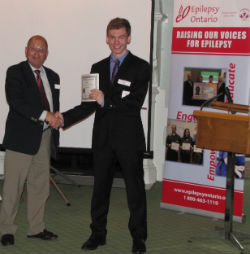
Duncan Green is seen here with OBCL president Lawton Osler after receiving her scholarship.
Duncan Green is seen here with OBCL president Lawton Osler after receiving his scholarship.

“It was quite a scary experience at first, as I had never told anyone that I have epilepsy, but it made me happy that people finally understood what it was actually like,” he says. “What people see in the media is often the most severe and worst cases, which gives many people a much different impression of epilepsy than (the) reality.”

Green has been affected by epilepsy since he was nine, although it would take many years before he had a formal diagnosis. Having the condition, he says, caused a “lifetime of underachievement” that was frustrating because he was not tapping his full potential. He hid his condition from his peers because he didn’t want to be viewed as being different.

In April 2012, Green suffered his first generalized tonic-clonic seizure. Two months later he was diagnosed with a form of idiopathic epilepsy.

“Once I was told, I did not believe my neurologist,” he recalls. “I thought that epilepsy was something that only happened to other people, that I could not possibly have it. I was both scared and felt alone.”

But Green is determined not to allow his condition to navigate his path in life. In fact, he wants to use his experience to help others. He has been accepted to the University of Toronto at Scarborough where he’s pursuing a degree in psychology.

“I entered into psychology with the intention of going into therapeutic psychology. I want to help other people with similar conditions overcome the psychological aspect of their condition which, in my experience, was worse than the condition itself,” he says.

Green is one of six Ontario students to receive an OBCL Epilepsy Scholarship Award. The scholarships were presented June 13.
 
OBCL has been supporting students with epilepsy through the scholarship awards since 2006. Every year, up to 10 Ontario students win a $1,000 scholarship for post-secondary education. As part of their application package, students must submit a personal essay under that year’s theme.

Writer: Deron Hamel
 
If you have feedback on this story, or have a story of your own that you would like to share, please contact the newsroom at 800-294-0051, ext. 23, or e-mail deron(at)axiomnews.com. You can also leave a comment below.

Mother attests to Summerfest’s value; golf fundraiser brings in $5K for annual camp

August 28, 2014

Philippa Howell says attending Summerfest for four years has helped her daughter, Georgina, enhance her social skills and build self-confidence while enjoying a summer camp experience at Camp Couchiching near Orillia.

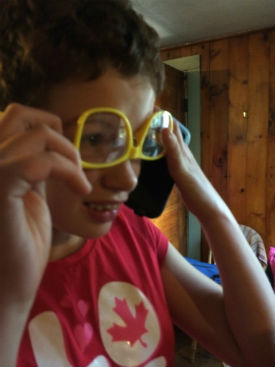
Georgina Howell
Georgina Howell

Georgina, 12, is living with intractable myoclonic epilepsy as well as autism. She has been attending the camp since she was eight, and Philippa says she has seen a steady progression in Georgina’s social skills.

Although she doesn’t talk about her positive experiences at Summerfest, Georgina gives social cues to her parents of the good times she’s having. For example, Philippa recalls how a couple of weeks before Georgina was to go to Summerfest one year she pulled out her Camp Couchiching T-shirt and said “campfire.”

“And then she wore that T-shirt as often as she could … and she kept saying, ‘When are we going for a campfire?’ It suddenly dawned on my husband and I that she had associated the picture of the campfire on the T-shirt … as somewhere she enjoyed going,” Philippa says.

“Immediately, any worry, or fear or stress we might have had about her being anxious about being away from us evaporated. …

“Four years later, I am shocked at how young (Georgina) was when I let her go (to Summerfest) but now I think, ‘Thank goodness’ because the experience she has at the age of 12 has blossomed — she’s grown and grown because of (Summerfest).”

Now in its 20th year, Summerfest has an average of 20 to 40 children and youths who have epilepsy attend the program; they participate in activities such as swimming, hiking, kayaking and sports.

Summerfest enables children and youths aged six to 15 who are living with seizure disorders to attend camp together. The camp provides a setting where children can “forget about their epilepsy and just be a kid,” says Epilepsy Ontario executive director Rozalyn Werner-Arcé.

One of the factors making Summerfest possible is the annual Richardson Charity Golf Tournament. The ninth annual tournament was held Aug. 23 at BraeBen Golf Course in Mississauga. About 60 golfers participated, raising about $5,000 to support Summerfest.
The tournament was launched by chief organizer Ian Richardson and his family in honour of his father who lived with epilepsy. Since its 2006 launch, the tournament has raised about $50,000.

“We had a handful of new people this year, as well as the regular folks who’ve been out for the last number of years so it was a good (tournament),” Ian says.

Writer: Deron Hamel

If you have feedback on this story, or have a story of your own that you would like to share, please contact the newsroom at 800-294-0051, ext. 23, or e-mail deron(at)axiomnews.com. You can also leave a comment below.