Author Archives: eCreative Studios

Epilepsy Ontario sees another year of successful advocacy

December 11, 2014

Advocacy was once again a strong point for Epilepsy Ontario in 2014, with the organization playing a leading role in furthering awareness of the issues facing people living with seizure disorders, says executive director Rozalyn Werner-Arcé.

logo
“One area that Epilepsy Ontario really saw a lot of success in 2014 was engagement,” Werner-Arcé says. “As an advocacy organization, we’re always looking to help people better understand issues people living with epilepsy are facing, and I really feel we’ve built upon relationships with politicians and policy makers this year.”

On March 26, Epilepsy Ontario representatives were at Queen’s Park for Purple Day to raise awareness among MPPs about the issues people with epilepsy and their families are facing. Epilepsy Ontario has been at the provincial legislature every Purple Day, a day of worldwide epilepsy awareness, since it began in 2008.

Based on feedback from government officials, Werner-Arcé says the Purple Day efforts have paid off.

“MPPs and bureaucrats are hearing about it, talking about it and remembering it,” she says. “This is good feedback and a reinforcement that we need to keep doing what we are doing.”

Werner-Arcé joined education and health experts from across Ontario in April to speak to Bill 135 — also called Ryan’s Law — which has since been re-introduced and passed a second reading as Bill 20 in October.  She also addressed the committee about the need for encompassing legislation to better protect school children living with chronic conditions including epilepsy.

Bill 20 which has passed its second reading, is a private member’s bill introduced by Elgin-Middlesex-London MPP Jeff Yurek. It honours 12-year-old Ryan Gibbons, who died in October 2012 after suffering a severe asthma attack during recess at school in Straffordville, Ont.

Ryan’s Law is aimed at ensuring every child and teen with asthma attending Ontario public schools is allowed to carry an inhaler at all times in case of emergency.

Bill 135 has seen strides made to help protect students with asthma, but Epilepsy Ontario has been pushing for policymakers to bring other conditions, including epilepsy, into the fold, Werner-Arcé says.

“We need to see legislation (to ensure safety for students with epilepsy) for sure because (not all school boards) are not doing it willingly,” Werner-Arcé says.

Another annual event the organization attended this year was Epilepsy Action Day. Also held at Queen’s Park, this day is focused on continuing dialogue with the provincial government on issues people with epilepsy face.

This year’s Epilepsy Action Day was held Dec. 1, and largely focused on keeping children living with epilepsy safe at school.

Werner-Arcé and other Epilepsy Ontario and epilepsy agency representatives met with politicians including staff from the Ministry of Health and Long-Term Care and NDP health critic France Gélinas.

Meeting with Queen’s Park representatives on a one-to-one basis proved to be fruitful, Werner-Arcé notes. By taking time to speak with politicians individually the agencies’ representatives were able to get their buy-in as well as create and build upon relationships.

“We want to continue to work with government to ensure that people with epilepsy have access to the services that they need, whether it’s through getting treatment and community-based care, or keeping kids safe at school and making sure that they get the kinds of educational supports they need so they can reach their full potential and develop into productive, contributing citizens,” Werner-Arcé says.

Writer: Deron Hamel

If you have feedback on this story, or have a story of your own that you would like to share, please contact the newsroom at 800-294-0051, ext. 23, or e-mail deron(at)axiomnews.ca. You can also leave a comment below.

Epilepsy Action Day continues dialogue with gov’t on important issues

December 4, 2014

The fifth annual Epilepsy Action Day at Queen’s Park on Dec. 1 was successful in its mission of engaging MPPs in the important issues facing people with seizure disorders, says Epilepsy Ontario executive director Rozalyn Werner-Arcé.

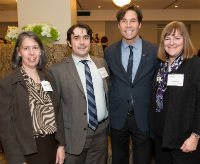
Epilepsy Ontario executive director Rozalyn Werner-Arcé (third from left) and Donna Blair of Epilepsy Ottawa (second from right) are seen here with government officials at Queen’s Park during Epilepsy Action Day Dec. 1.

During the event there were three areas that representatives from Epilepsy Ontario and seven other epilepsy support agencies across the province asked the nearly 40 MPPs attending to focus on.

One is ensuring community-based services and Community Epilepsy liaisons are expanded across the province. Epilepsy agencies are also asking the government to protect and keep children safe at schools through programs devoted to seizure awareness, first-aid training and administration of rescue medications. Lastly, the MPPs were asked to advocate to Education Minister Liz Sandals to ensure neurological conditions are considered during the review of the “categories of exceptionalities” which is currently underway.

“Each year it keeps getting better and better,” Werner-Arcé says of Epilepsy Action Day. “I think that there is an increasing recognition about the impact that epilepsy has on our health-care system and on the lives of Ontarians.”

From left to right, Epilepsy Ontario epilepsy information specialist Suzanne Nurse, Epilepsy Toronto executive director Drew Woodley, Ontario Minister of Health and Long-Term Care Eric Hoskins and Epilepsy Support Centre executive director Mary Secco.

Aside from having MPPs’ keen interest in the issues facing

Ontarians living with epilepsy, Werner-Arcé says Epilepsy Action Day is also proving to be an excellent forum for strengthening relationships between epilepsy support agencies and the government.

“We were able to make new contracts and gain support for all three of our key messages,” she says.

Meeting with MPPs on a one-to-one basis also proved to be fruitful, Werner-Arcé notes. By taking time to speak with politicians individually the agencies’ representatives were able to get their buy-in, she adds.

Looking ahead, epilepsy support agencies will be meeting with the MPPs in their communities to continue fostering relationships and ensuring the dialogue is ongoing.

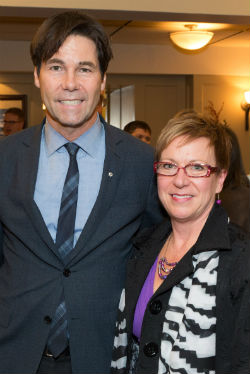
Minister of Health and Long-Term Care Eric Hoskins and Epilepsy Ontario executive director Rozalyn Werner-Arcé.

“We want to continue to work with government to ensure that people with epilepsy have access to the services that they need, whether it’s through getting treatment and community-based care, or

keeping kids safe at school and making sure that they get the kinds of educational supports they need so they can reach their full potential and develop into productive, contributing citizens,” she says.

Aside from Epilepsy Ontario staff attending the event, representatives were on hand from Epilepsy Toronto, Epilepsy Ottawa, Epilepsy Niagara, Epilepsy Durham Region, Epilepsy Halton Peel Hamilton, Epilepsy Kingston and London’s Epilepsy Support Centre.

Writer: Deron Hamel
 
If you have feedback on this story, or have a story of your own that you would like to share, please contact the newsroom at 800-294-0051, ext. 23, or e-mail deron(at)axiomnews.ca. You can also leave a comment below.
The continuing success story of Kerry Jenkins

November 27, 2014

In January, Voices of Epilepsy spoke with 45-year-old Peterborough resident Kerry Jenkins, who had lived with epilepsy since age seven. She shared her story of how deep brain stimulation (DBS) surgery cut her seizures in half and eliminated her tonic-clonic seizures. The surgery continues to improve her quality of life.

Kerry Jenkins is seen here during Purple Day 2013.

Today, Jenkins says that 75 per cent of her seizures have been eliminated as a result of the surgery. While she’s still experiencing four to six seizures per month, they’re all “very minor” complex-partial seizures. Changing the timing on her DBS device is what has made the difference, she says.

In December 2012, Jenkins received a DBS implant. Also called a “brain pacemaker,” it is implanted into the chest. An electrode connects the device to the brain and a stimulating charge is sent at programmed intervals.

Last November, Jenkins’ neurologist, Dr. Danielle Andrade, changed the timing of the DBS implant, so it went for a full minute then switched off for five minutes. She also altered the device’s positive and negative charges. Starting in February, Jenkins had a six-week period where she was seizure-free.

Although her seizures did return, Jenkins says full recovery from the surgery can take more than two years. Given her success to date, she says she’s optimistic about the future.

As a result of improvements with her condition Jenkins is now able to be more independent. Even something as simple as going for a walk alone with her dog has become more enjoyable because the fear of having a serious seizure is gone.

“I feel better and the seizures that I have are mild, (but) I would like to get rid of the rest of the seizures,” Jenkins tells Voices of Epilepsy. “Twelve months ago I was still having complex-partial seizures; those are gone. My life is a lot better. ”

Jenkins’ success with DBS surgery caught the attention of Epilepsy Toronto. At the agency’s annual general meeting (AGM) in May, she was asked to give a presentation during a panel discussion on the value DBS surgery has had on improving her quality of life.

“They knew how much better I was doing and they wanted me up there speaking,” she says.

Jenkins offers some advice for anyone who has a seizure disorder and wants to improve their condition.

“If they have tried everything else, I think they should be pushing for (DBS surgery),” she says.

Writer: Deron Hamel

If you have feedback on this story, or have a story of your own that you would like to share, please contact the newsroom at 800-294-0051, ext. 23, or e-mail deron(at)axiomnews.ca. You can also leave a comment below.

How Chelsea Kerstens faced — and overcame — epilepsy’s challenges

November 20, 2014

When Chelsea Kerstens scaled a 4,500-foot side of the Grand Canyon as a participant in Epilepsy Durham Region’s Epic Climb in October, it was one more challenge she successfully met in the 13 years since she had her first seizure.

Chelsea Kerstens poses for a photo with Epic Climb ambassador Cameron Shiels.
Chelsea Kerstens poses for a photo with Epilepsy Durham Region’s Epic Climb ambassador Cameron Shiels.

Following her accomplishment, Kerstens, 27, spoke with Voices of Epilepsy, reflecting on the challenges she has faced since she was 14 and how her experiences led to her becoming an advocate for epilepsy awareness with Epilepsy Durham Region.

Kerstens had her first seizure at 14, but her condition went undiagnosed until she was almost 18. Once diagnosed, she faced the challenge of finding the correct medication to address her seizures. This trial-and-error process took several years, but doctors eventually discovered a combination of medications that caused her seizures to stop.

She has now been seizure-free for three years.

Since her first seizure, Kerstens has faced many hurdles. Her teenage years, when she experienced the most seizures, weren’t easy and this was compounded by the fact she was a high-school student at the time, she says.

“You start to live a life of isolation,” Kerstens says. “I was lucky enough that I was still able to find a way to take part in day-to-day activities. I stayed at school, I still participated in sports, but there was a definite shift in terms of who wanted to be around me.”

It wasn’t until she had completed university that Kerstens learned about Epilepsy Durham Region. She reached out to the agency and eventually began volunteering. She credits Dianne McKenzie, the agency’s executive director, for encouraging her to share her story with students at educational events to help raise awareness of epilepsy, which affects an estimated one in every 100 Canadians.

After completing university, it wasn’t easy going to job interviews and disclosing her condition to potential employers — the fear that she would be judged for having the condition was always a cloud hanging over her, Kerstens says.

Kerstens is an advocate for people living with epilepsy through her work at Epilepsy Durham Region and as a team leader with E-Action, an online community that provides information for those wishing to learn more about epilepsy.

“I see (my volunteering experiences) as positives that give me a lot of skills that many others don’t have, so I was more than happy to have that on my resumé,” Kerstens says.

And how does it feel to now work as an epilepsy awareness advocate?  

“It’s an excellent feeling,” Kerstens says. “The only way I can describe it is that it feels like I’m doing what I’m meant to be doing.”

Writer: Deron Hamel

If you have feedback on this story, or have a story of your own that you would like to share, please contact the newsroom at 800-294-0051, ext. 23, or e-mail deron(at)axiomnews.ca. You can also leave a comment below.