
Author Archives: eCreative Studios

Community support Epilepsy Durham Region’s greatest success: executive director

November 1, 2012


Five-year-old Fayth Elizabeth is the ambassador for Epilepsy Durham Region’s Legacy campaign.

When you’re a small epilepsy support agency of two people, you need to know how to make the most of your available resources — and that’s exactly what Epilepsy Durham Region has done for 25 years.

The agency receives no government or United Way funding. Instead, Epilepsy Durham Region has built community relationships to educate people about epilepsy and the impact the neurological disorder has on people’s lives.

The engagement has paid off, says executive director Dianne McKenzie, noting the strong community support the agency has received since its establishment in 1987 has been its No. 1 success. This support, she adds, has helped the agency surpass its 25th anniversary fundraising goal, a key initiative in helping deliver services.

Last week, the agency marked 25 years of advocating for people living with epilepsy. Instead of throwing a party to celebrate the past quarter century, the agency decided to launch a campaign earlier this year to continue to raise money to provide vital supports.

Through this fundraising campaign, called Lora’s Legacy, the agency has raised more than $29,000 in 2012, surpassing its goal of $25,000. Money raised is being put towards three key initiatives: helping support the cost of medication, supporting the cost of medical appointments, and outreach programming.

It has been through the strong community support the agency receives that the campaign has been so successful, says McKenzie.

“People are truly committed to helping one another,” she says.

“We’ve had a lot of activities throughout the year and wherever we went we talked about what we were doing.

“We were very fortunate to have corporate citizens and people in general understand that epilepsy is a condition which is underfunded and misunderstood and surrounded by stigma, and they are willing to help. ”

There are eight municipalities in Durham Region, and the agency provides supports — and community engagement — to people living in each of these areas.

As executive director, McKenzie can be found providing in-services to educate people throughout the region about epilepsy and why epilepsy support agencies need funding and volunteers. She and outreach co-ordinator Jessica Scheffee also organize public education days that help get the word out.
 
Community engagement has been Epilepsy Durham Region’s greatest success in its first 25 years, but what about the next 25 years?

McKenzie says the agency still has a lot of work to do. While the communities the agency serves are engaged and people are lending their financial and volunteering support, epilepsy continues to have a negative stigma for people living with the disorder. This stigma can result in people with epilepsy struggling with employment issues or being denied insurance.

Stamping out this stigma is one thing the agency wants to play a part in doing during the next 25 years, says McKenzie, adding she’s willing to pay a big price to see people with epilepsy afforded the exact same life benefits as everyone else.

“(I would like) to be put out of business,” she says.

If you have feedback on this story, or have a story of your own that you would like to share, please contact the newsroom at 800-294-0051, ext. 23, or e-mail deron(at)axiomnews.ca. You can also leave a comment below.

Writer: Deron Hamel
SickKids helping kids with epilepsy excel academically, socially

October 26, 2012

From making printing easier through the use of weighted, vibrating pens to helping creative thoughts flow with voice-to-text software, The Hospital for Sick Children (SickKids) is making “learning come to life” for children who have epilepsy and seizure disorders.

SickKids is grooming kids in grades one through 7 to excel at school, develop self-confidence and build resiliency through its Epilepsy Classroom, says Dr. Elizabeth Kerr, clinical neuropsychologist at SickKids and head of the Epilepsy Classroom.

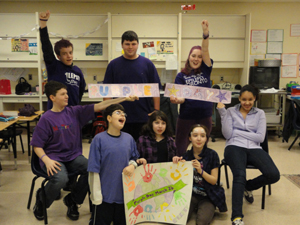
Students of the Epilepsy Classroom celebrate Purple Day, an international grassroots effort dedicated to increasing awareness about epilepsy.

The classroom provides academic remediation and psychosocial intervention and encompasses a medical treatment program.

Most children who participate in the program have cognitive difficulties and/or psychosocial issues that are impacting their academic achievement.

“We always want kids to be more resilient, self-confident and more empowered,” Kerr says about the objectives of the Epilepsy Classroom.

“We expect to see academic gains.”

One of the keys to success is the way the information is taught, Kerr says. “We teach from where their skill level is at.”

The direct-instruction model encompasses reviewing previously taught information to ensure it is understood. SickKids also teaches self-regulation skills and utilizes modeled responses.

The Epilepsy Classroom makes going to school fun. Through primarily donations, children have access to technology like laptops, iPads, an interactive white board and a variety of supporting applications and software to help with printing, spelling, learning the alphabet and more.

“It helps engage their attention,” Kerr says. “We’re always trying to remain cutting-edge and service the kids to the best of our abilities.”

The Epilepsy Classroom is a Section 23 classroom within Ontario’s Ministry of Education and SickKids partners with the local school board to provide programming.

After the one-year program, children transition back into a traditional school setting with or without an educational assistant, or go into a home-schooling environment, depending on their own individual needs.

Beyond academics, the classroom aims to help kids better understand epilepsy, cope with peer pressure and be more resilient.  A multidisciplinary team, which includes a special education teacher, educational assistants, a development pediatrician, a neuropsychologist and a social worker, works to better understand the interplay between epilepsy and each student’s learning profile and social-emotional needs.

SickKids supports children’s social-emotional needs on an individual basis and through group sessions led by Kerr and a social worker on concepts including mindful thinking, optimism and brain behaviours.

An occupational therapist is also on hand to suggest physical tools that can help with a child’s learning inside the classroom and beyond.

SickKids utilizes a holistic approach. The approach centres around understanding each child as a whole and identifying how to best address their needs based on their strengths and challenges.

The Epilepsy Classroom was established in the early 1990s within the child development centre at SickKids. In 2005 when the child development centre moved to Holland Bloorview Kids Rehabilitation Hospital, SickKids retained the classroom under its neurology department. Since then, it has been offering a more “homogenous” classroom setting, which includes the full-year program, alternating years between younger and older grades.

For more information about the Epilepsy Classroom and to view the referral form, click this link.

Writer: Natalie Hamilton

If you have feedback on this article or a story idea to share, e-mail natalie(at)axiomnews.ca or call the newsroom at 800-294-0051.

Webinars train teachers how to spot, respond to seizures in classroom

October 18, 2012

Imagine you’re a school teacher and suddenly one of your pupils has a seizure in the classroom. Would you know how to appropriately respond?

If not, a new service being offered by Epilepsy Ontario to schools in regions of the province without a local epilepsy support agency can help.

Suzanne Nurse

Epilepsy Ontario epilepsy information specialist Suzanne Nurse is leading webinars that are available to schools. The webinars provide background information about what epilepsy is, types of seizures, and how to recognize and respond to seizures.

“The reason we are doing this is that, in general, most teachers don’t have a lot of knowledge about seizures and epilepsy. Epilepsy is such a common neurological disorder, many schools in the province will have a student in their school who does have epilepsy, whether they know it or not,” says Nurse.

In Ontario, between 10,000 and 20,000 students have epilepsy, and approximately 1,000 will be diagnosed with epilepsy each year.

Because epilepsy is common and seizures even more common — people can have isolated seizures even if they don’t have epilepsy — it’s important for any school’s staff members to have training on what to do in the event a student has a seizure, says Nurse.

“That’s an important feature of this introductory training session; it’s to teach teachers what to do if a seizure happens,” she explains.

“It also provides information about what different types of seizures look like, because sometimes seizures go unrecognized.”

Nurse says the need for this service “became obvious” to Epilepsy Ontario after several families of children living with epilepsy expressed concern about the lack of training for teachers about seizure disorders.

Nurse says the best possible long-term results from the sessions would be for teachers to be empowered, should they face a situation where a student is having a seizure, and that they can become positive role models to their students if they have to respond to someone who is having a seizure.

“And the benefits are enormous for children who have epilepsy,” Nurse adds.

“If they’re going to a school where all of the staff are trained and knowledgeable about epilepsy, it makes the students and the families feel much more comfortable about the environment.”

The webinar also introduces information related to the impact that epilepsy can have on the social, emotional and academic development of children.

Nurse notes that epilepsy is a spectrum of many different disorders: some students with epilepsy will be at the top of their class, while others may experience language, attention or memory deficits associated with their epilepsy disorder.

This training is a first step toward improving outcomes for all children with epilepsy in the province and helping kids reach their full potential, says Nurse.

If your school would like to provide epilepsy and seizure training for your teachers, please contact Epilepsy Ontario at 905-474-9696.

If you have feedback on this story, please contact the newsroom at 800-294-0051, ext. 23, or e-mail deron(at)axiomnews.ca, or leave a comment below.

Click here to sign up for the weekly Voices of Epilepsy e-news.

 Writer: Deron Hamel

Epilepsy Halton Peel Hamilton aiming to raise $50K in marathon

October 9, 2012

About 130 people will be running under the Epilepsy Halton Peel Hamilton banner at the Oct. 14 Scotiabank Toronto Waterfront Marathon, an annual five- and 2.5-kilometer run that raises money for a myriad of charities. The agency is hoping the event will raise $50,000.

Money raised will continue to support the programs, services, education and support that the agency provides for people living with epilepsy, their families and caregivers, explains the agency’s executive director Cynthia Milburn.

Angela Watson is seen here running in last year’s Scotiabank Toronto Waterfront Marathon for team Epilepsy Halton Peel Hamilton.

Aside from the funds raised, the event also provides visibility for the agency and creates camaraderie through its partnership with Epilepsy Ontario, which is also sending a team to run under the banner of Epilepsy Halton Peel Hamilton, she adds.

“This event engages our clients and provides them with a way to give back as many have signed on with ambitious fundraising goals,” says Milburn.

Milburn says while the run is primarily a fundraising event, it’s also an opportunity for epilepsy awareness, “as the sea of purple shirts walk and run throughout the crowd.”

“This year, over 120 participants are on our team and this is due to the dedicated staff, volunteers and Board at Epilepsy Halton Peel Hamilton,” says Milburn, adding that 30 people ran for the agency in 2011.

Epilepsy Ontario’s executive committee president Elisa McFarlane says the agency joined Epilepsy Halton Peel Hamilton as a show of solidarity. Money raised by the Epilepsy Ontario team will be put towards provincial programs such as the summer camp and advocacy and epilepsy research. Participating in the event is also an opportunity to help raise awareness of epilepsy, she notes. (Click here to sponsor Team Epilepsy Ontario).

“We will all be in our purple garb to promote the cause — the awareness part is really important to us as well as raising funds,” McFarlane says.

Participants on the Epilepsy Halton Peel Hamilton team include Denise Cathcart, who has won several ribbons and medals in the Paralympics, and Angela Watson, who is running in the marathon for the 25th straight year.

Epilepsy Toronto will also have a team in the Scotiabank Marathon this year.

If you have feedback on this story, please contact the newsroom at 800-294-0051, ext. 23, or e-mail deron(at)axiomnews.ca, or leave a comment below.


Writer: Deron Hamel