Author Archives: eCreative Studios

Cast your vote for multimedia epilepsy awareness campaign

November 29, 2012

Educating people about epilepsy can help reduce the stigma people living with the neurological disorder often face at work or in school. It’s for this reason Epilepsy Niagara is working to secure funding through a contest to launch a multimedia awareness campaign — and the agency needs your support to achieve its goal.
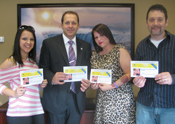
The Epilepsy Niagara team is joined by Niagara Falls Mayor Jim Diodati in support of the agency’s participation in the Aviva Community Fund contest. From left to right, support services co-ordinator Stacey MacNeil, Jim Diodati, executive director Kristin Welton and community outreach co-ordinator Bob Romeo.

Epilepsy Niagara is competing for funding in the nationwide Aviva Community Fund contest. If it gets enough public votes on the contest’s website, the agency will be better positioned to have its proposal, which centres on raising epilepsy awareness by engaging local schools and the business community, considered by a judging panel.

The awareness campaign would aim to educate people about epilepsy and help erase negative perceptions of the neurological disorder, explains Epilepsy Niagara outreach co-ordinator Bob Romeo. From experience, Romeo says this has been an effective strategy.

“There’s a stigma towards (epilepsy) and every time we go out and do different presentations and things like that people are blown away with the information because they may have a student or a co-worker who has epilepsy,” says Romeo.

“We try to talk about how every person reacts to a seizure differently. We want to get that (type of information) out in the community and let everyone know how many people are affected. We would like to go around to businesses as well to let employers know that you can hire someone with epilepsy, that they can work like anybody else.”

The epilepsy awareness multimedia campaign proposed includes running print and radio advertisements as well as creating an awareness video that would be played at businesses and schools.

Epilepsy Niagara executive director Kristin Welton says people should also know that if an awareness video were produced as a result of funding it could be used to better educate people about epilepsy from coast to coast.

“This isn’t just a Niagara-based multimedia campaign — it’s something that can be used throughout the province and across Canada. It benefits everyone who is living with or is affected by epilepsy,” she says.

Romeo adds the long-term effect from an epilepsy awareness multimedia campaign would be more understanding about the neurological disorder as well as other facets of awareness, such as epilepsy first-aid training for schools and businesses.

The epilepsy support agency entered the Aviva Community Fund contest in the autumn and has made it to the semi-final round of voting, which will run Dec. 3-12, with judging to take place Dec. 20 to Jan. 28. The organization has entered the medium funding contest, which provides a $50,000 to $100,000 prize to one winner.

As part of the competition, community organizations submit fundraising ideas, budgets and goals. Organizations then use social-media tools like Twitter and Facebook to get votes by spreading awareness of what they’re trying to achieve.

You can cast your vote for Epilepsy Niagara by clicking here.

If you have feedback on this story, or have a story of your own that you would like to share, please contact the newsroom at 800-294-0051, ext. 23, or e-mail deron(at)axiomnews.ca. You can also leave a comment below.

Writer: Deron Hamel

Survey seeking first-hand stories about living with epilepsy

November 22, 2012

A new survey available on the Epilepsy Ontario website is aiming to discover what the epilepsy community wants to talk about and to seek out people’s experiences of living with the neurological disorder and the key issues important to them.

Epilepsy Ontario executive director Rozalyn Werner-Arcé says the organization is hoping the survey will provide feedback that will help drive the Voices of Epilepsynews program in a direction that will result in more people-centred stories that get to the heart of issues.

Epilepsy Ontario executive director Rozalyn Werner-Arcé

People’s experience with employment, human rights and medication issues — these are some of the story possibilities Werner-Arcé says should be highlighted more often through the Voices of Epilepsy.

“We want to ensure that the Voices of Epilepsy truly reflects the voices of our readership.,” she explains.

“We want the content to be of interest to our readership as well as reporting on issues that are relevant to the epilepsy community.”

Storytelling is an influential tool when Epilepsy Ontario meets with government officials to discuss the concerns and needs of the epilepsy community, she adds.

“There is nothing more powerful than storytelling — we’ve seen that when we are meeting with government,” she says.

“Personal stories help others living with epilepsy realize they are not alone, illustrate the variety of different experiences — both good and bad — that people with epilepsy may have, and can inspire individuals and the whole community.”

While stories told from the perspective of those living with seizure disorders and their families isn’t new to the Voices of Epilepsy, it’s something Werner-Arcé says the organization wants to see happen more regularly.

Examples of stories published on the website illustrating the people-centred approach to stories the organization is hoping to see more of include:

A mother’s struggle to obtain a new vagus nerve stimulator for her daughter
An Ottawa police officer’s mission to educate law-enforcement officials about seizure disorders
A young woman’s account of why the province needs an epilepsy strategy

You can access the survey by clicking here.

“I really urge people to take a few minutes to fill this out,” says Werner-Arcé.

“The Voices of Epilepsy is really for our stakeholders, our epilepsy community, but it is also a tool to educate the public about the condition, so we really want to maximize this opportunity.”

If you have feedback on this story, or have a story of your own that you would like to share, please contact the newsroom at 800-294-0051, ext. 23, or e-mail deron(at)axiomnews.ca. You can also leave a comment below.
 
Writer: Deron Hamel

OBI-funded research projects progressing well

November 15, 2012

Progress is being made in several epilepsy research projects launched earlier this year to discover new treatments and therapies for people affected by the neurological disorder.

Scientists involved in these projects, which include research into new medications, breakthrough diets and brain stimulation, among others, gathered in Hamilton this past weekend to share updates on their research since funding was granted by the Ontario Brain Institute (OBI) earlier this year.

From left to right, Dr. Jorge Borneo and Dr. Mac Burnham, co-directors of the OBI Epilepsy Research Project


Research into more than 20 areas related to seizure disorders began in the spring. A reapplication for funding is expected to be made by the researchers in early 2013.

The Hamilton conference was aimed at bringing the researchers together to find out how much progress they had made and discussing what information to put in their reapplication, says director of the University of Toronto Epilepsy Research Program and co-director of the OBI-Epilepsy Research Project, Dr. McIntyre Burnham.

It was also an opportunity to engage with representatives from the epilepsy nonprofit advisory committee and ensure that the voice of people with epilepsy was heard throughout the discussion.  In order to improve people’s overall quality of life, co-operation and collaboration between research, clinical care and epilepsy support agencies must become the norm.    

Burnham, who is involved with projects studying the role of diet in seizure control, notes some of the highlights of the research to date:

— Animal studies are showing omega-3 fish oils are elevating seizure threshold. Since omega-3 fish oils are a food additive, as opposed to a medication, researchers don’t have to go through the same development process they do for pharmaceuticals, which can take up to 10 years. Development of food additives can start immediately. Burnham says researchers are looking to add omega-3 fish oil to people’s normal diets, with the anticipation that seizure numbers will be reduced after three months.

— Dr. Gabriel Ronen of McMaster University is conducting a study on the benefits of exercise for children living with epilepsy. The study is monitoring a group of children with epilepsy who are involved in a walking program and comparing their seizure numbers to children with epilepsy who are not participating in regular exercise. “Their hypothesis is that the kids who get exercise will have fewer seizures,” says Burnham.

— Acetone analogues are being tested in animals and preliminary results are indicating some of the acetone analogues are anticonvulsant. Acetone in the bloodstream has been found to be elevated in people who use the ketogenic diet, which favours foods low in carbohydrates.

— Dr. Elizabeth Kerr, at the Hospital for Sick Children, is researching ways to improve working memory in children with intractable epilepsy using a commercially available computer-based training program.

Burnham says he and the other researchers attending the conference are pleased with the progress made.

“At the end of our second quarter everybody was on track toward meeting their milestones, and we’re pretty happy about that,” he says.

If you have feedback on this story, or have a story of your own that you would like to share, please contact the newsroom at 800-294-0051, ext. 23, or e-mail deron(at)axiomnews.ca. You can also leave a comment below.

Writer: Deron Hamel

Task force to create international epilepsy guidelines established

November 9, 2012

A task force to create international epilepsy guidelines for physicians and researchers has been recently established, with the goal of bringing together best practices from around the world that address issues related to epilepsy treatment and research.

The International League Against Epilepsy (ILAE) Task Force on Guidelines in Epilepsy was set up to encourage experts from around the world to work together to discover each others’ best epilepsy guidelines related to diagnosis, testing, medications, imaging, surgery and many other topics.

Dr. Nathalie Jette of the
University of Calgary and
Hotchkiss Brain Institute
Institute of Public Health

The ILAE website describes the organization as “the world’s preeminent association of physicians and other health professionals working toward a world where no persons’ life is limited by epilepsy.”

One purpose of the task force is to mitigate the amount of time and resources spent generating different guidelines around the world that essentially come to the same conclusions, explains Dr. Nathalie Jette, an associate professor of neurology at the University of Calgary and the task force’s co-chair.

The task force also wants to develop ways to ensure best practices related to epilepsy treatment and research reach as many clinicians and researchers as possible — having so many countries with their own guidelines creates a stumbling block in this respect, says Jette.

Often, she says, guidelines will be published and those clinicians who have a special interest in epilepsy will read and implement the recommended practices, but the guidelines don’t reach as many physicians who are treating people with epilepsy as they should.

To date, the task force has been performing a systematic review to identify the most effective published epilepsy guidelines from around the world from almost 7,000 documents.

The task force is aiming to examine all the documents by the end of December and complete the data abstraction by the end of March.

“Then, we will be coming up with recommendations and deciding where we will go from there,” says Jette.

Jette explains the best possible long-term result from international epilepsy guidelines:

“If there are some guidelines which can be effectively implemented, then it should decrease disparities in care, it should decrease the treatment gap and it should improve outcomes for people with epilepsy,” she says.

An established set of international epilepsy best practices also fills a gap in Canada, where there is no Canadian-specific set of epilepsy guidelines, says Jette.

Canadian practitioners and researchers are currently using other guidelines from the American Epilepsy Society, the American Academy of Neurology and the ILAE.

If you have feedback on this story, or have a story of your own that you would like to share, please contact the newsroom at 800-294-0051, ext. 23, or e-mail deron(at)axiomnews.ca. You can also leave a comment below.

Writer: Deron Hamel