
Author Archives: eCreative Studios

Client-pharmacist relationship crucial for those with complex disorders during clobazam shortage

January 31, 2013

Having a strong client-pharmacist relationship can make a difference to a person living with a seizure disorder in times of a medication shortage, and for people like Kayleigh Boyd, who is affected by seizures as a result of having Rett syndrome, the client-pharmacist relationship can be even more crucial, says her mother, Terry.

Kayleigh Boyd, 25, was fortunate to have a pharmacist who secured a supply of clobazam during the shortage. For Kayleigh, who has seizures as a result of having Rett syndrome, access to this medication is crucial.


Rett syndrome is a complex disorder affecting females almost exclusively. Children begin life with normal development and then have a regression and loss of speech and motor skills. Epilepsy is a common feature of Rett syndrome. Seizure management is one of the most challenging aspects of this complex disorder that can also include mobility loss, breathing problems, as well as speech and cognitive impairments.

 
For a person living with Rett syndrome who is affected by seizures, shortages of a medication like clobazam can lead to a life-threatening situation.

Fortunately, due to her strong client-pharmacist relationship, Terry, who is also president of the Ontario Rett Syndrome Association, was able to have Kayleigh’s pharmacist secure a six-month supply of clobazam after Epilepsy Ontario informed her of the shortage in early January.

The only reason the medication was secured was because the pharmacist made the effort to go to a secondary supplier to obtain clobazam after the primary supplier was found to be out of stock, says Terry.

But not everyone can expect to have the same outcome, says Terry. Because it may not be cost-effective, many pharmacists will not go to a secondary supplier to obtain medication during a shortage, she adds.

“And this is going to be an issue for many families: to find a pharmacist who is willing to be paying for an extra supply and then wait for payment to come from the government,” Terry explains.

In the case of people with serious, complex conditions, having a strong client-pharmacist relationship can help the pharmacist better understand the severity of a situation — and likely encourage them to go the extra mile for the client.

Many in the epilepsy community are stressing the need for legislation making it mandatory for pharmaceutical companies to issue warnings whenever there is an impending drug shortage.

Epilepsy information specialist Suzanne Nurse notes how a clobazam shortage can be especially precarious for people living with complex disorders like Rett syndrome.

“I have heard from people with complex and drug-refractory epilepsy disorders who have had negative consequences in the past when they were  switched from clobazam made from one pharmaceutical company to a formulation of clobazam from another company, such as increased seizures, changes in mood and a worsening of their condition,” explains Nurse.

“Not having the drug at all is something that people don’t even want to think about, and pray that they will not have to face. Indications this week are that the clobazam shortage is easing, which is a tremendous relief to everyone who relies on this drug.”

If you have feedback on this story, or have a story of your own that you would like to share, please contact the newsroom at 800-294-0051, ext. 23, or e-mail deron(at)axiomnews.ca. You can also leave a comment below.
 
Writer: Deron Hamel
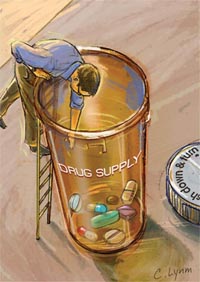
Alternative drug therapy, close physician contact recommended during clobazam shortage

January 24, 2013

People who are taking clobazam for seizures and are at risk of running out of the drug should be discussing alternative drug therapies with their prescribing physician. This can help to ensure that the patient-doctor relationship is strong, says Dr. Jose Martin del Campo.

A medication alternative recommendation from Martin del Campo, a neurologist at the Krembil Neuroscience Centre in Toronto, and London Health Sciences Centre neurologist Dr. Jorge Borneo, was published Jan. 21.DrugShortage

The recommendation states that if people who are prescribed clobazam are affected by the shortage, they should talk with their prescribing physician about alternative medications and treatment options such as clonazepam.

Clonazepam, like clobazam, is an anticonvulsant that is also a benzodiazepine. Serious withdrawal symptoms can develop when a benzodiazepine medication is halted or reduced, which is why clonazepam is being recommended.

Martin del Campo underscores that clonazepam is not a long-term substitute for clobazam.

“There is no ‘what do you prescribe instead,’ because there has never really been a study that proves that the current recommendation of using clonazepam is effective in controlling the seizures,” he says.

“This is a big deal because we don’t really have an effective alternative drug.”

Martin del Campo also recommends that people with seizure disorders who are taking clobazam maintain a close relationship with their prescribing physician throughout the duration of the shortage.

Close patient-doctor relationships will allow the physician to monitor the patient if they’re taking an alternative medication. Also, in cases where individuals remain on clobazam, it is important to stay in regular contact with their physician to develop an alternative treatment plan, should they become affected by the shortage.

Should a patient with no alternative medication therapy plan run out of clobazam, Martin del Campo does not recommend they go to their local emergency room. Simply put, the attending doctor likely will not know what to do.

“It’s more practical to advocate through the family physician, so if the neurologist isn’t available, the next person that should see the person is their GP, because the GP has been in contact with the treating neurologist,” says Martin del Campo.

In the meantime, Martin del Campo emphasizes that pharmaceutical companies need to start playing a greater role to ensure the public has more notice of impending drug shortages.

“If they were to alert the public that (a shortage) may be coming, it would alert the pharmacists to try to get sufficient stock, because pharmacists should know how many prescriptions for Drug X (they will need), or where they could get some more,” he says.

If you have feedback on this story, or have a story of your own that you would like to share, please contact the newsroom at 800-294-0051, ext. 23, or e-mail deron(at)axiomnews.ca. You can also leave a comment below.

Writer: Deron Hamel

The following file has information you can discuss with your health care provider if your pharmacist is unable to refill your prescription for clobazam:
Download Medical Recommendation for Adults with Epilepsy

Note from Epilepsy Ontario: We received notification on Jan. 24 from Apotex Inc. (one of the companies manufacturing clobazam) that a shipment of Apo-Clobazam was released earlier than predicted. While this is good news for people who are taking clobazam for seizure control, this does not resolve the issue of lack of drug shortage notification. For some additional information on other brands of clobazam that are in short supply visit the following website:  drugshortages.ca. Pharmaceutical companies report information about drug shortages on a voluntary basis, therefore the information available on this national reporting website may not be complete or up-to-date. The best source of information regarding the availability of clobazam is your pharmacist.

Back to Top

National action plan could curb impact of drug shortages

January 17, 2013

Daryl Yeo discovered there was a clobazam shortage after receiving an e-newsletter from Epilepsy Ontario Jan. 4 announcing a warning to those needing the seizure control drug. For Daryl, the president of Epilepsy Toronto and father of a woman with epilepsy who takes clobazam, this is a sign that things need to change.

Upon learning of the medication shortage, Daryl called his 33-year-old daughter, Lindsay, to let her know she needed to contact her pharmacy to get more information about the shortage. It turned out the pharmacy was out of stock.

Daryl and Lindsay Yeo

While Lindsay eventually obtained the medication from another pharmacy, Daryl says it was only because of Epilepsy Ontario’s e-mail alert that she found out in time.

“If I hadn’t got the notice from Epilepsy Ontario giving us the heads-up, Lindsay wouldn’t have found out until probably a couple of days ago,” says Daryl, adding that if people needing a medication only find out about shortages when they go to refill their prescription it can be too late.

This incident, says Daryl, underscores the need for pharmaceutical companies to announce warnings of drug shortages before they happen — and a push from government to communicate to the public whenever drug shortages occur to ensure people can make necessary arrangements, should their medication become unavailable.

Daryl says many people in the epilepsy community share this opinion. What’s needed, he says, is a unified voice to make things happen — and not just from the epilepsy community.

Drug shortages can affect anyone undergoing medication therapy for any number of medical conditions. Daryl says the best possible way to address the need for a national warning system would be for epilepsy agencies to collaborate with other advocacy groups, such as cancer, heart and stroke and mental health agencies, to create a unified voice.

“(We need) to speak with one loud voice where people . . . can inundate their MPs, ministers and the prime minister with e-mails saying that in a country like Canada, there’s no reason why we can’t have a more effective system and here’s (what can be done),” says Daryl.

Giving people ample notice of medication shortages would maximize the time needed for people to refill prescriptions or work with their doctor to develop alternative medication plans, says Daryl.

Additionally, there’s a safety benefit to having a warning system in place, he says.

“Clobazam, for instance, you can’t just quit cold turkey, you need to wean yourself off, and if you’re going to move to an alternative drug you need to do that over a period of time,” Daryl says.

Although there is a national website — drugshortages.ca — where pharmaceutical companies post medication shortage advisories, it’s a voluntary system. Daryl says posting advisories needs to become mandatory and that push needs to come from government.

“(That system) is not working, in my mind. When I got the notice through Epilepsy Ontario, I went onto the site (and there was) no reference to clobazam whatsoever,” says Daryl.

In addition to an improved notification system, there needs to be an effective response plan in place to minimize or prevent anticipated shortages, says epilepsy information specialist Suzanne Nurse.

This, Nurse says, should include an early notification to patients and their health-care providers when drug shortages cannot be avoided.

“The other essential component we need is for government and industry to work together on potential solutions if a drug shortage is anticipated,” she says.

“Ideally, this would prevent a potential supply disruption from evolving into an actual drug shortage at community and hospital pharmacies.”

You can sign up for Epilepsy Ontario’s weekly e-news by clicking here.

If you have feedback on this story, or have a story of your own that you would like to share, please contact the newsroom at 800-294-0051, ext. 23, or e-mail deron(at)axiomnews.ca. You can also leave a comment below.

Writer: Deron Hamel

Unable to get clobazam? Work with your doctor, pharmacist

January 10, 2013

If people who take clobazam to control their seizure disorder are unable to obtain the medication, they need to be working with their doctor and pharmacist to develop an alternative drug-therapy program.

Karen Sullivan, Shoppers Drug Mart’s director of pharmacy professional affairs for Western Canada

This is the message Karen Sullivan, Shoppers Drug Mart’s director of pharmacy professional affairs for Western Canada, recently shared with the Voices of Epilepsy in the wake of an announcement of a clobazam shortage.

Clobazam, which is marketed by several pharmaceutical companies in Canada, is a common medication prescribed to people with seizure disorders. The medication is usually prescribed to work in tandem with other pharmaceuticals. Some manufacturers have recently been reporting back-orders of clobazam, due to a current shortage of active pharmaceutical ingredients, the raw materials used in the manufacturing of medications.

This supply shortage may or may not affect individuals who take clobazam, depending on which manufacturer makes their medication and other factors, such as the amount of stock their pharmacy has on hand and the duration of the supply problem.

Should you find yourself unable to obtain clobazam, Sullivan says your first step should be to speak with your pharmacist, who may be able to track down a prescription for you. The next option should be to speak with your physician who, by working with your pharmacist, may be able to design an alternative medication plan for the duration of the supply shortage, she adds.

“The physician who is overseeing their care is going to be in the best position to assess what some of those alternatives may be,” says Sullivan.

Sullivan says the supply shortage is an issue anyone taking clobazam should be aware of and, because it is an older seizure-control medication, there are not as many alternatives available, making it even more critical that consultation between the patient, pharmacist and physician occurs.

“That’s where they can look at the patient’s past history and what previous therapy decisions have been made, and how that might affect any decisions they might need to make regarding alternatives,” says Sullivan.

If you take clobazam, Epilepsy Ontario recommends you contact your pharmacy to ask about the medication’s supply. If your pharmacist is unable to fill your prescription, contact your health-care provider immediately. Do not make any changes to your treatment — for example, skipping doses, reducing the dose, or discontinuing the drug — without consulting your doctor.

If you have feedback on this story, or have a story of your own that you would like to share, please contact the newsroom at 800-294-0051, ext. 23, or e-mail deron(at)axiomnews.ca. You can also leave a comment below.

Writer: Deron Hamel