
Author Archives: DHamel

Need for social, emotional support the greatest concern for children with epilepsy: study

June 4, 2015

By Deron Hamel

Canadian children living with epilepsy say it’s their need for social and emotional support from friends and family – not their seizures – that concerns them most about their quality of life.

300This is the main finding from a recent study that surveyed 480 children aged eight to 14 who are living with active or medication-managed epilepsy. The children, who were patients from six Canadian paediatric epilepsy tertiary care ambulatory programs, were surveyed on 25 questions directly related to their quality of life using the Child Epilepsy Quality of Life Questionnaire.

“I think this article highlights the fact that we should be very careful about not dismissing children’s perceptions of their lives because we may be missing a very important point of view,” Dr. Nora Fayed, a McMaster University researcher and the study’s lead author, says in an interview with Neurology Today.

Suzanne Nurse, Epilepsy Ontario’s director of information and client services, says the study’s findings reinforce a concept that has been gaining momentum in recent years, “and which any individual or family living with epilepsy can attest to – that epilepsy is more than just seizures.”

“We’re very happy to see research with a focus specifically on the child’s point of view and wish that good quality of life indicators would be added to more studies, such as clinical trials for epilepsy treatments,” Nurse says.

For those working with people living with seizure disorders, improving quality of life is the No. 1 goal, Nurse adds. The study, she notes, is another step towards helping children with epilepsy enhance their quality of life.

“This study gives us a better understanding of the factors that make the biggest difference in the lives of children with epilepsy,” Nurse says. “With this knowledge we can focus our efforts where they matter most.”

If you have feedback on this story, or have a story of your own that you would like to share, please contact the newsroom at 800-294-0051, ext. 23, or e-mail deron(at)axiomnews.com. You can also leave a comment below.
Possibility of life-enhancing change energizes new executive director

May 28, 2015

By Lisa Bailey

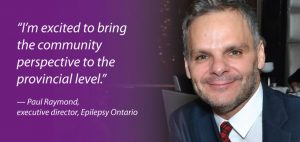
With involvement at the local, provincial and national level of epilepsy agencies, Paul Raymond has gained new perspective on the realities and challenges for people living with the seizure disorder.

LG-Paul-Raymond-QuoteNow, as Epilepsy Ontario’s new executive director, he’s energized by the prospect of helping to change the landscape and enhance the lives of people throughout the province.


“It (Epilepsy Ontario) is a great organization, this is a great opportunity,” he says. “And I came from an agency of Epilepsy Ontario so it’s nice to be able to move on to new challenges.

“I loved the local agency role, the hands-on (aspect of it), but I’m really excited about some of the larger-scale issues especially around advocacy and effecting provincial change.”

For instance, Raymond says, Epilepsy Ontario is engaged with a number of provincial ministries on various issues, such as enhancing care for people living with epilepsy and educating teachers to lessen fear and boost preparation around a possible seizure incident at school.

“There are issues where we’re really trying to make changes so we can improve the quality of life of people living with epilepsy across the entire province,” Raymond says.

His past roles and experiences have generated a solid education and understanding of many advocacy issues. Raymond was Epilepsy York Region’s executive director for the past eight years. Before that, he had been Epilepsy Ontario’s fund development director and Epilepsy Canada’s communication director.

“Each level has given me a very different perspective,” Raymond says.

His work at the national level gave him a sense of the differences across the country. With Epilepsy York Region, he provided front-line services to people living with epilepsy and learned about the challenges they face.

“With every step closer to the community, I gained a much better understanding from that face-to-face connection with people living with epilepsy,” Raymond says. “They were coming into my office and I was meeting them. And that’s what I think really prepared me for the role at the provincial office – it’s having that front-line contact with what the real issues are.”

Those issues range from medication side effects and public transportation access to the negative perception of people who live with epilepsy, and the paralyzing fear of having a seizure in public. These issues can cascade and lead to depression and isolation.

“The fear of having a seizure in public is so great that (people living with epilepsy) choose not to go out and not to contribute to society – not to seek employment or not to volunteer because the issue is just overwhelming to them.”

Hearing these stories first-hand has given Raymond a real personal perspective on issues that he can then share with elected officials and public servants.

“To relay the individual stories of people living with epilepsy is absolutely critical,” he says, expressing hope that it will heighten understanding and awareness of what are complicated challenges so they can then be addressed.

Raymond says he’s come to Epilepsy Ontario at a good time; he commends his predecessor, Rozalyn Werner-Arcé, and the board of directors for defining in recent years a clear role for the organization and growing its credibility as a “go-thru” agency connecting people with local support partners and agencies.

He hopes to enhance those connections even more with his strengths in communication and team building.

“I really see Epilepsy Ontario working with all of the agencies in Ontario as a cohesive group . . . I think my contribution would be bringing the agencies and the provincial level together and working together to make all of Ontario a better place for people living with epilepsy.”

If you have a story to share or feedback on this article, please contact the newsroom at 800-294-0051, ext. 25, or e-mail lisa(at)axiomnews.com.

Parents applaud Summerfest’s impact on their children

May 21, 2015

By Deron Hamel

Parents of children attending Summerfest Camp say the annual camping experience enhances independence, builds self-confidence and drives personal development.

A scene from Summerfest Camp.

Speaking with Voices of Epilepsy in 2014, Philippa Howell recalled how she had concerns when her daughter, Georgina, went to her first Summerfest Camp in 2010.

Georgina, then eight, had never been away on her own before. Georgina also has intractable myoclonic epilepsy. But concerns Philippa had would go away when she saw the positive impact the camping experience was having on her daughter.

Philippa recalled how a couple of weeks before Georgina was to go to Summerfest Camp one year she pulled out her T-shirt from Camp Couchiching, where Summerfest Camp is held each year, and said “campfire.”

“And then she wore that T-shirt as often as she could … and she kept saying, ‘When are we going for a campfire?’ It suddenly dawned on my husband and I that she had associated the picture of the campfire on the T-shirt … as somewhere she enjoyed going,” Philippa said.

“Immediately, any worry, or fear or stress we might have had about her being anxious about being away from us evaporated. …

“Four years later, I am shocked at how young (Georgina) was when I let her go (to Summerfest) but now I think, ‘Thank goodness’ because the experience she has at the age of 12 has blossomed — she’s grown and grown because of (Summerfest).”

Parent Nicole Graham also attests to the benefits of Summerfest Camp. Like Philippa, Nicole had concerns about her daughter attending the camp. As the mother of a child with epilepsy, Nicole says she often supervises Alexa in many of her daily activities.

However, when Alexa is at Summerfest Camp, she does those activities on her own — and wants to continue doing so when she returns home.

“There’s a lot of personal development that happens at Camp Cooch,” Nicole says.

Now in its 21st year, Summerfest Camp has an average of 20 to 40 children and youths who have epilepsy attend the program; they participate in activities such as swimming, hiking, kayaking and sports. The camp is staffed with people trained in how to work with children living with epilepsy.

Summerfest Camp was founded in 1994 by Anita Allen, a neurology clinic nurse at Toronto’s Hospital for Sick Children (SickKids). The camp enables children aged six to 15, who are living with seizure disorders, to attend camp with other children. Camp Couchiching provides a setting where children can forget about their epilepsy.

Epilepsy Ontario is hosting its second annual fundraising cruise in support of Summerfest Camp in Toronto on June 17. The Summerfest: Sail Away cruise, which includes a buffet dinner, dancing, silent auction, 50-50 draw and gift-giveaways, will coast along Lake Ontario’s shoreline for three hours. Tickets can be purchased online by clicking here.

If you have feedback on this story, or have a story of your own that you would like to share, please contact the newsroom at 800-294-0051, ext. 23, or e-mail deron(at)axiomnews.com. You can also leave a comment below.

Phase 3 trial to provide clearer picture of CBD’s side effects: researcher

May 14, 2015

By Deron Hamel

The third phase of a study examining the impact of cannabidiol (CBD) on people living with severe, drug-resistant forms of epilepsy will paint a clearer picture as to whether or not the cannabis extract has any side effects, says epilepsy researcher Dr. McIntyre Burnham.

CBD_300Phase 2 of the multi-centre study, which was presented at a recent American Academy of Neurology meeting, involved 213 people aged two to 26 living with more than 10 severe, drug-resistant types of epilepsy, including Dravet syndrome and Lennox-Gastaut syndrome, both of which can result in lifelong seizures and intellectual disability.

CBD is an extract from the cannabis – or marijuana – plant. Unlike THC, the most abundant chemical compound in cannabis, CBD will not get people “high.” CBD is the most abundant, non-psychoactive chemical compound in cannabis.

Study participants were given a liquid form of CBD, administered orally to complement their regular treatment. The study was an open-label trial, meaning there were no placebos administered to participants.

Only 10 participants – five per cent of those involved with the study – stopped taking CBD because of side effects.

“They’ve never found very many serious side effects of this compound,” Burnham tells Voices of Epilepsy. “In the recent trials, generally speaking, the side effects were not too serious and passed. The most common ones were sleepiness and some stomach upset.”

However, Burnham says that because the study was an open-label trial, the participants, plus their families and the researchers, were aware they were taking CBD, which can create a margin of error.

“You don’t really trust reports of side effects until you have it in a double-blind situation,” he says.

Phase 3 of the study will be double-blind trials. In other words, neither the doctors nor the participants will know who is getting CBD and who is taking the placebo.

“In double-blind trials you always assess how many of the patients are in the drug arm and compare it to how many patients in the placebo arm got it (the adverse event). We don’t have the placebo arm in (Phase 2 of the) study, so you can’t really make much statement about side effects,” Burnham says.

“Everyone’s always very careful about interpreting Phase 2 studies.”

If you have feedback on this story, or have a story of your own that you would like to share, please contact the newsroom at 800-294-0051, ext. 23, or e-mail deron(at)axiomnews.com. You can also leave a comment below.