
Author Archives: DHamel

Epilepsy is my motivator, says student

July 30, 2015

By Deron Hamel

Andreia Real says she has found living with epilepsy to be more of a motivator than a challenge.
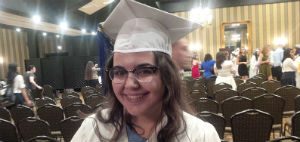
Andreia Real is seen here at her recent high-school graduation.

She first began experiencing febrile seizures as a young child, but wasn’t diagnosed with epilepsy until age 15, after having two severe seizures.

After being diagnosed, Andreia says her first reaction was “why me?” But her older brother had a conversation with her about epilepsy that ensured her positive perspective. He explained the risks of the condition, but also provided her with the names of notable people who also have epilepsy.

“Immediately, my perspective of epilepsy changed,” Andreia says, adding that this conversation fuelled her ambition to strive for great heights. She began dedicating herself more to her studies and extracurricular activities.

“My condition has not impeded my dreams but liberated them,” she says. “Ironically, (a condition) that at first I thought had disabled my future has actually shaped it and given my life purpose.”

Andreia, who graduated from Loretto College School in Toronto in June, says her teachers took notice of her resilience; they made her a “mindful ambassador,” a group of students selected to discover innovative methods of dealing with challenges affecting the school’s community.

In September, Andreia will be attending the University of Toronto to study criminology. Her goal is to become a lawyer so she “can use the law to better the community.”

“I want to provide affordable counsel to my community so that anyone that requires justice can achieve it,” she says.

To help with her educational pursuits, Andreia has received an OBCL Epilepsy Scholarship Award. She is one of four students to receive the award this year. The scholarships were presented to recipients June 17 during Epilepsy Ontario’s Summerfest: Sail Away cruise in Toronto.

OBCL has been supporting students with epilepsy through the scholarship awards since 2006. Every year, up to 10 Ontario students win a $1,000 scholarship for post-secondary education. As part of their application package, students must submit a personal essay under that year’s theme.

In the meantime, Andreia is looking ahead to her future with optimistic zeal.

“No one knows what the future holds, but I can guarantee one thing, I will not be using epilepsy as a reason to not achieve my goals; I will use it as my motivator,” she says.

If you have feedback on this story, or have a story of your own that you would like to share, please contact the newsroom at 800-294-0051, ext. 23, or e-mail deron(at)axiomnews.com. You can also leave a comment below.

New report provides Ontario-specific findings for epilepsy and other brain disorders

July 23, 2015

By Deron Hamel

The collective impact and prevalence of brain disorders, including epilepsy, in Ontario is explored in a new report developed by the Ontario Brain Institute (OBI) and the Institute for Clinical and Evaluative Sciences (ICES).

Specifically, the report, which was published in July, provides an understanding of the cumulative prevalence of 13 brain disorders in Ontario.

“We wanted to get an understanding of what brain disorders look like in Ontario,” explains Jordan Antflick, the OBI’s manager of knowledge translation. “We didn’t have an accurate picture of that ever before.

“This is an objective take looking at what brain disorders look like from the perspective of the health-care system and defining them collectively as brain disorders, including mental health and neurological diseases,” he says.

“The whole idea of looking at them together begins to paint a picture of the collective impact – who’s living with brain disorders, how many new cases there are every year and (what) the cost is from the health-care system perspective.”

In short, the report will help make an economic case for the impact of brain disorders in Ontario, Antflick says.

“It gives us a very keen understanding of the costs and some of the drivers of these costs – (such as) hospital costs,” he says. “This (report) helps with policy and planning decisions to determine what services need to be invested in to support people living with epilepsy.”

Key points in the report related to epilepsy include:

– Almost 90,000 Ontarians identified as having epilepsy during the study period of 1995-2011
– The average one-year health-care cost per person with a new diagnosis of epilepsy was $10,631
– Publicly funded health-care costs are highest for people 65 and older
– Among people who have epilepsy, more than 50 per cent of their health-care costs attributed to hospital visits and physician care

Antflick says the study is unique to Canada and Ontario because Ontario has a single payer for all publicly funded health care. This allows all transactions people make within the health-care system – including doctor and hospital visits as well as publicly funded prescriptions – to be tracked and the information stored in a single database.

This database, which is overseen by ICES, was never intended for research purposes; however, the organization has been working for many years to figure out how to use the data for research purposes as well as to understand how the health-care system works and how to make it more efficient, Antflick says.

“We have created a very rich source of data that’s standardized and provides a very accurate perspective of the health-care system, (and) we have the clinical expertise and the people who understand this data and make sense of it, and that’s who we worked with to create this report,” he says.

Click here to read the report.

Click here to read Epilepsy Ontario’s overview of the report.

If you have feedback on this story, or have a story of your own that you would like to share, please contact the newsroom at 800-294-0051, ext. 23, or e-mail deron(at)axiomnews.com. You can also leave a comment below.
Scholarship winner began advocating for epilepsy awareness shortly after diagnosis

July 16, 2015

By Deron Hamel

It wasn’t long after Sarah Hysenaj had her first seizure that she became an epilepsy awareness advocate.

Sarah was 11 years old and on a school field trip when she had her first seizure in front of her classmates. Fortunately for Sarah, her teacher knew exactly what was happening and what to do.

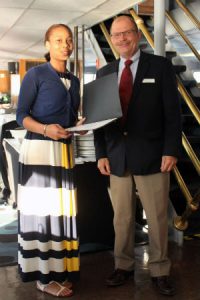
OBCL scholarship recipient Sarah Hysenaj is seen here with OBCL president Lawton Osler during the presentation of her award.

“My teacher had a brother with epilepsy and immediately recognized my symptoms and knew what was occurring and how to take care of me,” Sarah recalls. “My teacher called my parents and explained everything, and my mom was able to provide this information to my paediatrician, who made the referral to a neurologist.”

That was seven years ago.

After her diagnosis, Sarah, who recently graduated from Rosedale Heights School of the Arts in Toronto, began raising awareness of epilepsy. She launched a unique initiative called Strings For Life, which sees noted musicians donate their used guitar strings to Sarah who uses them to make beaded jewelry that she auctions off at the Epilepsy Toronto Busker Ball.

Celebrities who have donated their guitar strings include record producer Daniel Lanois, Blue Rodeo guitarist Jim Cuddy, American country singer Iris DeMent and members of the Late Show with David Letterman band.

One day after an appointment with her neurologist, Sarah was with her mother and they were passing the CN Tower, which was lit up red in honour of Remembrance Day. She recalls wondering if there was a day to mark epilepsy awareness. This was before March 26 was designated as Purple Day in 2008.

Remembering her experience looking at the CN Tower a few years earlier, Sarah helped with the effort to have Toronto’s most famous landmark lit up purple on Purple Day in 2009.

In September, Sarah will be attending Ryerson University’s photography studies program. To help with her educational pursuits, Sarah has received an OBCL Epilepsy Scholarship Award. She is one of four students to receive the award this year. The scholarships were presented to recipients June 17 during Epilepsy Ontario’s Summerfest: Sail Away cruise in Toronto.

OBCL has been supporting students with epilepsy through the scholarship awards since 2006. Every year, up to 10 Ontario students win a $1,000 scholarship for post-secondary education. As part of their application package, students must submit a personal essay under that year’s theme.

For Sarah, living with epilepsy is all about maintaining a positive state of mind. She notes that she has faced several other challenges, including a learning disability and anxiety, but she approaches them as opportunities rather than difficulties.

“Choosing to consider them as opportunities helped me to have a sense of control over challenge,” Sarah says. “These opportunities, in turn, helped me to improve myself, gain confidence and independence, and therefore because of these challenges I don’t believe I would have become the person I am today and for that I am grateful.”

If you have feedback on this story, or have a story of your own that you would like to share, please contact the newsroom at 800-294-0051, ext. 23, or e-mail deron(at)axiomnews.com. You can also leave a comment below.

Student attributes surging self-confidence after seizure diagnosis to family, friends

July 9, 2015

By Deron Hamel

When Anya-Belle Brown began having seizures in Grade 8, she says she began to lose her self-confidence and found it challenging to complete her schoolwork.

OBCL scholarship recipient Anya-Belle Brown is seen here with OBCL president Lawton Osler during the presentation of her award.

Her condition would not be diagnosed for a few years, and in the meantime she continued to experience seizures, which caused Anya-Belle to fall asleep and exhibit “unusual behaviour patterns.”

Eventually, Anya-Belle was diagnosed with ring chromosome 20 syndrome, which is caused by the arms of the normally straight 20th chromosome to curl and form into a ring shape. The condition often produces seizures.

Unfortunately, Anya-Belle didn’t receive much support from her teachers; she recalls how one teacher didn’t even believe she had a seizure disorder, which shook her self-confidence even more.

While Anya-Belle continues to experience about six seizures per day, understanding her condition, coupled with the support she receives from family, friends and some of her teachers, has been a game-changer, she says.

“They encourage me every day to do well and to put my best foot forward; they’re my champions, they cheer me on during every race, and they seek out the best possible resources for me to succeed,” Anya-Belle says. “They always expect the best from me … I don’t know where I would be without their never-ending support.”

Anya-Belle’s family and friends, she adds, educate people about her seizure disorder to help them understand the condition and how to respond to it.

Anya-Belle says this outpour of support has resulted in an upswing in her self-confidence, which has helped her segue into the next phase of her life. In September, she will attend Sheridan College’s journalism program.

“Today, I can say that my confidence level has increased over the five years I have struggled with my seizures, and things are looking up for me,” she says.

“If I could go back five years ago, I would tell my scared and worried self that I will get through this and this is just a small part of me and not the whole sum. I am stronger and wiser than ever before.”

To help with her educational pursuits, Anya-Belle has received an OBCL Epilepsy Scholarship Award. She is one of four students to receive the award this year. The scholarships were presented to recipients June 17 during Epilepsy Ontario’s Summerfest: Sail Away cruise in Toronto.

OBCL has been supporting students with epilepsy through the scholarship awards since 2006. Every year, up to 10 Ontario students win a $1,000 scholarship for post-secondary education. As part of their application package, students must submit a personal essay under that year’s theme.

As she prepares for the next phase of her life, Anya-Belle says her self-confidence is stronger than ever.

“With more self-confidence and self-esteem, (and) the love and support of my family and friends, I know my future is very bright,” she says.

If you have feedback on this story, or have a story of your own that you would like to share, please contact the newsroom at 800-294-0051, ext. 23, or e-mail deron(at)axiomnews.com. You can also leave a comment below.