
Author Archives: DHamel

Summerfest camper enjoys experience so much she wants to become a camp counsellor

October 8, 2015

By Deron Hamel

Isabella has attended Summerfest Camp since she was nine. Now 15, Isabella attended her last Summerfest Camp experience this past summer, but she has plans to continue her relationship with the camp, which provides a variety of outdoor experiences for children and youths with epilepsy.
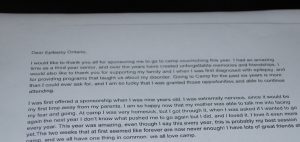
LetterKnowing the difference the camp makes to children living with epilepsy, Isabella, a Grade 10 student, is applying for Summerfest Camp’s two-year leadership development program (LDP) program next year.

By participating in the LDP, Isabella says her goal is to eventually become a Summerfest Camp counsellor.

“(That) would be an amazing experience, and I would be able to stay at camp for an entire summer with all the great people there,” Isabella says.

“Many counsellors have told me that their best years at camp were while they were in the LDP program, and I would love to become a part of that.”

Summerfest Camp just completed its 21st season. An average of 20 to 40 children and youths living with epilepsy attend the program each summer. Campers participate in activities such as swimming, hiking, kayaking and sports.

The camp, located near Orillia at Camp Couchiching, is staffed with people trained in how to work with children living with epilepsy.

Asked about her favourite aspects of Summerfest Camp, Isabella says it’s the people – both counsellors and campers – and the many activities offered at Camp Couchiching, especially swimming.

“I also learned how to kayak and canoe,” she says.

Isabella also wrote a letter to Epilepsy Ontario in July to thank the organization, which financially supports Summerfest Camp, for the five summers she has spent at Camp Couchiching.

“Camp Couchiching is a place that has taught me so much, not only outdoor skills, but skills I can use every day such as independence, self-confidence and to interact well with others,” Isabella says in her letter.

Isabella’s mother, Lisa, says she has seen the positive impact Summerfest Camp has had on her daughter.

“It’s a great experience – kids have to be responsible for a lot of their own things, and it’s good for their confidence and I think it builds independence,” Lisa says.

The fact that Isabella wants to become a Summerfest Camp counsellor is a testament to its value.

“That’s how much it has been a positive experience for her,” she says.

Summerfest Camp was founded in 1994 by Anita Allen, a neurology clinic nurse at Toronto’s Hospital for Sick Children (SickKids). The camp enables children aged six to 15, who are living with seizure disorders, to attend camp with other children. Camp Couchiching provides a setting where children can forget about their epilepsy.

If you have feedback on this story, or have a story of your own that you would like to share, please contact the newsroom at 800-294-0051, ext. 23, or e-mail deron(at)axiomnews.com. You can also leave a comment below.

Mother credits Summerfest Camp for daughter’s enhanced confidence and independence

October 1, 2015

By Deron Hamel

Enhanced confidence, independence and making friends – these are the main benefits Philippa Howell says her daughter, Georgina, has garnered since she started attending Summerfest Camp five years ago.

Philippa Howell says her daughter, Georgina, pictured above, has experienced a spike in her self-confidence and independence since she began attending Summerfest Camp five years ago.

Georgina, 13, is living with intractable myoclonic epilepsy as well as autism. She has been attending the camp since she was eight. In that time, Philippa says her daughter has flourished in many ways, and she largely attributes this to Georgina’s Summerfest Camp experiences.

Held near Orillia at Camp Couchiching (affectionately called “Camp Cooch”) every summer, Summerfest Camp enables children aged six to 15 who are living with seizure disorders to attend camp with other children. The camp has the resources to meet the needs of children living with epilepsy and provides a setting where they can enjoy a carefree camping experience.

Now in its 21st year, Summerfest Camp has an average of 20 to 40 children and youths who have epilepsy attend the program. Children participate in activities such as swimming, hiking, kayaking and sports.

Swimming is one of the many activities children enjoy at Summerfest Camp, and Philippa says Georgina’s confidence in water has skyrocketed.

Philippa saw this first-hand recently when she and her family went to the cabin they’ve stayed at every August for the past nine years. Unlike previous years, Georgina was spending most of her time swimming in the nearby lake.

“Her confidence was, ‘I can swim, and I can do this in open water,’ which is what she does at Camp Cooch. She swam distances I could not believe,” Philippa says.

Georgina has also made many friends from across Ontario during her stays at Summerfest Camp, Philippa says.

“These friendships stay at camp. They all wait 11 months and two weeks before seeing each other again, and they all become friends again. Friendship is definitely one of the positives from it,” she says.

Georgina’s positive experience at Summerfest Camp has provided her the confidence to attend another camp this year, “which is amazing,” Philippa says.

“She only went for a week, and when I went to pick her up, she did not want to be picked up,” Philippa says. “She had made some friends, and they were all there when I was picking her up to say goodbye.”

It was Summerfest Camp that provided Georgina with the confidence and enhanced sense of independence to attend a second camp, Philippa says.

“We never would have been able to do this if we hadn’t had the support of Summerfest to (create a) camping experience for her,” Philippa says, adding she and her husband are hoping Georgina can go for four weeks next year.

If you have feedback on this story, or have a story of your own that you would like to share, please contact the newsroom at 800-294-0051, ext. 23, or e-mail deron(at)axiomnews.com. You can also leave a comment below.

2,000% price hike on infantile spasms medication ‘predatory behaviour’: Neurologist

September 24, 2015

By Deron Hamel

A 2,000-per-cent price hike on a medication to treat infantile spasms is “predatory behaviour” on the part of Questcor Pharmaceuticals, and drug companies could hike prices on other seizure medications if policies aren’t put into place, says pediatric neurologist Dr. Carter Snead.

300Infantile spasms – also called West syndrome – is a catastrophic seizure disorder found in infants, usually four to eight months old, that is characterized by spasms, an interictal electroencephalogram (EEG) pattern called hypsarrhythmia, and intellectual disability.

The most effective treatment for infantile spasms is Synacthen Depot (Cosyntropin), a synthetic form of the pituitary hormone known as adrenocorticotropic hormone (ACTH). Without prompt and effective treatment, an infant will develop severe neurological and cognitive impairments.

In February 2015, Questcor Pharmaceuticals, which has acquired the rights to market Synacthen Depot, raised its price from $35.66 to $801.19 per vial. The cost of the required six-week treatment skyrocketed from about $750 to almost $17,000.

Toronto’s Hospital for Sick Children and the Ontario Drug Benefit (ODB) program negotiated the price down to $680 per vial. The price tag for a treatment course will run $14,280.

The exorbitant price increase bears weight on the public health system, says Snead, an expert in the treatment of infantile spasms.

“They (Questcor) have done absolutely nothing to justify this huge price increase,” Snead says. “There has been no investment in research (and) no investment in drug development. This is completely ugly pricing behaviour.”

In June 2014 Questcor acquired the rights to Synacthen distributed in Canada and Europe. Questcor had previously acquired distribution rights in the U.S. for a natural ACTH product, H.P. Acthar Gel, and raised the price of the medication from about $50 per vial to $28,000 per vial.

Snead says this is an example of price gouging on the part of pharmaceutical companies and fears things could get worse.

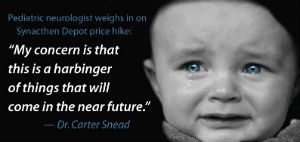
“My concern is that this is a harbinger of things that will come in the near future,” Snead says. “This is predatory behaviour on the part of drug companies – period.

“This won’t be the last time this happens. Canada, the United States and Europe need to put some kind of system in place so manufacturers of drugs … have to follow strict regulations following price increases, and the increases cannot exceed the consumer price index.”

In March, one month after the price hike, Snead formally complained to the Patented Medicine Prices Review Board (PMPRB) in Ottawa, asking for the matter to be corrected. He also mobilized the Canadian League Against Epilepsy and the Canadian Child Neurology Society to follow suit.

The effort was all for naught, Snead says.

“It turns out that if the drug is no longer under patent protection, then pricing doesn’t fall within (the PMPRB) jurisdiction,” Snead says. “Once again, the (drug companies) are getting away with murder, and it seems that nothing legally can be done about it.”

The issue of price gouging by pharmaceutical companies received worldwide attention this week when it was announced that a U.S.-based pharmaceutical company raised the price of Daraprim, a medication to treat the parasitic infection toxoplasmosis, which is often found in people affected by HIV and cancer, by a whopping 5,000 per cent.

After a global flurry of anger and criticism was directed at Turing Pharmaceuticals’ CEO Martin Shkreli on social media, the company announced it would lower the price.

“I wouldn’t be surprised if he (Shkreli) looked at the experience Questcor had and said, ‘Hey, this is a strategy to make a lot of money,’” Snead says.

If you have feedback on this story, or have a story of your own that you would like to share, please contact the newsroom at 800-294-0051, ext. 23, or e-mail deron(at)axiomnews.com. You can also leave a comment below.

Tongue-choking and other epilepsy myths debunked

September 17, 2015

By Deron Hamel

This week’s edition of Voices of Epilepsy looks at some of the common myths about seizure disorders and helps set the record straight on everything from how to react when a person is having a seizure to how epilepsy affects a person’s ability to hold a driver’s licence.

300One of the most common myths about epilepsy concerns what to do when a person is having a seizure. First-aid training used to include instructions to hold down a person’s tongue with a spoon or other object to prevent the person from choking on their tongue. We now know this is the wrong approach.

In reality, people having seizures are not in danger of choking on their tongue.

Do not put your fingers or any other object into a person’s mouth while they’re having a seizure, says epilepsy information specialist Suzanne Nurse.

“By putting a foreign object in someone’s mouth while they’re having a seizure you can actually break the person’s jaw or teeth, as well as cause a choking hazard,” Nurse says.

Other common myths about epilepsy:

There is only one type of seizure

In reality, there are many different types of seizures. Epilepsy information specialist Suzanne Nurse says people often mistakenly believe all seizures result in the person having convulsions.

“The way that seizures look varies greatly depending on the seizure type and the brain networks involved in the seizure. Some seizures resemble daydreaming and last only a few seconds,” Nurse says.

“Other seizures cause a brief visual disturbance, or a tingling or numbness sensation, or an uncontrollable twitching in a region of the body, or a brief inability to communicate, or a sudden change in mood,” Nurse says.

Having epilepsy disqualifies people from driving

Epilepsy is eminently treatable. While new onset seizures are typically associated with a loss of driving privileges, people can regain their licences once their seizures are controlled with treatment, Nurse says.

“In Ontario, there are specific criteria that must be met in order to have a driver’s licence reinstated which includes a seizure-free period of six months since the last seizure for non-commercial drivers with epilepsy,” Nurse says.

“There are some exceptions when seizure-freedom isn’t required, for example people who have seizures that do not impair awareness or the ability to drive and people who only have seizures while sleeping. Other criteria include conscientiousness in following treatment recommendations. If someone’s seizures recur they need to stop driving.”

Epilepsy is only developed in childhood

Epilepsy can begin at any age. It’s true that there are many types of epilepsy that begin in early childhood, however, it’s not uncommon for someone to start having seizures as an adult. In fact, stroke and neurodegenerative diseases can be risk factors for epilepsy and are the main causes of epilepsy in seniors, Nurse says.

Seizures are caused by supernatural forces

This myth may seem a bit odd to most people, but in some cultures seizures are still seen as being the result of supernatural causes.

“Epilepsy used to be known by other names including the ‘sacred disease,’ and seizures were often explained by demonic possession or intervention by the gods,” Nurse says.

“The understanding that epilepsy is in fact a brain disorder began more than 2,400 years ago when Hippocrates postulated that the epilepsy had a natural cause and was no more divine or sacred than other diseases.

“Modern neurology and neuroscience have proven Hippocrates correct, but the myth persists in some circles.”

If you have feedback on this story, or have a story of your own that you would like to share, please contact the newsroom at 800-294-0051, ext. 23, or e-mail deron(at)axiomnews.com. You can also leave a comment below.