
Author Archives: DHamel

Organizers for Summerfest fundraising cruise aiming to build upon last year’s success

May 7, 2015

By Deron Hamel

Kelly Cvijanovich says she hopes Epilepsy Ontario’s second annual fundraising cruise in support of Summerfest Camp will build upon the success from last year’s inaugural event.

Cvijanovich, the cruise committee’s chair, says organizers have commissioned a larger boat for this year’s event and are selling more tickets due to the excellent turnout in 2014.

Cvijanovich says the committee doesn’t have a specific dollar amount it’s hoping to raise for Summerfest Camp. Instead, committee members have focused their efforts on increasing awareness of the event as well as creating more exposure for Summerfest Camp and its importance to children living with epilepsy and their families.
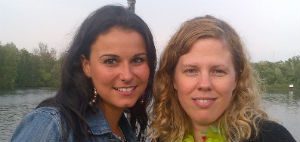
Kelly Cvijanovich and Jana Azizieh pose for a photo during last year’s inaugural cruise in support of Summerfest Camp.

“We really want to get the message out about (Summerfest) and the service that it provides,” Cvijanovich tells Voices of Epilepsy. “We’re really excited about this year’s cruise.”

For 21 years, Summerfest Camp has seen an average of 20 to 40 children and youth attend each session, where they participate in activities such as hiking, kayaking and sports at Camp Couchiching, near Orillia.

Summerfest enables children aged six to 15 who are living with seizure disorders to attend camp with other children. The camp provides a setting where children can forget about their epilepsy and enjoy a camping experience with others.

Last year’s cruise didn’t go without challenges. Stormy weather rolled in over Lake Ontario shortly before the event began and there was concern as to whether or not the event would proceed. In the end, people did get a little wet, but the cruise carried on and, literally, weathered the storm.

Cvijanovich says this experience “was a nice analogy for epilepsy.”

“We panicked at the beginning when the clouds were upon us, and we thought that there would be no way to sail, but we overcame the challenge and the fear, and we pushed on through,” she says.

Global News’s Mark McAllister, who is living with epilepsy, will emcee this year’s cruise.

The Summerfest: Sail Away cruise, which includes a buffet dinner, dancing, silent auction, 50-50 draw and gift-giveaways, will coast along Lake Ontario’s shoreline for three hours on June 17. Tickets can be purchased online by clicking here.

If you have feedback on this story, or have a story of your own that you would like to share, please contact the newsroom at 800-294-0051, ext. 23, or e-mail deron(at)axiomnews.com. You can also leave a comment below.

CBD study shows promise, but more trials needed

May 1, 2015

By Deron Hamel

Results from an early phase clinical trial suggest that cannabidiol (CBD) may be an effective treatment for stemming the number of seizures for people living with severe, drug-resistant forms of epilepsy, however, randomized controlled trials are needed before conclusions can be drawn on the chemical compound’s effectiveness, says Dr. Elizabeth Donner.

CBD_300While Donner, the director of the comprehensive epilepsy program at Toronto’s Hospital for Sick Children, says the U.S. study shows promise in helping reduce seizures for those living with severe forms of epilepsy, randomized controlled trials where the effects of CBD are compared to the effects of placebo will provide more insight into CBD’s effectiveness in seizure control.
CBD is an extract from the cannabis plant. Unlike THC, the most abundant chemical compound in cannabis, CBD will not get people “high.” CBD is the most abundant non-psychoactive chemical compound in cannabis.

The multi-centre study, which was presented at a recent American Academy of Neurology meeting, involved 213 people aged two to 26 living with more than 10 severe drug-resistant types of epilepsy, including Dravet syndrome and Lennox-Gastaut syndrome, both of which can result in lifelong seizures and intellectual disability.

Participants were given a liquid form of CBD, administered orally to complement their regular treatment. The study was an open-label trial, meaning there were no placebos administered to participants.

“Given that this is an open-label study, it is very difficult to draw a conclusion with regards to efficacy,” Donner tells Voices of Epilepsy, adding the scientists involved with the study have also stated that more research is needed. “It’s difficult to be draw conclusive results from an open-label study.”

Although the study was not a randomized control trial, Donner says the results are still “compelling,” and warrant the rigorous scientific investigation of CBD’s effectiveness in treating people with drug-resistant epilepsy that will constitute the study’s next phase.

“I am very pleased that we are going to get high-quality information from randomized control trials.” Donner says.

Researchers found that, on average, the 137 people who completed the 12-week study experienced a 54-per-cent seizure reduction from beginning to end. Twenty-three of the 25 participants with Dravet syndrome who completed the study had convulsive seizures before adding CBD to their treatment. They experienced a 53-per-cent decrease in these seizures.

After 12 weeks, nine per cent of the patients with Dravet syndrome were seizure-free. Eleven of the 22 individuals with Lennox-Gastaut syndrome had atonic seizures at baseline and they experienced 55 per cent fewer drop attacks.

Only 10 participants – five per cent of those involved with the study – stopped taking CBD because of side effects.

“An important part of this study is what we can learn about how this group of children and young adults with epilepsy tolerate cannabidiol,” Donner says.

“It gives us good information with regards to what adverse effects to monitor for as we move forward looking at cannabidiol as a treatment.”

If you have feedback on this story, or have a story of your own that you would like to share, please contact the newsroom at 800-294-0051, ext. 23, or e-mail deron(at)axiomnews.com. You can also leave a comment below.

MEDICATION ALERT: Acetazolamide

April 29, 2015

Update (July 6, 2015): The acetazolamide shortage has been resolved. Acetazolamide tablets are available again from AA Pharma. The Drug Identification Number or DIN is 00545015.

Please note that Acetazolam (Valeant Canada LP) is no longer available, this product has been discontinued. Drug Identification Number or DIN is 00295019. 

If you need any assistance please let us know. Call us at 905-474-9696 or toll-free 1-800-463-1119, or send an email to [email protected]. You can contact Epilepsy Ontario to discuss any concerns you have or to get more information.

Updates may also be available on drugshortages.ca

For additional information:

*    Drug Shortage FAQ’s
Link: https://epilepsyontario.org/wp-content/uploads/2014/02/Drug-Shortages-FAQs.pdf

Epilepsy presentation to gov’t officials well-received

April 24, 2015

By Deron Hamel

The operations manager of the Ministry of Health and Long-Term Care’s Exceptional Access Program (EAP) says a March 26 educational session delivered to staff members from the Ontario public drug programs division enhanced people’s understanding of epilepsy and the issues faced by those living with the condition.

EpOnt300Richard Lin says the lunchtime PowerPoint presentation by neurologist Dr. Carter Snead was delivered in a manner that was comprehensive, concise and informative to people, regardless of their health-care knowledge or professional background.

About 30 people attended the event, which was hosted by EAP in partnership with Epilepsy Ontario. The EAP helps Ontario patients with exceptional circumstances obtain medications not funded by the Ontario Drug Benefit (ODB) formulary, or where no alternative pharmaceutical is available.

Snead’s presentation, which was created in collaboration with Epilepsy Ontario, provided background about the different types of epilepsy as well as drug treatment options for people living with the condition.

Snead also addressed the importance of medication access to people with epilepsy and how treatment has changed during the past 10 years.

“More importantly, he talked about how epilepsy as a disease is going to be treated and managed in Ontario and where that’s going right now,” Lin tells Voices of Epilepsy.

“(The presentation) was important for staff to understand how epilepsy, as a disease, impacts patients, but also the burden of the condition on their caregiver and on our health-care system.”

Lin says there wasn’t a particular element of the presentation that was most valuable – attendees were engaged throughout the entire session, he notes.

“I think all of it was relevant to understand the disease itself and its impact on the public, on society, and how (medications) tie into managing epilepsy,” he says. “I thought that everything Dr. Snead spoke about was very relevant.”

There was a question-and-answer session following the event. Lin says it was encouraging to see attendees and Snead asking and answering each other’s queries.

If you have feedback on this story, or have a story of your own that you would like to share, please contact the newsroom at 800-294-0051, ext. 23, or e-mail deron(at)axiomnews.com. You can also leave a comment below.