Author Archives: DHamel

Thesis examines disclosure among young women with epilepsy

January 14, 2016

By Deron Hamel

When searching for a topic for her master’s thesis at Brock University, Suzanne McGuire noticed a lack of published information about how young women living with epilepsy disclose their condition.

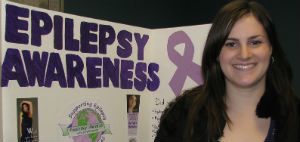
Suzanne McGuire (pictured above) has been researching how young women living with epilepsy disclose their condition.

Epilepsy, McGuire notes, is one of the oldest documented medical conditions, yet, there is little information about how people disclose their condition. This gap in available information sparked her idea to interview women with epilepsy aged 20 to 35 to hear their stories and how they chose to disclose their condition to others.

Young women have a unique perspective on living with a seizure disorder, and McGuire wanted to share their experiences through her thesis.

Indeed, her choice of subject matter was unique – the lion’s share of research on how epilepsy affects people’s lives does not go beyond the impact of seizures. McGuire wanted to delve into the heart of the matter and hear women’s stories to discover if they chose to disclose their diagnosis to others and how people’s reaction – both positive and negative – affected their decision to continue to tell others.

The main thing McGuire says she discovered through her research is that there isn’t always a direct relationship between positive and negative experiences and epilepsy disclosure.

“If anything, it’s more like epilepsy disclosure is like a revolving door – no one is fully in or out of the shadows,” she tells Voices of Epilepsy.

“They will disclose epilepsy at certain times, when they think it’s appropriate, but in other circumstances, like job interviews, they’ll step back into the shadows and not be as open.”

McGuire’s research also indicated that living with epilepsy is a constant transforming process for young women.

“It is not something you’re just diagnosed with, you take your medication, and that’s it – it continually evolves and can affect your life in many different ways,” says McGuire, who completed her master’s degree in October.

McGuire says one of the most interesting discoveries that surfaced through her research is the near-instant sense of connection she had with the women she interviewed.

“We didn’t know each other at all previously, but we could just start talking to each other … (about) epilepsy,” she says. “That was quite interesting.”

If you have feedback on this story, or have a story of your own that you would like to share, please contact the newsroom at 800-294-0051, ext. 23, or e-mail deron(at)axiomnews.com. You can also leave a comment below.

Theatre group provides life-changing experience for man with Dravet syndrome

January 7, 2016

By Deron Hamel

Since Brock Welton began participating in a North Bay theatre group last year he has become more independent and social, says his mother, Jo-Anne.

Brock Welton (far left), joined TOROS, a North Bay inclusive community theatre group for young people, in 2015.

Brock, 22, has Dravet syndrome, a catastrophic form of intractable epilepsy, as well as an intellectual disability stemming from the condition.

Last year Brock joined TOROS, a progressive and inclusive community theatre for young people, and he has blossomed through the experience, Jo-Anne says.

Brock became connected to the group through his older sister who had been a TOROS member. He had often watched his sister on stage and enjoyed the experiences so much he never wanted to leave, Jo-Anne notes.

Jo-Anne says Brock was “very quiet” when he began participating with TOROS. He wanted to be there, but wasn’t interacting with others, she notes.

But the other TOROS members empowered Brock, encouraging him to take an active role in the spotlight and to participate in their song and dance numbers.

In a short time, Brock thrust himself into the action, attended rehearsals and eventually performed on stage, an aura of self-confidence surrounding him. No evidence of the shy young man who once stood at the side of the stage remains.

“Now, you need a hook to get him off the stage,” Jo-Anne chuckles. “He just loves it.”

The confidence Brock exudes today has grown beyond his work with the theatre group, Jo-Anne says.

“I find he is so much more self-driven, and I have had to adjust to this because I was always so used to doing everything for him,” she says. “My role has changed from being someone who is his total caregiver to him telling me what he wants to do with his life, and I am trying to accommodate him.”

By sharing Brock’s story, Jo-Anne says she hopes other parents of children with epilepsy or a disability will be hopeful that their sons and daughters can enjoy quality experiences like Brock has.

“What this experience has given me is hope; it has given me hope that no one is ever stagnant, people are always learning, it doesn’t matter what diagnosis they have or what a therapist says, no one ever knows their full potential – and I have seen that in such a strong sense with Brock,” she says.

The strides Brock has made have also positively impacted Jo-Anne.

“As a parent of a child with special needs, I felt successful,” she says.

Click here to see a video about Brock.

If you have feedback on this story, or have a story of your own that you would like to share, please contact the newsroom at 800-294-0051, ext. 23, or e-mail deron(at)axiomnews.com. You can also leave a comment below.

2015 OBCL scholarship recipients demonstrate perseverance, ambition

December 21, 2015

By Deron Hamel

Four students received the OBCL Epilepsy Scholarship Award in 2015. Each has a different and unique story. Each has their own academic and career aspirations. But the tie that binds the four students has been their ability to overcome challenges they’ve faced with epilepsy.

300As 2015 comes to a close, Voices of Epilepsy would like to revisit the features we published in summer of the four award recipients – Anya-Belle Brown, Amanda Cook, Sarah Hysenaj and Andreia Real – as it’s these types of stories that inspire others.

Anya-Belle Brown

Anya-Belle is studying journalism at Sheridan College. She says the road getting to where she is today has been difficult at times, but support from those around her has been a game-changer.

Anya-Belle was in her mid-teens when she was diagnosed with ring chromosome 20 syndrome, which is caused by the arms of the normally straight 20th chromosome to curl and form into a ring shape. The condition often produces seizures.

While Anya-Belle continues to experience about six seizures per day, understanding her condition, coupled with the support she receives from family, friends and some of her teachers, has made all the difference, she says.

“They encourage me every day to do well and to put my best foot forward; they’re my champions, they cheer me on during every race, and they seek out the best possible resources for me to succeed,” Anya-Belle says. “They always expect the best from me … I don’t know where I would be without their never-ending support.”

Amanda Cook

Amanda, who is now enrolled in the interior design technology program at George Brown College, can also attest to the value the support of others brings to people with epilepsy.

Before her diagnosis, Amanda says, her teachers, friends and family members didn’t understand what she was going through. Even she didn’t fully understand it, she says. Having a formal diagnosis encouraged Amanda to learn more about her condition and seek support to help her live with her seizures.

With the help of support groups, friends, family and school counsellors, Amanda says her confidence has dramatically increased. This change has come at a crucial time, as she is beginning to chart the course of her future.

“Before I was diagnosed with epilepsy, my hope for my future was bleak; I always thought I would either be in an accident while I was unaware of my surroundings, or would never do well enough in school to be accepted into or graduate from any college,” Amanda says.

Sarah Hysenaj

Sarah, who is now attending Ryerson University’s photography studies program, was diagnosed with epilepsy when she was 11.

One day after an appointment with her neurologist, Sarah was with her mother and they were passing the CN Tower, which was lit up red in honour of Remembrance Day. She recalls wondering if there was a day to mark epilepsy awareness. This was before March 26 was designated as Purple Day in 2008.

Remembering her experience of looking at the CN Tower a few years earlier, Sarah helped with the effort to have Toronto’s famous landmark lit up purple on Purple Day in 2009.

For Sarah, living with epilepsy is all about maintaining a positive state of mind. She notes that she has faced several other challenges, including a learning disability and anxiety, but she approaches them as opportunities rather than difficulties.

“Choosing to consider them as opportunities helped me to have a sense of control over challenge,” Sarah says. “These opportunities, in turn, helped me to improve myself, gain confidence and independence, and therefore because of these challenges I don’t believe I would have become the person I am today and for that I am grateful.”

Andreia Real

For Andreia, living with epilepsy is more of a motivator than a challenge, she says. A first-year student at the University of Toronto who is pursuing a criminology degree, Andreia says her first reaction was “why me?” But her older brother had a conversation with her about epilepsy that inspired her positive perspective. He explained the risks of the condition, but also provided her with the names of notable people who also have epilepsy.

“Immediately, my perspective of epilepsy changed,” Andreia says, adding that this conversation fuelled her ambition to strive for great heights. She began dedicating herself more to her studies and extracurricular activities.

Andreia says her teachers took notice of her resilience; they made her a “mindful ambassador,” a group of students selected to discover innovative methods of dealing with challenges affecting the school’s community.

“My condition has not impeded my dreams but liberated them,” she says. “Ironically, (a condition) that at first I thought had disabled my future has actually shaped it and given my life purpose.”

OBCL has been supporting students with epilepsy through the scholarship awards since 2006. Every year, up to 10 Ontario students win a $1,000 scholarship for post-secondary education. As part of their application package, students must submit a personal essay under that year’s theme.

If you have feedback on this story, or have a story of your own that you would like to share, please contact the newsroom at 800-294-0051, ext. 23, or e-mail deron(at)axiomnews.com. You can also leave a comment below.

Cannabidiol the Voices of Epilepsy’s hottest topic of 2015

December 10, 2015

By Deron Hamel

Epilepsy Ontario’s weekly column, the Voices of Epilepsy, saw strong readership in 2015, and of all the issues covered this year one received more buzz on the organization’s social-media platforms than any other: cannabidiol (CBD).

CBD_300CBD is a substance derived from the marijuana plant. It is the most abundant, non-psychoactive chemical compound in cannabis. CBD has been receiving increased attention as a putative epilepsy treatment in the past few years.

Voices of Epilepsy published several articles about CBD treatment in 2015. Parents of children using CBD and epilepsy experts weighed in on the issue. The Voices of Epilepsy’s Facebook page lit up with commentary, “likes” and “shares” each time the CBD issue was addressed.

One of these stories – and the article that received the most views – was about the Supreme Court of Canada’s landmark decision in June to legalize all forms of medicinal marijuana.

Mandy McKnight spoke with Voices of Epilepsy shortly after the decision was made. Her seven-year-old son, Liam, has Dravet syndrome, a severe form of epilepsy with frequent, prolonged, drug-resistant seizures.

Liam has had a licence to use medical marijuana to treat his epilepsy since he was five. He had been having nearly 70 seizures per day until he began CBD treatment. Since then, his seizures have been reduced by 90 per cent.

However, before the Supreme Court’s ruling, the only legal way to deliver medicinal marijuana was through smoking or vaporizing the plant it in its dry-leaf form – which is unacceptable for a young child.

When Mandy spoke with Voices of Epilepsy earlier this year, her son could only receive dry-leaf marijuana from a licensed supplier. She was making a cannabis-enriched oil from the dry-leaf marijuana and then sending a sample to a laboratory in British Columbia for analysis to determine the CBD content.

Based on the lab results, the McKnights determine the amount to administer to Liam. He consumes the medical marijuana, in a solid form, with his meals.

This process was technically illegal, so the Supreme Court’s unanimous June 11 ruling comes as a huge relief to Mandy and her family.

“The fact that we have not got that hanging over our heads right now is just incredible – it feels like a huge weight has been lifted off of us,” Mandy says.

Voices of Epilepsy also spoke with Carol Clarke who discussed the hope she has that CBD would help enhance quality of life for her 28-year-old daughter, Brooke, who has complex-partial seizures.

Brooke has had a seizure disorder since adolescence. She has tried numerous treatments, including surgery and pharmaceutical therapies, with limited results. After consulting several doctors, Brooke and Carol finally found a physician who would write a prescription for medicinal marijuana in hopes that the high CBD content would reduce Brooke’s seizures but this was only one hurdle.

Carol was reluctant to pursue the treatment further without more medical guidance. She says there needs to be more information available about proper CBD dosages as well as support for people receiving this treatment.

“How do I know how much to put into a cookie? How many cookies should she eat? How often?” Carol says. “I (am) really skeptical about going that route. Between trying to figure out the dosage and the expensive cost of it, we have done nothing at this point.”

Suzanne Nurse, director of information and client services at Epilepsy Ontario, confirms there is a great deal of interest in CBD.

“The positive anecdotal reports as well as results released this spring from an early phase CBD trial offer tremendous hope to the epilepsy community, most especially to individuals and families living with severe, difficult to treat forms of epilepsy,” she says.

“However, there are still a lot of unknowns regarding this treatment. It is extremely important for people to talk to their epilepsy specialist, to make informed decisions and to always work closely with their epilepsy care team.”

If you have feedback on this story, or have a story of your own that you would like to share, please contact the newsroom at 800-294-0051, ext. 23, or e-mail deron(at)axiomnews.com. You can also leave a comment below.