Tag Archives: Epilepsy Ontario

Student determined to turn epilepsy experience into helping others

September 21, 2026

By Deron Hamel

Mallory McDonald describes two parts of her life: the part before June 21, 2023, and the part after.

It was on that date that Mallory was diagnosed with epilepsy. At the time, she was in her last semester of a social services diploma program, and she had started experiencing seizures in class and at work.

“It was terrifying waking up in an ambulance, not knowing what happened, where I was, or who I was with,” she tells Voices of Epilepsy. “I began to worry about how others would see me and whether I could still pursue the career I had worked so hard for.”

Following her diagnosis, Mallory says she had to learn how to manage her condition while continuing her education. This meant adjusting to her medication, going to doctor appointments and living with the uncertainty of when she would have her next seizure.

“I struggled with anxiety and depression as I accepted how much my life had changed, especially when I was close to getting my (driver’s) licence back,” she says.

“There were days when I questioned whether I could continue, but I refused to let epilepsy take away my future.”

Mallory took control of her condition and would go on to complete her diploma. Each hurdle she has faced because of her epilepsy, she says, has provided her with “strength and resilience.”

“Living with epilepsy has shown me invisible challenges and strengthened (my) compassion to support others,” Mallory says. “Although epilepsy is part of my story, it does not define me. It has inspired me to persevere, advocate for others, and pursue a career dedicated to helping people.”

Today, Mallory is studying criminology at Trent University. She is also one of four recipients of a $1,500 Epilepsy Ontario scholarship, which is sponsored by Waymo.

Mallory says she wants to use her education to help others. After she completes her degree, Mallory has her sights set on becoming a 9-1-1 operator.

“I want to help people during some of the most difficult moments of their lives by providing calm, compassionate and effective support,” she says.

“My experience with epilepsy has strengthened my empathy, communication skills and determination through challenging situations.”

Mallory adds that living with epilepsy has given her an interest in educating people to help reduce the stigma surrounding epilepsy.
She says she wants to share her experience of living with epilepsy, provide accurate information and encourage conversations.

“I want people living with epilepsy to feel understood and supported rather than embarrassed or alone,” she says.

If she had the opportunity to speak to her younger self, Mallory says she would explain that she was going to experience something she never could have prepared for – but that she would also get through it.

“I would tell her not to blame herself or wonder why this happened to her,” Mallory says. “She is still the same person she was before epilepsy.”

Epilepsy Ontario would like to extend a sincere thank-you to Waymo for sponsoring our scholarships for the first time this year. Through Waymo’s generous support, four Ontario students living with epilepsy were each awarded a $1,500 scholarship to support their post-secondary education. We are grateful to Waymo for helping make these opportunities possible and for supporting students living with epilepsy across Ontario.

Hidden, not rare: Why Alex Johnson is using a sweater to raise epilepsy awareness

March 26, 2026

By Deron Hamel

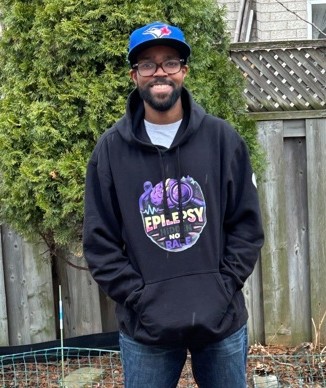
For Alex Johnson, the phrase “Epilepsy: Hidden, Not Rare” resonated with him when he saw it printed across a sweater at the Epilepsy Shop, Epilepsy Ontario’s online store.

Alex, who is living with epilepsy, says he felt a personal connection with the message, which prompted him to buy the sweater.

“The message reminded me that lots of people couldn’t see (my epilepsy), but I knew it existed,” Alex tells Voices of Epilepsy. “This was a message that really caught me.”

There were shirts and sweaters with other messages, but Alex says that one stood out most for him.

“It was a message that people needed to see and understand; it’s a message that should be reaching the public,” he says. “It’s not necessarily me saying something about myself, but it is something I am saying to the public.”

The Epilepsy Shop was launched in 2020 and sells an array of colourful T-shirts and hoodies embossed with campaign names to help support local epilepsy agencies and raise awareness of seizure disorders.

Customers can find regular T-shirts, women’s cut T-shirts or hoodies in a variety of colours and sizes. Every item is created on demand to eliminate waste, and all profits support epilepsy services and programs.

Alex says he would like to see more apparel with messaging directed at the public at large, which he believes would be a helpful way to increase epilepsy awareness.

He suggests that adding phrases like “There are Many Different Types of Seizures” or “One in 100” – a reference to the number of Canadian adults estimated to be living with epilepsy – would further educate the public.

This sort of messaging, Alex adds, is prominent on social media or in pamphlets during March – Epilepsy Awareness Month – but not throughout the rest of the year.

“The other 11 months of the year, nobody will know, nobody will see it on social media, but there is an opportunity to (send these messages) with shirts,” he says.

Click here to visit the Epilepsy Shop.

Student using epilepsy experience to fuel advocacy and research

January 9, 2026

By Deron Hamel

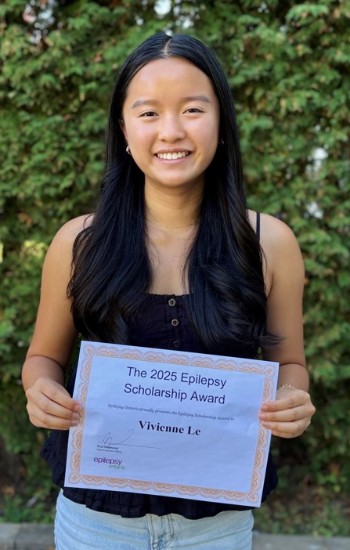
Vivienne Le says that if she could speak to her younger self, the first thing she would tell herself is that having epilepsy will not make her “less capable” or “less worthy.”

The student from Ottawa, who is studying health sciences at Queen’s University, says when she was younger she felt “frustrated and alone,” and wanted to blend in with her peers without constantly having to worry about having a seizure or hiding her condition.

Looking back, Vivienne says the things about epilepsy that frightened her when she was young now give her strength.

“I would tell (my younger self) not to be afraid to speak openly about her experiences because sharing her story will connect her to others and help combat the stigma that once caused her pain,” Vivienne says.

“(I would tell her that) one day, she will use her voice and her lived experience to make a difference through volunteering, advocacy and even contributing to epilepsy research. Most importantly, I would tell her that epilepsy will shape her, but it will not define her limits. She will go to university, chase big dreams and prove to herself that she is more than her diagnosis.”

Vivienne says her experiences with epilepsy have shaped her outlook and helped her navigate her career path. Once she completes university, she plans to attend medical school and become a doctor specializing in neurology. She says she wants to contribute to research and health-care initiatives aimed at improving quality of life for people living with epilepsy.

“Growing up with epilepsy has given me both a personal connection and a sense of purpose in this field,” she says. “I want to combine clinical care with research to improve treatments, reduce stigma and advocate for those living with neurological conditions.”

Vivienne’s passion in this area has already led her to get involved in epilepsy research at BC Children’s Hospital and the Centre hospitalier de l’Université de Montréal, where she has contributed to projects, including an analysis of epilepsy surgery outcomes.

Vivienne says epilepsy has motivated her to strive for achievements outside of academics, adding she recently created Viv in Purple, a social media platform to share her story of living with epilepsy and creating a space for others to share their experiences.

“The messages I have received from people who found hope through my posts remind me why I am committed to advocacy,” Vivienne says.

“Ultimately, living with epilepsy has not limited me. It has given me purpose and shaped my determination to turn personal challenges into opportunities to help others, whether through research, health care or advocacy.”

Vivienne is one of four recipients of Epilepsy Ontario’s 2025 scholarship. For more than 15 years, the organization has been providing scholarships to exceptional students who have confronted and overcome remarkable barriers in their academic and personal lives due to epilepsy.

“This $1,500 scholarship will help cover tuition and research-related expenses, allowing me to dedicate more time to my advocacy work and academic goals,” Vivienne says. “By combining my lived experience, academic background, and community involvement, I hope to create a more compassionate and supportive environment for people with epilepsy.”

Camp Couchiching offering a 3-day experience for children to ‘fall in love’ with Summerfest

April 28, 2016

Deron Hamel

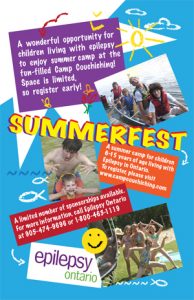
summerfest15(P)Camp Couchiching is offering a unique opportunity to children and youths living with epilepsy who want a taste of what Summerfest Camp is like without committing to full two-week programs.


The three-day “mini Summerfest Camp” is being held over the Victoria Day weekend, May 21-23.

The opportunity also helps alleviate anxieties for parents who may have concerns about leaving their children for extended periods of time, says Oona Ashmore, summer camp director at Camp Couchiching, where Summerfest Camp has been held every year since 1994.

Summerfest Camp has nurses and counsellors who have training in working with people with seizure disorders. The major aim of the program is to provide a camping experience for children with epilepsy in an environment where they can be themselves and their parents can take comfort in knowing their children are in safe hands.

Ashmore characterizes the weekend Summerfest Camp as a “smaller version of the summer camp.” She says she has seen many children participate in the three-day camp and enjoy it so much they sign up for a two-week session in summer.

“It’s an opportunity for kids and their families to fall in love with the camp,” Ashmore tells Voices of Epilepsy. “For families who have children with medical uncertainties, it’s a really nice opportunity to see their kids come back with really great, exciting stories about how much they liked camp.

“And the parents hear how the staff is responsible and were paying attention to the kids’ needs, which makes the parents more comfortable.”

Summerfest Camp enables children aged six to 15 who are living with seizure disorders to attend camp with other children. The camp provides a setting where children can relax and have a good time. While at the camp, the children participate in activities such as swimming, hiking, kayaking and sports.

This year, the Summerfest Camp’s summer program will be offered in five sessions:

Session 1: July 3-15
Session 2: July 17-29
Session 3: July 31-Aug. 12
Session 4: Aug. 14-26
Session 5: Aug. 28-Sept. 2 (one-week session)

To ensure as many children as possible can attend Summerfest Camp, Epilepsy Ontario provides a limited number of sponsorships for families who require financial assistance. The sponsorship request form can be found on the Epilepsy Ontario website.

If you have feedback on this story, or have a story of your own that you would like to share, please contact the newsroom at 800-294-0051, ext. 23, or e-mail deron(at)axiomnews.ca. You can also leave a comment below.