
By Deron Hamel
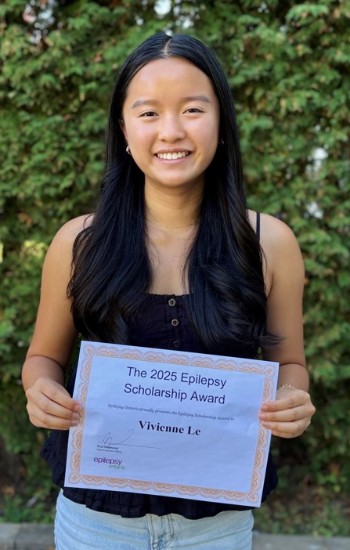
Vivienne Le says that if she could speak to her younger self, the first thing she would tell herself is that having epilepsy will not make her “less capable” or “less worthy.”
The student from Ottawa, who is studying health sciences at Queen’s University, says when she was younger she felt “frustrated and alone,” and wanted to blend in with her peers without constantly having to worry about having a seizure or hiding her condition.
Looking back, Vivienne says the things about epilepsy that frightened her when she was young now give her strength.
“I would tell (my younger self) not to be afraid to speak openly about her experiences because sharing her story will connect her to others and help combat the stigma that once caused her pain,” Vivienne says.
“(I would tell her that) one day, she will use her voice and her lived experience to make a difference through volunteering, advocacy and even contributing to epilepsy research. Most importantly, I would tell her that epilepsy will shape her, but it will not define her limits. She will go to university, chase big dreams and prove to herself that she is more than her diagnosis.”
Vivienne says her experiences with epilepsy have shaped her outlook and helped her navigate her career path. Once she completes university, she plans to attend medical school and become a doctor specializing in neurology. She says she wants to contribute to research and health-care initiatives aimed at improving quality of life for people living with epilepsy.
“Growing up with epilepsy has given me both a personal connection and a sense of purpose in this field,” she says. “I want to combine clinical care with research to improve treatments, reduce stigma and advocate for those living with neurological conditions.”
Vivienne’s passion in this area has already led her to get involved in epilepsy research at BC Children’s Hospital and the Centre hospitalier de l’Université de Montréal, where she has contributed to projects, including an analysis of epilepsy surgery outcomes.
Vivienne says epilepsy has motivated her to strive for achievements outside of academics, adding she recently created Viv in Purple, a social media platform to share her story of living with epilepsy and creating a space for others to share their experiences.
“The messages I have received from people who found hope through my posts remind me why I am committed to advocacy,” Vivienne says.
“Ultimately, living with epilepsy has not limited me. It has given me purpose and shaped my determination to turn personal challenges into opportunities to help others, whether through research, health care or advocacy.”
Vivienne is one of four recipients of Epilepsy Ontario’s 2025 scholarship. For more than 15 years, the organization has been providing scholarships to exceptional students who have confronted and overcome remarkable barriers in their academic and personal lives due to epilepsy.
“This $1,500 scholarship will help cover tuition and research-related expenses, allowing me to dedicate more time to my advocacy work and academic goals,” Vivienne says. “By combining my lived experience, academic background, and community involvement, I hope to create a more compassionate and supportive environment for people with epilepsy.”